Posts Tagged ‘World Society for the Protection of Animals’

By Xue Chaohua in Lanzhou and Jin Zhu in Beijing (China Daily)

“Its ‘Feel Good Sunday’ and whenever I read or hear of horses being “released” instead of “captured” it always gives me a good feeling, to say the least.  The stories of wild Takhi being reintroduced into the wild by Mongolia, Russia and now China has interested Terry and myself as we feel the United States may find itself in the same position, very soon, as our government removes and warehouses the last of our free roaming while equines.  This past July Terry and I traveled to Mongolia to witness the fruits of their reintroduction effort, if you have not read the brief recounting of our adventures you can do so in the Sept. issue of trueCOWBOY Magazine by clicking (HERE).  Enjoy your day!” ~ R.T.

While U.S. Destroys It’s Wild Herds other Countries Attempt to Reintroduce Theirs

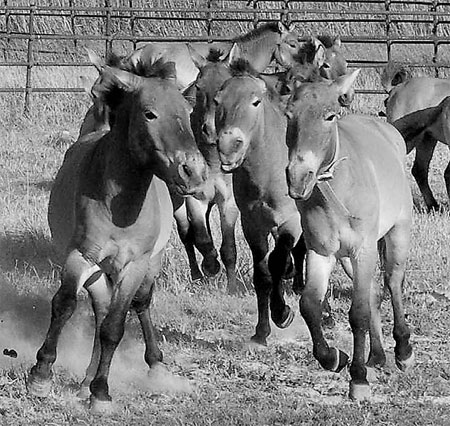
Captive Przewalski’s horses are released into the wild in Dunhuang, Gansu province. Zhang Yongsheng / for China Daily

A herd of 21 highly-endangered Przewalski’s horses were released into the National Nature Reserve in Dunhuang in Northwest China’s Gansu province on Sept. 16th, as part of efforts to replenish the animal’s numbers in the wild.

The release follows a successful trial that turned seven horses loose in the same area in 2010.

“So far, everything goes well. All the horses have adapted to their new home and none have health problems,” said Sun Zhicheng, an official from the nature reserve.

The horses underwent a series of physical examinations when they arrived in Dunhuang on Tuesday after traveling more than 10 hours by road from Wuwei of Gansu, he said.

The Przewalski’s horse, with its stocky body and short neck, is the only true living species of wild horse. The rare species, which was once common on the Eurasia continent, was last seen in the wild in 1969. Its dwindling numbers have been blamed on human activity.

At present, there are more than 1,000 Przewalski’s horses kept in zoos around the world. In the 1980s, China reintroduced the horse from foreign countries, including the United States and Germany, according to the Gansu Endangered Animal Protection Center under the State Forestry Administration.

In the 1980s the number of captive Przewalski’s horses in the center was only 18, there are now 75, including the 21 returned to the wild.

About 300 such horses are now also kept captive in Gansu and the neighboring Xinjiang Uygur autonomous region, according to the center.

“We have taken into full consideration the future reproduction of the horses. The 21 released horses included four males, eight females and nine are immature,” said Zhao Chongxue, deputy director of the center.

“I’m full of confidence for the survival of the 21 horses in the wild, as a previous experimental release of seven horses in 2010 was successful. Today, all of those seven horses are healthy and strong in the wild and a little horse was born in July,” he said.

But professionals are worried that decreased water in the nature reserve due to years of exploitation of groundwater may pose a threat to the horses living in the wild.

“We dug 10 new springs this year to satisfy those horses and will break ice in winter to ensure their water supply,” Sun said.

At present, the ancient horse’s survival and reproduction rates in the wild are not high, said Sun Quanhui, an official from the World Society for the Protection of Animals, headquartered in London.

“Long captivity and rather close blood relations among the horses returned to the wild meant it was not easy for them to survive for a long time. So far, there is no stable population of Przewalski’s horses in the wild anywhere in the world,” he said.

Other countries, such as Russia and Mongolia, are also striving to return the horses to the wild, he said.

“Although the horses are precious, they have not attracted as much attention as pandas in China up to now. The country needs to give more support to try to save this rare horse species,” he said.

Accreditation establishes high standards of credibility and recognition for global sanctuaries

DSCN4357

HfH volunteers rescuing horses in New Orleans after Hurricane Katrina - (Photo by Terry Fitch)

October 27, 2009 (Hitchcock, TX) – Today the Global Federation of Animal Sanctuaries (GFAS), the only globally recognized organization providing standards for identifying legitimate animal sanctuaries, announced Habitat for Horses became the first equine rescue and sanctuary accredited to its standards and, thereby, recognized by GFAS. The accreditation signifies the official implementation of clear and respected international standards for the public, donors and government agencies to recognize credible sanctuaries that adhere to the true mission of providing safe haven and humane care for abused animals.

“I am honored to recognize Habitat for Horses. We, as humane nonprofits, need organizations like Habitat for Horses to serve as role models of what sanctuaries are intended to be and help weed out masquerading sanctuaries that only exist to exploit animals for financial benefit and entertainment with no regard for their welfare,” said Adam Roberts, President of the GFAS Board of Directors and Senior Vice President of Born Free USA.

Habitat for Horses, one of the largest equine protection organizations in the U.S., earned its GFAS accreditation after being certified as adhering to the GFAS standards for sanctuary operations, administration and veterinary care. Trained GFAS verifiers made onsite visits to the sanctuary to analyze its operations, the animals’ health and the quality of the sanctuary grounds. As an accredited sanctuary, Habitat for Horses now can serve as a mentor to guide other sanctuaries through the process of GFAS accreditation and serving as a leader in the GFAS community.

4-26alliance 005

"Nebraska 200" wild mustangs saved due to HfH intervention

“The link between humans and horses is a magical one that dates back to our ancestors. At Habitat for Horses, we believe that abusing, neglecting and discarding horses are affronts to the sanctity of life. We work to promote and secure the well being of all horses and to educate others. We are honored to be the first sanctuary to be accredited by GFAS. The accreditation will assist us in promoting our mission and ensuring other sanctuaries can operate by the same standards for humane animal care,” said Jerry Finch, Founder of Habitat for Horses.

In addition to being an accomplished and pioneering leader within the GFAS community, Habitat for Horses also works closely with law enforcement. It provides safe havens for rescued horses, conducts investigations and assists in court, and these activities enable law enforcement to pursue more equine cruelty cases. The sanctuary also saves wild horses and adopts horses to qualified, loving and responsible permanent homes. Habitat for Horses was founded in 1998 and is a 501(c)3 nonprofit organization chartered by the State of Texas.

646

HfH Officers and volunteers with equine artist Leslie Anne Webb - (Photo by R.T. Fitch)

“We are especially pleased to work with Habitat for Horses. It is an exemplary sanctuary that demonstrates leadership in animal rescue through so many different actions. Its GFAS accreditation will further strengthen its credibility and reputation with the public and donors,” said Patty Finch, GFAS Executive Director (and of no relation to Jerry Finch).

For additional information on GFAS, please visit http://www.sanctuaryfederation.org. For additional information on Habitat for Horses, please visit www.habitatforhorses.org.

About Global Federation of Animal Sanctuaries

Global Federation of Animal Sanctuaries (GFAS) is a 501(c)3 nonprofit organization dedicated to the sole purpose of strengthening and supporting the work of animal sanctuaries in the United States and abroad. The federation’s goal in working with and assisting sanctuaries is to ensure they are supported, honored, recognized and rewarded for meeting important criteria in providing care to the animals in residence. GFAS was founded in 2007 by animal protection leaders from a number of different organizations in response to virtually unchecked and hidden animal exploitation of animals for human entertainment and financial profit. These founding organizations sit on the GFAS Board of Directors to continue guiding the organization’s work in a collaborative manner. They include Born Free USA, The Humane Society of the United States, Captive Wild Animal Protection Coalition, World Society for the Protection of Animals, American Anti-Vivisection Society International Fund for Animal Welfare and Animal Welfare Institute.

Reblog this post [with Zemanta]

Bookmark and Share