

 By Nicole Gelinas as published in the New York Post
“There’s always an underlying fear when any government entity starts to pressure one industry,”
New York City Mayor de Blasio can fight with the groundhog. He can fight with the governor. He can fight with charter-school lady Eva Moskowitz. But on this St. Patrick’s Day, he’d be wise to drop his fight with the Irish.
De Blasio promised last year that his first act as mayor would be to kill 300 middle-class jobs, many held by Irish immigrants. “Here it goes,” he pledged. “First thing, it’s time to ban horse carriages in New York.”
Why? The horses are well-treated, as everybody (except the don’t-bother-us-with-facts folks at PETA) knows by now.
Simple. A tiny cadre of donors showered the mayor with money last year — and savagely attacked rival Christine Quinn, too. They made clear that banning horses was their top priority. (Some of these folks seem to covet the horse stables on Manhattan’s Far West Side; others are radical animal-rightsers.)
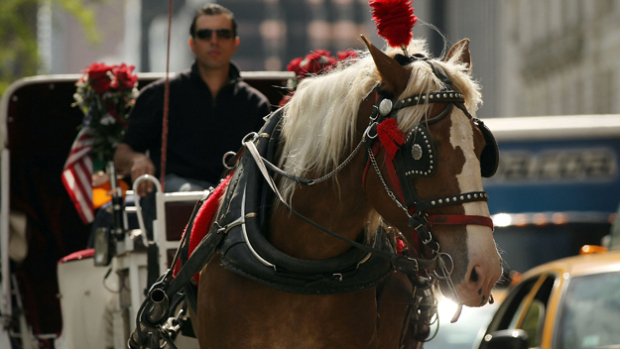 The mayor is making good on his side of the deal. Last week, his top deputy said it was just taking more time than expected.
No wonder. When was the last time New York City banned an entire lawful industry?
“It’s completely unprecedented,” says Colm McKeever, an Irish immigrant who has driven a horse carriage for 25 years.
Sure, the smoking ban affected businesses — but it didn’t outlaw any. Mike Bloomberg tried to ban sodas, but only the big ones. Rudy Giuliani once tried to ban porn shops and peep shows — and failed in court. In that case, the city figured that banning the legal sex trade would make it easier to crack down on illegal behavior like pimping on the streets by such establishments.
But how does the city ban a business that has done no harm to people or animals?
That’s doubtless what’s giving the real brains in City Hall a headache. To ban the carriages on health and safety grounds, the city would need evidence — and there is none.
Plus, de Blasio has already prejudiced a weak case. By saying that a visit to the horse stables wouldn’t change his mind, he made it clear that he’s not interested in facts. Both courts that struck down Bloomberg’s soda ban noted the mayor’s interference with the scientific process.
Ban the carriages on transportation grounds? Still need that pesky evidence.
And that’s impossible — because the mayor wants to replace the horse carriages with antique cars. Any study is going to find that cars go faster than horses. Letting 68 cars circle Central Park when it’s closed to other car traffic will endanger walkers, including children.
Plus, the city would also have to compensate carriage owners for their medallions and, possibly, drivers for lost income.
Carriage drivers, because of their higher skill level, easily make twice as much as cabbies. Replacing a lifetime’s worth of income derived from 68 medallions could easily cost taxpayers tens of millions of dollars.
And the city can’t argue that a license to drive an electric car is compensation enough. Antique cars failed in San Francisco.
“We’ve been interviewing our customers,” says McKeever. “Nobody wants to ride in a car. . . The tourist trade will be a laughingstock” around the world. (Despite the mayor’s words to the contrary, you can ride in a horse carriage in other global capitals, including London and Paris.)
And the carriage folks know all this.
Plus, they have business sympathy. The Manhattan Chamber of Commerce polled its members — mostly firms with 10 or fewer employees — and found that 76 percent want the horses to keep their jobs. “There’s always an underlying fear when any government entity starts to pressure one industry,” says Nancy Ploeger, the CoC president.
They also have the city’s unions, who last week told the mayor to back off.
They even have cool celebrities. Liam Neeson, who held an open house for politicians at the stables last week, “has been an unbelievable support,” says McKeever. Jimmy Fallon, too, is on board. (And the mayor? He has Alec Baldwin.)
Most important, though, the carriage drivers have public opinion. A January Quinnipiac poll showed that 61 percent of voters want to keep the horse trade, “with support for the horses from every group.” Only 28 percent want to see a ban…(CONTINUED)
Related articles


Categories: Horse News





 Straight from the Horse's Heart
This is about as clear as one can tell it.
Short and to the point. “Truth & the Fact”.
YOU read it, and then think.
Heritage – History – Tradition, all done lawfully.
Yes, the Law is on the side of
The Famous Horse Drawn Carriages of Central Park.
-> https://www.facebook.com/FamousHorseDrawnCarriagesofCentralPark
The factual evidence and the proper care of working horses
has always been posted by Blue Star Equiculture.
-> https://www.facebook.com/equiculture
And Stopping NYC Horse Abuse Lies has posted article after article of all the public support.
-> https://www.facebook.com/StoppingNYCHorseAbuseLies
All of the “Above links” will give you information and more.
As also will the link:
http://www.savenychorsecarriages.com/
And to note, another open house for Veterinarians and professional horse folks was just held this past weekend within the Clinton Park stable. The open invitation had been posted on their page(s), and many attended.
They don’t hide anything. And more & more the truth is coming forward.
LikeLike
Also a useful link – “Equine Advocates’ President, Susan Wagner welcomes Bobby II, a former New York City carriage horse who was rescued from slaughter to Safe Home Equine Rescue & Sanctuary on June 30, 2010. Equine Advocates first had him shipped to an equine hospital where he was examined and checked out before his arrival at the sanctuary. The vet report states that he is lame in his right front limb at a trot, but we are confident that with lots of TLC he will recover completely over time. This wonderful horse, affectionately referred to by EA staff as “Bobby Segundo,” will spend the rest of his life being retired and turned out in the company of other horses – quite a departure from the unnatural conditions under which he was previously forced to live. An Equine Advocates supporter who came to meet Bobby, fell in love with him on the spot and decided to fully sponsor him. To learn more about Equine Advocates Horse Sponsorship Program and Bobby’s rescue, including the New York Times and Rural Intelligence articles, please visit http://www.equineadvocates.org.”
LikeLike
Whats going on with Our Mustangs ???? Have we forgotten about them?????? What about the ones freezing out in the elements ??? With no shelter ???????
LikeLike
The media will make this political just to make the mayor look bad & all focus on the horses welfare will be lost. The same political force that doesn’t like the mayor, also don’t much like animal activists either. They are slaughterhouse sues crowd who don’t care about animals, except as profit.
I think the most focus should be on the welfare of the horses, if a horse is thin, or lame, or over heated, document it. The carriage horses also seem connected to the states large Amish population. Maybe they get horses from them or dump horses to the same slaughter auctions the Amish use.? The Amish road horses have the same welfare concerns of the carriage horses. Not watered enough (if at all) hard surfaces, hard on the hooves & legs. Overwork, distance and hours. ‘retired’ at auctions and off to slaughter. Welfare rules to protect carriage horses could also protect any Amish horses who use the same public roads. Those horses also have very inhumane working conditions and ‘retirement’ also means a trip to slaughter. Besides the big breeders and the race tracks, it’s the Amish who help keep horse slaughter ‘pipeline’ alive in this country. Their ‘carriage’ horses need some welfare rules & could be included in humane working horse rules.
LikeLike
“They are slaughterhouse sues crowd who don’t care about animals, except as profit.”
You really shouldn’t generalize just because you don’t agree with people on some subjects. I’m assuming you’re trying to paint people with conservative views as pro-slaughter. You couldn’t be more wrong, and you (and others who do this) have done more damage to your own cause than you realize. We need to have everyone on the side of the horses, no matter what their politics, religion, or race are. I hate to see this kind of purposeful division in the anti horse slaughter crowd.
LikeLike
This article is about carriage horses. Why dismiss their welfare and bring up an unrelated issue? Focus on the problem at hand.
LikeLike
The author of this “Opinion” piece, writes with so many twists & turns. No facts. She writes a “spin.”
Some of these writings, blogs, etc., against a ban, condemning horse advocates, glorifying the Irish-immigrant-drivers, the stables the Taj Mahal, border on insane writing. Gibberish.
Every excuse in the book. I am waiting for Michelangelo’s “Hand of God” to come down from the Sistine Chapel as a *Fact to keep the NYC Carriage Horses working.
So much to criticize in her piece, but I quote one of her *Facts: “But how does the city ban a business that has done no harm to people or animals?”
How? This is just some of the “how” :
http://www.buzzfeed.com/mjs538/the-ugly-truth-about-horse-carriages
LikeLike
Let’s see…if Lliam Neeson was about to show up with a busload of reporters and camera crews don’t you think the stable were spiffed up to the max for such an event? The biggest fallacy is that these folks writing and giving their ‘thumb’s up’ in the polls most likely have never owned an animal much less a horse. They are probably the same folks who vote in polls to stop ‘performing animals’ in circuses but don’t correlate the two. These horses are not working at a necessary job…they are ‘performing’ on the streets for the pleasure of those who ride and those who just stop to pet and look at the animal.
Again with the ‘tradition’ BS…there are Native American’s that are pushing our Yellowstone bison into extinction because it’s ‘tradition’ for them to eat buffalo meat although their grandparents would be turning over in their graves if they knew what their offspring are doing. It was a ‘tradition’ in the Old South to own slaves so to hell with the ‘tradition’ argument.
There comes a time when “That’s the way it’s always been” is no longer a viable argument. When there are only 4,000 +/- Yellowstone Bison left in the world you have to stop killing them. Animals live and work in pain for the pleasure of mankind entirely too much and it’s time for the nostalgia factor to be tossed out the window and for human’s to show they are in fact humane.
Government should not have to force an end to this industry. The owner’s should be able to read the writing on the wall that no matter what their skewed polling shows the majority of people in this country do not abide animal cruelty.
LikeLike
The US Government recently killed 600 Yellowstone bison in their annual slaughter. They were killed beause cattle ranchers who rent Public Land for a pittance demanded it. Bison was (and still is) the primary food source for some Native Americans and according to their tradition they take no more than they need. In the 19th Century the US Government nearly drove the bison to extinction in order to force Native Americans onto reservations. The bisons, wolves and wild horses all have the same enemies: greedy politicians, the BLM, USFWS, ranchers and other special interests, especially fracking. Here is a photo from the end of the bison’s reign in the United States c.1870:
LikeLike
Thin it’s all a non issue. Horses work. I believe horses enjoy being team players. The issue is their care. They must be cared for properly or left in the wild. I for one would rather have a roof over my head in New York then corralled the elements in New Mexico.
LikeLike
do you have horses? When did horses become team players? “Players” have an option. There is no “I” in Team. How many carriage drivers say “we were working in the rain”?
Now, I am not against all carriage horses/owners. But horses do NOT belong in over crowded streets. Lets face it, how many drivers, esp in NYC, are courteous? It is a fast paced city were people want to get to their destination yesterday. They cross streets when and where they want to, the smog is incredible. If the air/pollution is bad for people why is it OK for animals?. In NYC carriage horses are not a necessity, they are a “luxury”, for many pompous people who are too lazy to walk and want to impress.
Amish, while too many don’t care for their horses well (some do). Those horses work out of necessity. They are not in big cities where vehicles weave in and out of traffic, smog, nasty ass attitudes, horns honking (even tho they are not supposed to honk, lets face it they do)
LikeLike
I do have horses, and have had horses for almost 40 years. If you are a good horseman/woman horses are very good team players. Mine come running to me when they see me or hear my voice. In this day and age, any horse that is not broke to ride or drive is vulnerable to being shipped across the border.
I don’t know anything about traffic in NYC, so I don’t know if it’s unsafe, that would be my only objection to the carriage rides. I would be willing to bet that the horses in NYC are generally treated better than the Amish horses that I see.
LikeLike
While in New York in December, I decided to take advantage of a beautiful day to walk to the American Museum of Natural History. The Museum is contingent with New York’s Central Park. On the ground standing next to his horse’s head stood the driver, an affable looking man. The driver appeared to be answering the question of a person who had already stepped away. The horse appeared well fed and well cared for. His head was lowered and he was licking a bit and chewing, which is horse language for “I am relaxed and content.” I saw nothing that would alarm me in the demeanor of the driver or the horse. In fact, I found it a bit of comfort to my horse lovig heart that the driver was standing near the horse’s head while they were at rest. The horse was not tied down or restrained, and actually could have walked off if he had been so inclined, but the driver’s presence meant that the horse would not have gone far. So what I saw was a driver that had made a decision not to unnecessarily restrict the horse.
Equine welfare advocates often want the world to work as if it were centered around makeing sure that every horse lives in whatever our vision of the perfect life for horses must be for the horse to be happy. One of the ways horse rescue and equine welfare groups fail is through our intexibility, and for those who have never cared for horses or seen how horses can be well cared for in a variety of different settings, it is difficult to stray from the exact formula we have. Dr. Temple Grandin’s book on What Animals Need does a pretty good job of defining the needs of different species of animal both domestic and some wildlife. She is fairly concise, and I have neither seen nor read anything that contradicts the points that she makes.
LikeLike
I would not listen to one word coming from Temple Grandin she is Pro Horse Slaughter !!!!!!!!!!!!!!!!!!
LikeLike
Dr. Temple Grandin’s work is devoted to make animals less fearful before and as they are being killed in slaughterhouses. Does that make her pro-animal or pro-slaughter or both? The observation of a momentary exchange between one horse and driver is not representative of the entire industry. I can’t help but feel there are more than a few ringers among the commenters.
LikeLike
Awwwww Gee isnt that commendable of Dr Grandin, Sorry I am not a fan !!!! Wouldnt she do better to have devoted herself to stopping the needless Murders and Slaughters of the innocent Horses ??????
LikeLike
Federal law through international treaty (the 1997 International Plant Protection Convention) gives the U.S.D.A. the authority to come to anyone’s house or farm and remove their animals based on the IUCN’s arbitrary decision to list species of both plants and animals as alien, invasive, and a potential threat to plants or agriculture. Since the original IPPC was created to protect agriculture, the authority to enforce this law lies with the U.S.D.A. A 2007 Presentation by the U.S.D.A. APHIS and Wildlife Services at Fort Collins on Managing Invasive Terrestrial Vertebrate Pests lists horses (Equus caballus) donkeys (Equus asinus) and zebra (Equus bruchelli) as grazing ungulates that are potentially harmful to agriculture. Note the change in the word donkey to take the place of the word burro, so the brain of wild horse and burro interests isn’t immediately triggered. This document references the 1993 OTA Report on Harmful, Nonindigenous Species to the United States. This is further evidence that the intent of Article 8 (h) in the CBD is enmeshed into the 199& Update of the IPPC that did not go into effect until October 2, 2005.
President Clinton’s E.O. 13112, The Alien Species Act issued February 3, 1999, is the leadership and responsibility for authority to carry out both UN CBD Article 8 (h) and the 1997 IPPC when the two were in full effect. The national invasive species management plan was not in place before 2001.
On June 20, 2000 Congress passed a Plant Pest Protection Act modeled on the IPPC as part of a larger Agricultural Risk Protection Bill. This bill was to cover the same area that international law would in the gap. It was scheduled to expire December 31, 2005, but may have been continued under separate statute, since the nation was still not aware of the entire scope of the international law.
If our wild horses and burros in the west had not been protected by Congress, it may not have been necessary to get Article (8) h in international treaty in order to override the sovreign power of federal law.
So the point is that there exists (it is not a possibly, maybe sometime in the future) a measure to end all animal agriculture and shut down the pet industry tomorrow, so when we hear people that earn their livelihood expressing fears that this could happen, we cannot afford to shrug this off as something that could not happen in America because it already has. Our wild horses and burros have been on the front lines since 1996.
The 2014 Farm Bill legalized the eradication of wild hogs which first appears in the 1993 OTA Report.
LikeLike
Yes, but this is about the NYC Carriage Horses The HORSES! The Mayor is ending animal abuse & cruelty. This is the bottom line. He is not shutting down a business as a “take-over.”
LikeLike
Hook a carriage up to the author or one of the highly skilled drivers and let them haul tourists through the busy streets of New York in rain, sleet, snow and oppressive heat. Only then can they get the horses point of view. This letter exhibits concern for NYC carriage drivers and taxpayers but is completely lacking in any feeling for the horses who have to compete with cars on the noisy polluted city streets. Either keep carriages on non-motorized roads (i.e. Central Park) or do the right thing and let these long suffering equine slaves retire. This is 21st Century not the 19th–please update the traffic on the streets of New York accordingly. It is surprisingly easy to treat animals humanely–all it takes is the desire to do right by animals and the will to follow through.
LikeLike