Tag: Equine Welfare Alliance

EWA and Animal Law Coalition Call for Federal Investigation into BLM Covert Wild Horse Roundup

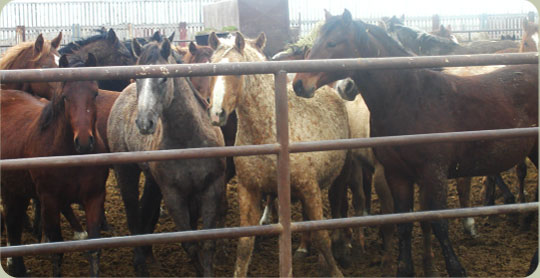
CHICAGO, (EWA) – On June 23, 2010, the Bureau of Land Management (BLM) Elko District office buried on its website a notice that approximately 175 “abandoned, domestic, estray” horses located within Pilot Valley, NV, were scheduled for impoundment beginning June 25. The round up was expected to take 3 – 4 days with corrals set up on nearby private land owned by Simplot Land and Livestock until the horses could be transported and placed under the jurisdiction of the State of Nevada.

Rate this:

BLM Admits Helicopter Stampede Caused Wild Horse Deaths, Refuses Outside Observers in Nevada Census

HOUSTON, (Horseback) – The federal Bureau of Land Management, under siege by press and public for it’s handling of offshore drilling, again has proven it is an agency with a tin ear when it comes to public relations.

With 150 horses and foals now dead in the wake of the most deadly “gather” in BLM history, the agency continues with an apparent government cover-up of the number of horses remaining in Nevada’s remote Calico Mountains.

Rate this:

The BLM Distorts Truth but the Facts Speak: The Calico Herd is GONE

How does one express what is going on. It is a scientific fact that the wild horses are a benefit to the range land and its biodiversity based upon there physiological makeup, grazing habits, and over all free roaming behavior. It is just as much a scientific fact the detrimental effects of cattle on the range land and its water sources, yet the BLM have raped the land of its horses and continue to increase cattle grazing in the area, at the taxpayers expense, all under the guise of establishing appropriate management levels of wild horses. Yet nature has been establishing what are considered appropriate management levels of all forms of wildlife including the wild horses for thousands of years, based upon environmental and predatory conditions, and doing an excellent job of it. Yes, there are continual fluctuations of numbers of varying species but all in ecological balance based upon natures mandate.

Rate this:

The Group that Cried Wolf

If there is one thing you learn as an equine welfare advocate, it is perseverance. You learn that change never happens overnight. You learn to accept change with little victories. You learn that weeks turn into months and months into years. You learn that for change to occur, you must stay steady on your path. You learn that you cannot do it alone and that you must work with and engage people that may have differing opinions on the road to a mutual goal. You learn which battles to fight and which battles will draw you closer to your goal

Rate this:

Utah Ramps Up Propaganda Against Wild Horses

On June 9th, 2010 a public hearing was held by the Bureau of Land Management (BLM) in Salt Lake City, UT on the issue of using helicopters and motorized vehicles in the controversial round ups of native wild horses on U.S. public lands.

If you did not, personally, attend the meeting you are not going to get a straight answer on what exactly went on or hear/read anything about the questions that were posed to the BLM authorities who were in attendance. Instead you will read local press releases containing ample rehearsed commentary from the BLM with plenty of hype thrown in for Ken Zalazar’s eastern wild horse death parks affectionately known as “Zalazoos”.

Rate this:

CFIA Confronted on Breaking Own Rules as Inhumanity and Dangers of Horse Slaughter Industry Probed

OTTAWA, June 7 /CNW/ – The Canadian Horse Defence Coalition (CHDC) today calls for a thorough performance review of the Canadian Food Inspection Agency, while questioning their management role in the monitoring and enforcement of equine slaughterhouses. Serious animal welfare concerns and potential dangers of horsemeat consumption will be addressed.

Rate this:

Renowned Wildlife Ecologist Appeals to BLM for Wild Horse Release

I am concerned about the fate of Calico complex wild horses now in captivity north of Fallon as well as those that remain living in the wild in the five HMA’s from which the former where captured. I recently flew over southern and central portions of Black Rock East, Black Rock West, Calico Mountain, and Granite Range HMA’s in a light plane. In this very open area I was only able to observe only 31 wild horses in several bands, while during this same flight I observed 350 cattle. There was a reasonable spring green-up of the landscape and the open treeless character of the terrain permitted a high degree of horse detection.

Rate this: