

BONHAM, TX — The future looks much brighter for horses rescued earlier this month from a Fannin County pasture. Now, their rescuers are asking for the public’s help in healing and adopting the animals.
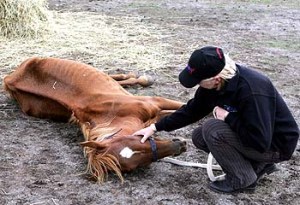
"These horses were in extreme pain and unable to walk," says Deanna Murillo of Habitat for Horses
After receiving a call about the welfare of the horses, investigators from the Fannin County Sheriff’s Office and Habitat for Horses, a statewide rescue group, met the horses’ owner at the pasture. Three horses were found dead in the pasture and several more had to be euthanized due to their poor condition. A majority of the remaining horses were removed, by owner consent, to another Bonham location, according to Deanna Murillo of Habitat for Horses.
“These horses were in extreme pain and unable to walk,” says Murillo. “Had we not arrived, they would have died a horrible death somewhere out in the pasture like the others … The condition of some of the horses was as bad as I’ve ever seen. Several would have died within days had help not arrived. It was already too late for some. The vet had to put down eight of them, either due to their weak, emaciated state or to founder, a condition that can be so painful the horse cannot walk.”
Murillo did note that six other horses, deemed in good condition by the veterinarian, were left with the owners. Theses horses are being regularly monitored by the Fannin County Sheriff’s Office and by Habitat for Horses representatives to insure the owners continue to take proper care of them.
It is believed the horses taken from the property will make a full recovery, but the healing process will take time and lots of special care. Some of the horses are receiving daily antibiotic injections, mostly due to “rain rot” which 90 percent of the horses have. The milder cases are being sprayed with medicated ointment daily which will continue until the rain rot skin problem is cleared up, possibly several more weeks. Several of the horses have eye infections and most all have cuts and scrapes caused from wire, boards with nails, metal and junk found littering the pasture and from the horses fighting amongst themselves, says Murillo. One of the horses is believed to have been bitten in the leg by a snake and was left untreated until the rescue. The leg has now been lanced and the horse is being given antibiotics and pain medication. The female horses are being pregnancy-tested, and the male horses old enough and strong enough to withstand the procedure will be gelded (neutered) in the near future.
In addition to receiving the proper veterinarian care, the horses are undergoing a proper re-feeding program. Murillo explains that, for the first few weeks, the horses will be given all the good quality hay they can eat. Then, on an individual basis, the most severely emaciated horses will begin the slow process is being reintroduced to feed.
“This will be the most dangerous part of their recovery,” said Murillo. “People want to do too much too soon. We have a program of feeding small amounts up to six times a day.”
The horses range from two months old up to 24 years old, with a majority being in the one-to-three-year-old range. The types of horses range from a thoroughbred shown to have won a race in 2006 and registered quarter horses to an Arabian, a Belgium, paints, palominos, and more.
Habitat for Horse is asking for the public’s help by way of adopting the horses, either with a traditional adoption or a “virtual” adoption, once the horses are ready.
For a traditional adoption, there will be a $50 adoption fee. The potential adopting person or family must fill out an application and representatives from Habitat for Horses will inspect the prospective home. Once approved, the chosen horse can be taken home, after which Habitat for Horses representatives will come back to the home at pre-determined times to re-inspect the horse’s new home and to make sure it is being well-cared for. Murillo stresses that horses can live up to 30 or more years, so the commitment to the animal will be lengthy.
For persons unable to actually house and care for a horse, virtual adoptions are available. People can sponsor a horse, helping with the costs of its continued care.
Donations in any amount are also encouraged and welcomed to help offset the tremendous cost of healing and caring for the horses. All donations are tax-deductible.
For more information, visit www.habitatforhorses.org or call 866-434-5737.
![Reblog this post [with Zemanta]](https://i0.wp.com/img.zemanta.com/reblog_a.png)
Categories: Equine Rescue, Horse News






 Straight from the Horse's Heart
1 reply »