

Fresh proposals for managing wild horses in the US may address some longstanding problems, but they are unlikely to appease advocates worried about the way the herds are managed across the western rangelands.

Pryor Mountain Horses running free prior to "gather" - Photo by Terry Fitch
New proposals for the management of America’s wild horse population have drawn a mixed response from campaigners for their welfare.
US Interior Secretary Ken Salazar last week announced a raft of proposals, including acquiring more productive grasslands further east on which to manage rehomed non-reproducing herds.
He described his proposals as a cost-efficient and sustainable management program.
It would involve the aggressive use of fertility control to manage herd numbers.
Wild horse advocates have long been critical of the bureau’s management of populations on the western rangelands.
Current strategies are acknowledged as unsustainable, with the cost of keeping 32,000 wild horses in captivity taking the lion’s share of the annual budget for wild horse and burro management.
In 2008, the $US27 million spent on keeping these animals represented three-quarters of that year’s enacted funding level of $36.2 million for the total program.
The Humane Society of the United States greeted Salazar’s plan with what it called cautious optimism. It said it believed use of contraception offered the best option for ongoing humane management of wild herd numbers.
Madeleine Pickens, who has been promoting a huge million-acre reserve as an option for rehoming captive mustangs, also welcomed the plan. Her plan also involves use of contraception to manage numbers.

Once free, now doomed to a life of imprisonment - Photo by Terry Fitch
However, many wild horse advocates remain deeply concerned over current management strategies employed in controlling herd numbers on the western rangelands.
The Bureau of Land Management’s aim is to maintain about 27,300 animals on rangelands set aside in legislation in 1971 for horses and burros in the West.
However, numbers currently stand at about 33,000 wild horses.
The current economic recession has hit adoption numbers hard, meaning the number of wild horses in captivity continues to grow.
From 2001 to 2008, the bureau removed more than 79,000 wild horses and burros from their rangelands, while placing only 47,000 into private care through adoption.
Estimates suggest that if current removal and holding practices were to continue, annual funding for the total wild horse and burro programme would reach about $US85 million by 2012, with an estimated 20,000 extra horses held in captivity.
Salazar’s proposals are themselves an acknowledgement that change is needed. However, it will do little to placate wild horse advocates critical of current management practices across the rangelands of the 10 western states.
Nevada-based Wildlife ecologist Craig Downer issued a sharp rebuke, saying he was disgusted by what he described as a disingenuous plan by Salazar and bureau director Bob Abbey.
“[It] purports to be for the wild horses, all the while abandoning their duty to defend their right to live in healthy thriving numbers in their legal herd areas throughout the West.”
The new plan would clear the way for more eliminations of western herds, he said.
“How hypocritical for them to say this is a turnaround, for it is the same old, same old. So many of the unique populations are being disrupted, destroyed, by these uncaring officials.
“A moratorium on roundups is urgently needed,” he said.
Downer outlined his concerns about current herd management strategies to a meeting of the Wild Horse and Burro Advisory Board Meeting just two weeks ago.
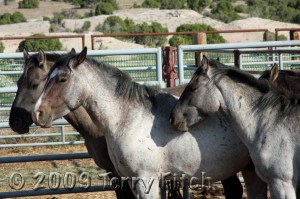
33,000 horses are alleged to be held imprisoned by the rouge BLM - Photo by Terry Fitch
Downer told the board meeting in Arlington, Virginia, that a war mentality had prevailed among bureau and United States Forest Service officials since at least the early 1980s.
“This hostile attitude and the actions it has engendered target America’s last wild horses and burros. Hence, the wild horse and burro program has become among the most deviant from its true legal mandate of any national program.
“The consequences of this have been devastating to the wild horses and burros in the wild.”
He said wild horse herds had been reduced to pitifully low, non-viable populations throughout the West, or were entirely absent from many of their legal herd areas.
“Overall there are around 2000 legal acres for every horse/burro still living free. Yet, the situation has only continued to grow ever worse for those that remain in the wild.”
He argued that the remaining herds were entitled to protection under the Endangered Species Act.
“Many of the wild equid populations being eliminated or reduced to non-viable numbers constitute unique populations that have adapted to their diverse regions over many generations.
“These have roots going back hundreds of years, including those Spanish Mustang remnants that I have thrilled to observe in Oregon’s Steen Mountains (the Kiger Mustangs) or in Montana’s Pryor Mountains – the only herd area of Montana’s seven legal herd areas still containing any wild horses.”
“These unique populations should qualify for protection under the Endangered Species Act. They should also qualify for protection under the National Heritage Act, for their value as a unique part of American historical heritage possesses roots tracing back to the earliest of pioneer days and is equally related to their great significance to Native American culture and history.
“These two aspects are deeply appreciated by millions of Americans, but are being callously ignored by authorities today.”

The BLM's "management" program proves to be a failure - Photo by Terry Fitch
He said there was an urgent need to reform America’s wild horse and burro program – “to reinstate its true purpose, to place the emphasis back on wild horses and burros in the wild and, so, to truly restore the diverse herds to their legal herd areas wherever this is still possible”.
“The rampage of wild horse and burro roundups that the bureau is now engaged in must be called to an immediate halt. A moratorium on these unjustified gathers must be promptly declared.”
Downer cited the planned elimination of 620 “very under-populated” wild horses from 12 legal herd areas near Caliente, in Nevada, across a complex of herd areas comprising 1.4-million legal acres.
“Many of these horses have already been eliminated from the northern three of these herd areas, but nine herd areas still have some sparsely distributed horses.
“I hope and pray that their elimination from the wild can still be prevented. These are horses that I, as a fourth generation Nevadan, have visited throughout my life and their absence will be keenly felt.”
Their planned elimination was mainly to accommodate livestock interests, he argued.
The bureau, he said, needed to honor congressional, judicial and public pleas for fairer treatment of these animals in the wild. Fairer portions of resources needed to be allocated to them, he said, including forage and water within their legal areas.
“We humans need to recognize their great healing presence that includes their universally appreciated aesthetic value upon our public lands. These two species have done so much for mankind over the centuries, but their true place is in the wild.”
Downer said control over the wild horses and burros and their 53-million-plus acres of legal herd areas must be taken from those now in charge of them, saying the animals had been betrayed.
“[They have] subverted their very right to live naturally and freely upon their legal land,” he said.
He proposed the formation of a new agency to manage the wild herds, with reserve design focused on setting up complete habitats for long-term viable populations of 1000 or preferably more horses or burros.
Downer said the World Conservation Union Species Survival Commission Equid Specialist Group recommended a full 2500 individuals for population viability.
He said freely living horses and burros had earned their right to occupy the west, “to realize their own special destiny and in the process to fulfill their own special role as a truly complementary and healing presence in relation to all of life, including man”.

Categories: Horse News, Wild Horses/Mustangs





 Straight from the Horse's Heart
A very well written article – as usual. It’s just so infuriating that the BLM has been breaking laws and ignoring the 1971 Act since it was passed, and no one seems to really care.
I realize the special interest groups are powerful, but this is plain disgusting. It would give me SUCH pleasure to see them ALL behind bars. I’m not expecting that to happen, mind you, but I’d sure be overjoyed if it did.
LikeLike
R.T.-
After watching George Knapp’s I-Team report, I went searching for information on Dawn Lappin, who has run Wild Horse Annie’s organization since Velma passed away in 1977. I found this quote on this webpage:
http://www.igha.org/BLM20.html
Dawn Lappin of Wild Horse Organized Assistance was stunned that BLM was keeping infirmed horses alive when there was unanimous agreement the humane solution would be euthanization.
“How these horses ended up on a refuge when they should have been destroyed is beyond me,” she said.
Do you know anything about Dawn’s work? Is she continueing the legacy of Velma? Did someone misquote Dawn?
Thanks.
LikeLike
Is there a specific place where we can brainstorm our ideas? Some sort of central idea gathering?
I have some ideas, like investigative reporting. Money is the government’s boss, because everybody wants it.
Where does it go?
Is any dubious entity paid by the BLM? Any of their employees with criminal records? Their subcontractors? How about those who voted for those laws?
Any expense wasted money, like 20 000$ bathrooms in their offices? What kind of luxury do they allow themselves? Any kickbacks? Pat-in-the-back exchanges politically? What are their personal relations with Special interest groups? Former employees? Any criminal organization hovering around the BLM and their contractors and employees?
What dirt can we gather from the BLM and their operations???
US laws may not protect wild horses properly at this time, but money and crime are well covered.
For a moment, let’s do some “natural horsemanship” with them: They are politicians, they know the game. Anything with legal or political consequence is useful, from one employee in a gathering doing “too much” to ties in those Special interests groups. Anything can and usually does get used in politics.
If they won’t do what we want, let’s get them in choosing what we want…
Any way to gain BLM employees into under cover spying for us?
Another brain spark: Hard ads. It works for Jane Goodall, maybe it will work for us. Pistures of the holding pens, crammed with wild horses. Their crime: Freedom. Their lawyers/judge/jury: The government. Sentence: Life imprisonment. Let’s go in lines like their land: Stolen. Protected by law: Ignored
Raise the suspense, as long as you can without showing horses, a bit like Jaws. Wait until the last moment to show the horses. Get people surprised.
Slogan: something easy to remember for everybody. Think like they are a new product on the market and people have to remember. Some catchy tune too.
I think our emotions for horses may hinder our efforts. They drive us, but we may feel a bit too involved to think like the rest of this planet.
I don’t expect to be too popular here, maybe, but I try to be true to who I am, an ordinary human with an ordinary life having ordinary problems, who is upset at what’s done to Wild Horses.
I’m not trying to upset you, I’m just showing what we face. We don’t live in a perfect world, our solutions will then be imperfect.
Who will lose their jobs? What contractors will go bankrupt?
Our actions DO have impact on someone’s finances. Saying something like “Let’s close all slaughter houses” will mean families plagued with money problems. People will lose their jobs, their houses, their security, and we must account for that.
If we try to follow the money, and find ways to help Special interests groups after our actions are successful, they may not push as hard to protect themselves. In return, the political pressure relaxes, and changes happen.
If wild horses are a burden to the BLM, how can we relieve it for them? Maybe we can find someone to manage some herds for them? Someone on our side?
I’m convinced we can win this if we solve real problems, one at a time. Any scientists on our side to make new plans for the BLM?
In the end, if we can do better than the BLM, we must be better at ALL they do. Not just what we think we can do, but ALL the program.
Just a few thoughts, in “working with them”.
LikeLike
Martin, Money for us to do some of the most basic things is thin. We need money to be in the field during roundups because the presence of press and photographers and observers can save lives. Documenting the BLM as it captures and handles horses needs to be seen by the public as it is happening. If you can help, we need you. There are ideas that are cost effective and those that only time will tell if they are needed.
Winter is coming and some of the roundups are scheduled through new years and into March and beyond. Right now we are behind in attending the isolated roundups. When this happens we have no idea what has occurred. Can you help? Mar lightprint1949@earthlink.net
LikeLike
https://rtfitch.wordpress.com/2009/10/12/news-update-the-stampede-to-oblivion-is-now-online/
Bonjour Martin,
It seems to me you are a concerned individual otherwise you would not have wound up on this blog owned by R.T. Fitch.
Have you already watched the I-Team Investigative Report from Saturday? Use the link above. If you have not seen this video by journalist George Knapp of Nevada, you will be happy to hear many answers to your questions. George has been working on Mustang and Burro issues for 18 years.
There are many photo journalists we could recommend. Carol Walker for a start. On the top right of this page, you will see a section on Ginger Kathrens who has been filming the Montana Pryor Mt. Range Mustangs for over 10 years. She is an award winning film maker for ‘Nature’.
To give you more opportunities to learn you could read works done by pros like Craig Downer.
If you would like to assist financially, I suggest you email R.T. Fitch directly and ask his advice. I personally donated to The Cloud Foundation for their Mustang adoption fund and legal defense fund that works to stop roundups. I have also bought Ginger Kathren’s DVD series which helps the Cloud Foundation.
One of your concerns stated was about family money problems if workers lose their jobs at equine slaughter houses. We know a little about low-end jobs in Mexico. The work is hard, hours long and wages paid are well below what a family can survive on. That is why Hispanic people continue to stream over the border into the USA looking for jobs with decent pay and environments. No one in Mexico will complain about a filthy plant closing that only exploited the workers.
Emotions do come heavily into play when any equine is being assulted, abused or driven to extinction out of human greed. Horses have a unique and complex bond to the human soul. It is important to balance intelligence with emotions. However, this bond and overall feeling Americans have for the horse is one reason specifically why horse meat consumption is banned here.
It is good that you are asking a lot of questions and trying to help brainstorm. I hope you will be won over to a complete ‘horsemeat’ free diet. Turn that desire around to a desire to help BUILD UP life. The Creator of the world has designed humans and animals to return to the dust from which they came from. It’s good & right to bury our dead and allow the body to naturally return to the earth. The spirit goes back to the Creator.
Merci’ beaucoup,
(My family was Gauthier dit St. Germain who came to Neuveau France in the military. Others were Beauchamp, Gotchy, Puariea. We met Iroquois and then Cherokee.)
Morgan
LikeLike
Martin, I applaud your enthusiasm. Don’t let us stear you away – you bring new thoughtful and thought provoking insight from an “outsider”. Well, your with us now. There is much to leaarn on thses pages and the pages of The Cloud Foundation and the Animal Law Coaltion, just to name a few.
And let me say, I respect both sides of menu choices, though in USA eating horse is not our thing, in India eating cow is not their thing. My purpose here is strictly for the “wild horses” to stay in the wild and not be slaughtered for food. Actually your take is somewhat similar to some American Indian traditions if I’m not mistaken – and I very well may be mistaken.
Anyway, I too have been stuggling with that “phrase”, that one “catchy word”. I will work with you. I sent you a reply on Deviant Art, perhaps we could work together there somewhat. Well, I could if I could figure out how to actually work Deviant. Lots of other horse lovers there too, maybe you know some that might join.
I too would like to take the road of trying to work “with them” – and “trying” it will be. R.T. Fitch has written an article here, and posted another comment to that, about many roads to the same destination – we all have to find our particular nich – some investigative, some more aggressive than others, some more strategist, some more on the ground/at the front, etc, etc., but that makes this a beautiful calidescope of people working toward a common goal.
Look forward to hearing from you.
LikeLike