

Slap on the wrist for carriage driver accused of animal cruelty
SOURCE: dodo.com
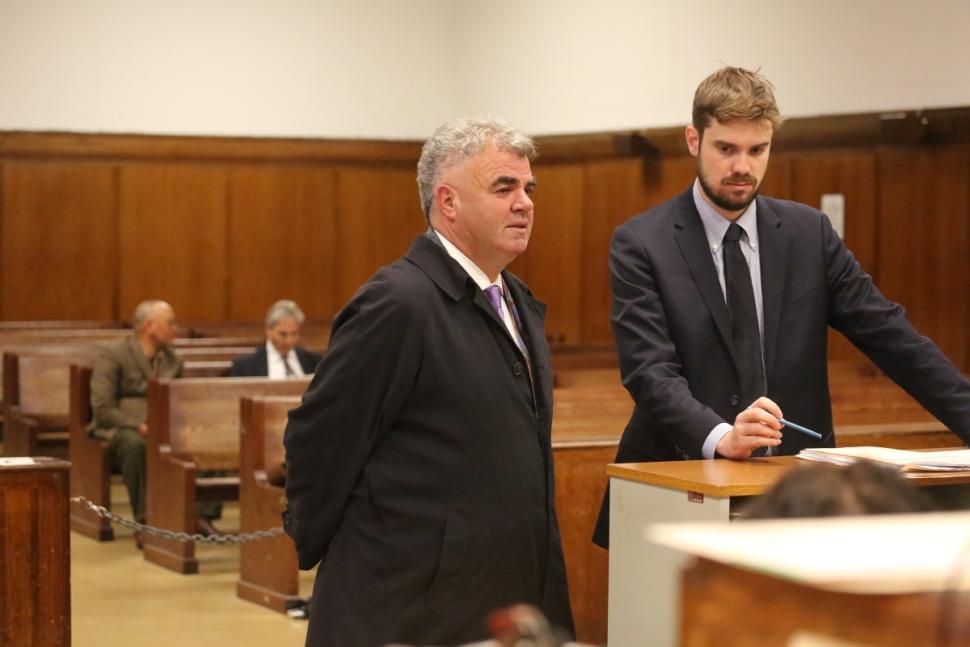
Jefferson Siegel/New York Daily News Saverio Colarusso (left) was arrested last December for working his injured carriage horse, Blondie. (nydailynews.com)
Saverio Colarusso, a New York City carriage driver who was charged nearly a year ago with animal cruelty in connection with a horse named Blondie, pleaded guilty on Wednesday to disorderly conduct. As part of a plea agreement with the district attorney’s office and sanctioned by a judge, Colarusso was allowed to plead to the lesser charge, which carries a five day community service obligation and a small fine. If he had been convicted of the more serious charge, he could have faced a fine of up to $1,000 and a year in jail.
A judge allowed Colarusso on Wednesday to leave the the courtroom through a back door to avoid encounters with animal activists who have attended his every court appearance. A prosecutor, Shilpa Kalra, told the judge the plea deal was offered because Colarusso “does not have a criminal history, the horse had mismatched hind feet which can contribute to the horse’s unusual gait beyond that which can be attributed to thrush, [and] the horse was in otherwise very good condition.” Despite Kalra’s comments in court, Colarusso has a checkered past that includes a charge of drinking while operating a carriage and fines for time-and-place violations, failure to turn on carriage lamps after dark, and failure to keep a daily log, as The New York Times reported after his arrest on the animal cruelty charge.
In the same courtroom where his case had been continued numerous times before and he had declined repeatedly to accept the plea agreement, Colarusso and his lawyer lingered afterward. Sources have said that the District Attorney’s office had appeared to be assisting Colarusso—giving him special treatment—by bringing him into an office after his court appearances for temporary refuge, shielding him from activists and news media. After an appearance last summer, Colarusso was sneaked out of the courthouse, a move that is virtually unprecedented, even among celebrities. This happened again on Wednesday, while reporters waited on the ground floor. It is highly unusual and suspect considering that the DA’s office was prosecuting him.
The misdemeanor animal cruelty charge against Colarusso came after Blondie was observed by NYPD Officer Brian Coll to be in visible pain and limping from injury to her rear left leg. He had been working with a limp for four days and, despite the injury, Colarusso said he had worked Blondie that day for five hours already, according to the criminal complaint.

Saverio Colarusso, whose license was revoked, seen at the hack line on Nov. 15, 2014
Independent of the court case, Colarusso had been fined $3,000 previously, and the Department of Health rescinded his carriage-driver’s license indefinitely. An order of protection was made to prevent him from being near Blondie. During the last year, he has been observed at the hack line, talking with other carriage drivers and promoting carriage rides to tourists.
After the animal cruelty charged was filed last December against Colarusso, a police veterinarian examined Blondie and found her to have thrush, which, if left unattended can cause serious lameness and put a horse’s life at risk. (A subsequent Department of Health veterinary examination of Blondie downplayed the seriousness of the thrush.)
Blondie was stabled at Clinton Park Stables and owned by Edward O’Hara. For a carriage horse to develop thrush would likely mean that the horse had been standing in filthy, urine-soaked straw bedding. In response to specific concerns by the Coalition to Ban Horse-Drawn Carriages about stable maintenance and care of carriage horses, an assistant district attorney had said that all aspects of the case were being investigated rigorously. No charges were filed against either the stable manager or Blondie’s owner, both of whom share responsibility for Blondie’s care.
Filed by a correspondent of the Coalition to Ban Horse-Drawn Carriages
Related articles


Categories: Horse Health, Horse News





 Straight from the Horse's Heart
We don’t need to ban horse drawn carriages, that’s part of Newyorks history, but what does need to happen is stricter rules that require they care for the horses in the stables as part of their jobs. they don’t like it, then those that actually care for the well being of the horses will step in and treat it as more then just a job.
LikeLike
This summer we just happen to be driving thru Golden CO during the farmers market~they had 3 carriages for rides for people~I don’t know how the horses are treated at home (they belong to a company for rent, we do not have carriage horses in Denver) but the big Draft horses looked thin, it was in the 90’s, people running in front of them, standing in the heat heads down it just looked so wrong. https://www.thedodo.com/horse-carriages-banned-utah-844014666.html
LikeLike
Geri, I understand there are people who treat animals (including horses) poorly, but think we might all do well to reconsider such things as outright banning of using animals to pull carriages or plows, for example. This ancient partnership brought us civilization and may well be needed again in the future for small scale, local agriculture. If we ban any teamwork opportunities for people and animals we will end up only having animals in zoos, further separating people from the rest of the creatures that share our world. In my view, the best defense against animal cruelty is to have animals in your life on a daily basis where you learn to care for and about them, and where each benefits the other. Co-evolution is nothing we should dismiss lightly, nor is our dependence on sharing this world with other life forms.
LikeLike
Icyspots~I’m not saying to ban them or not, I only posted the article I found, I agree with you on the fact of keeping our heritage and culture alive, I see every day where people and not just people who work with animals, but all professions are retiring or passing away taking their knowledge with them. As I stated I don’t have a clue how the animals are treated at home ~~but in this case in Golden the farmers market is on a pretty extensive trail and water system and on that particular day there were visitor’s to the market, regular shoppers, hikers, bikers, kayakers, tubers, skateboarders, rollerbladers, plus all the tourists that frequent the old west town of Golden, couple that with the car and bus and all the family’s with kids people jumping in front of the horses and it was in the 90’s, sorry was not a good situation for those horses. And these were not the folks in the pictures I see of NYC with the top hat and tails, these folks were not there to give a lesson on horse culture~~~~they were there to make money. As for the carriage horses in the city, I’ll leave that to those who are there and in the know, I only post what I find on a subject.
LikeLike
This is for all the folks lucky enough to own a horse.
http://www.horsechannel.com/horse-news/2014/11/4-reasons-to-be-thankful-for-horses.aspx
LikeLike
One of the unfortunate, very unfortunate, but nonetheless predictable consequences of the politicalization of animal welfare is that people who actually own animals (although I use the word own in the legal sense with the understanding that animals are sentient beings with spirits that belong to them), are aware that thrush can occur for other reasons besides standing than standing in filthy bedding. Thereoof problems that do not include thrush. So, while could be a link, the presence of thrush is not proof that the stables are dirty. On the other hand, the absence of thrush does not mean they are clean. There are many factors.
The attacks against the Romneys over the way they manage their lives with animals came from within the animal welfare community, and the shabbiest of all from the equine welfare community over common practices in horse management for horses used for pleasure and for local and regional sporting events that both amateur sportsmen and sportswomen and professional riders.
After the cameras left the Bundy stand-off, the BLM shot Bundy’s cows and a bull. Then they buried the cows with a back hoe. The pictures are gruesome, but not a single animal welfare group protested this savagery. While it is understandable that the conflict about wild horses and land us with cattle is a big issue in this case, the fact that no groups spoke out about what happened to Mr. Bundy’s cows makes it appear that animal advocates, particularly those that are protesting ag gag laws, are interested in shutting down animal use industries. There is nothing vague about the language in the documents I found about the wild horses and burros.
Many of the injuries that horses really have require a trained eye. Sometimes the limb that is injured is not the limb that appears to be injured. Lameness is often detected by looking at the movement of the horse’s head at different gates during a trot. I’ve never seen lameness diagnosed from the walk. I am not saying that it is not done, and you can detect whether or not a horse is “off” a bit at the walk, but it is hard to know why.
The policy advisory against horse slaughter in order not to increase the value of the horse does not make horse slaughter humane, but it does underscore that the people we thought were way out there on a limb with this position, were likely to have had an authentic reason to link the two. If there was even one person, and Representative Stenholm would have been such a person that got a whiff of this before he was re-districted in TX, it is very likely he knew about it. In fact, a paper published for CAST in 2002 probably hit his desk. And though this one was written for the agriculture industry and lacked some of the stronger and more formidable language, it would have enough to raise alarm in someone as astute as Representative Stenholm.
LikeLike
HH , wise words. To which I must add, at least TWO of Bundy’s bulls were gunned down from the air and the photos published. Apart from any human politics involved I found (and continue to bring to people’s attention) this a horror beyond comprehension. These animals were innocent and also were private property, yet were used for target practice on public lands and essentially executed using taxpayer dollars. The only explanation I found were the bulls were “dangerous” yet one was in a corral when killed as the photo shows, the other was out on the range threatening nobody and eating surely no more than $1.35 worth of forage per month if the grazing fees are as adequate as one would be led to believe by government officials.
Also you are right on about thrush – some horses are prone to it no matter what their level of care or work, it is found as often in high dollar show barns as in mucky backyard horse slums. It can be thought of as a sort of equine “athlete’s foot” in my opinion after a lifetime of horse ownership and care. While there may be issues with carriage horse care this is a weak point to hinge a case on, and ultimately threatens anyone who cares for horses since it isn’t directly linked to any particular standards of care. In my experience I’ve seen it most often in expensive gaited horses stalled in immaculate barns but who are shod in ways that keep the hoof narrowed and constricted.
LikeLike
Thanks for sharing your experience.
LikeLike
I would bet that the horses that the BLM want to castrate so they won’t have to remove them are near some important natural resources they do not want private citizens to know exist. In fact, it may well be that this has been the case since 2009. This may very well explain the police state at round-ups. Still, we found out from the EA’s and other documents what was happening. If the BLM doesn’t have to published EA’s and advocates don’t go to round-ups, the public will lose an important tool to prove what Senator Reid is really doing with out public lands.
We know the BLM is not interested in protecting the environment. What we have lacked is an understanding of why. Why do environmental groups fail to include horse in their native wildlife inventories—because these groups are working for people who cannot succeed unless they have the ability to get our horses removed. It is all about oil and natural gas. We don’t even know if fracking is harmful because the same people that have presented the false information about the horse are informing regulatory agencies.
Undestand, I am not saying that fracking is safe or not safe. It is being used around the world in countries that actually are using science to help protect the environment rather than destroy it, so that would make me want to look at the sciences from those countries using fracking. We have a much greater land mass than almost all countries, so chances are that people live closer to fracking areas than we do. At this point, there is no evidence that we can trust our government’s decisions on any scientific measure because the same that began this in the 70’s (actually before) are still in power or in highly influential positions. Go to Russia or China or a country not known to be involved in this scam or one that has begun pulling back to find evidence most likely based on science. China and Russia have both advanced while we travel to the dark ages.
LikeLike
HoofHugs~remember “bidder 70″http://www.windwildhorse.com/windblog/2013/07/02/blm-and-gas-fracking-will-be-the-death-of-the-wild-horses-soon
LikeLike
http://www.windwildhorse.com/windblog/2013/07/02/blm-and-gas-fracking-will-be-the-death-of-the-wild-horses-soon
LikeLike
A report from As sissies animal health about horses http://www.heraldonline.com/2014/11/28/6571753_assisi-animal-health-explains.html
LikeLike