
R.T. Fitch
R.T. Fitch’s life has been anything but ordinary. Straight out of high school, he joined the U.S. Air Force Band during the Vietnam era, and while stationed in Hawaii, he spent weekends at Sea Life Park training penguins, sea lions, and whales. His path through life has taken many unexpected turns—including more than a few lessons in love—until meeting his wife, Terry, brought a lasting partnership and a shared passion for animals.
Over the course of his adult career, R.T. worked internationally in multiple countries, gaining a broad, global perspective that colors both his worldview and his writing. Now rooted in Texas, he and Terry live on a small farm surrounded by four-legged companions with paws, claws, and hooves. Together, they have devoted years to equine rescue and wild horse protection.
An ordained volunteer chaplain and professional Santa Claus for a local historical society—with Terry by his side as Mrs. Claus—R.T. brings warmth, wisdom, and joy to every season. His work reflects a life of service, wonder, and connection to both people and animals.
He is the author of Straight from the Horse’s Heart, a moving collection of true rescue stories and spiritual reflections, and Fangs of Light, a supernatural tale steeped in symbolic and metaphorical storytelling. The first in a planned trilogy, Fangs of Light blends myth and mystery to explore themes of identity, redemption, and the power of empathy—offering readers not only suspense and intrigue but a deeper look at the light and shadow within us all.
The Bureau of Land Management (BLM) has divided the western states into six zones and private contractors bid on and received a contract for one or more zones. Each contractor is required by their agreement to capture a minimum amount of wild horses and/or burros in the zone. The MAXIMUM number of wild horses and burros that may be gathered is actually higher than the number that exists on their federally protected Herd Management Areas. The BLM reported that in the 2012 fiscal year there were only 37,294 wild horses and burros remaining on the range, but they have contracted to remove up to 44,000 from bait-trapping alone. So while the BLM feigns interest in humane care and concern for out Wild Horses and Burros, these BLM contracts continue on their fast-moving “managing for extinction”.

GEORGETOWN, Ky. — A horse that never posed in the winner’s circle is living the good life this summer on a scenic Kentucky farm, and his losses could mean a big win for retired thoroughbreds.
The priority at that point was to get the foal out and back to his family. It was a holiday weekend, the BLM office was closed, and there was no cell service in the area anyway, so it was up to us to help him. With no access to water or to his mother, the foal would most likely die. We moved very quietly and slowly, not wanting to panic him and cause him to run into the barbed wire, and injure himself. At this point he was bright eyed and active, and watched us as we worked.
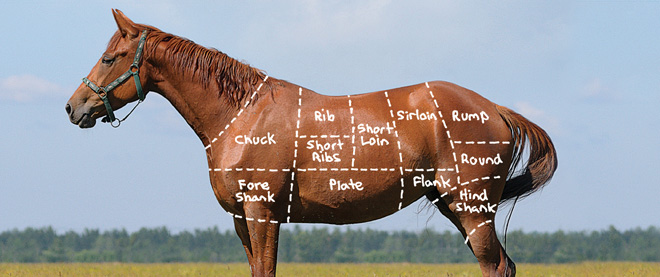
Horses are being singled out because they are not food animals in the US. Calling horses livestock does not make them food animals. Food animals are determined by how they are raised and regulated. Accordingly, US horses are non-food animals. They do not meet food safety laws by any stretch of the imagination. US horses are hauled out of the country with or without plants on US soil. According to USDA statistics, 775,474 horses were exported from 1989-2006 when all three foreign owned plants were operating on US soil.

Mitt Romney’s Oldenburg mare, Rafalca, is competing in London for Olympic dressage. Stephen Colbert has declared “competitive horse prancing” his Sport of the Summer, pointedly mocking the presumptive Republican presidential nominee for looking like a 1 percent aristocrat. After all, though Rafalca’s price is undisclosed, when the Romneys bought the horse in 2006, dressage prospects of her caliber cost as much as, if not more than, an average American home. Her annual overhead of more than $77,000 is double that of the average American family’s. No wonder the elite equestriennes gracing this month’s Town & Country are all billionaire princesses. Even at sub-Olympian levels, the animals are expensive.
Yup, you read the headline correct folks; I am really a nameless turd in the disguise of a regular, tax paying animal welfare advocate just flashing my name around so that I can become famous for donating virtually all of my spare time and a good portion of my retirement funds to keep the federal government from whacking what’s left of our wild equines and stopping uneducated morons from butchering and eating some of my very best friends…that would be me, the nameless turd, well, that’s what the partner (or whatever) of “Slaughterhouse” Sue Wallis has told his dwindling handful of horse eating followers.
HOUSTON, (Horseback) – Despite claims by pro-horse slaughter activists who would seemingly put a slaughterhouse on every rural main street, the market for American horse meat just dwindled to almost nothing. The European Union released its 2013 regulations for meat imported into the 27 countries.
On July 30th the Colorado division of the Bureau of Land Management (BLM) called off the alleged “Emergency” roundup of Colorado’s West Douglas Wild Horse Herd. Earlier in the month wild horse and burro advocacy groups; Colorado Wild Horse and Burro Coalition, Cloud Foundation, Front Range Equine Rescue, Habitat for Horses, Dr. Don and Toni Moore along with the Wild Horse Freedom Federation attempted to block the proposed gather as it appeared to be an attempt to circumvent the current litigation blocking the BLM from zeroing out the unique wild horse herd for almost two decades.

Western Watersheds Project (WWP) has received notification that Judge Harvey C. Sweitzer of the Department of Interior Office of Hearings and Appeals granted four Stays halting Bureau of Land Management grazing decisions on 48,000 acres of public land in the Grouse Creek, Meadow Creek, Rock Creek and Trail Creek Allotments in the Pahsimeroi River Watershed of central Idaho. The allotments are located in critical habitat for Greater sage-grouse whose numbers have been declining for many years in central Idaho.
A Lebanon company that was shut down last month after two accidents involving trailers loaded with horses appears to be up and running again under a new name and in a new location.


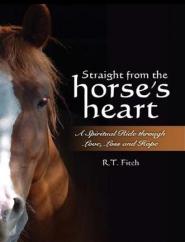





 Straight from the Horse's Heart
Most Recent Comments