

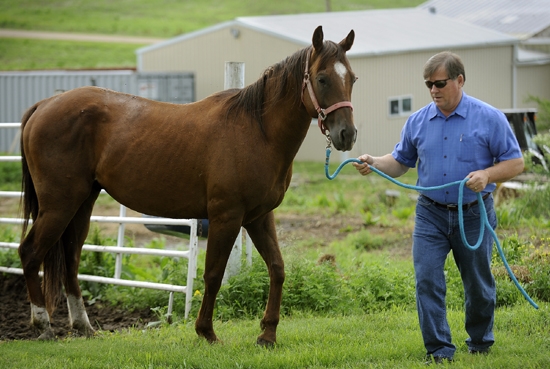
Veterinarian Dick Porter leads his horse "Tiger" out to munch on some green grass Friday morning as the horse recovers at his home near Ceresco. (Eric Gregory)
RURAL CERESCO — Maybe Tiger can’t believe his good fortune on this Friday morning.
He gets to walk out of his dirt pen, cross the private road that leads to the house on the hill, and spend a few minutes in the tall bromegrass — eating his first greens in at least a year.
The 8-year-old registered quarter horse has been back home with Richard and Gwen Porter a little more than three weeks now, chewing his way through two feedings a day of dry grass, alfalfa, oats and protein pellets.

The Porters are working to restore the 200 or more pounds Tiger lost on the 3-Strikes Ranch near Alliance and the neglect they believe he suffered over the past year.
Tiger was one of the lucky 211 rescued from the ranch in mid-April. Seventy-four horses — many of them mustangs — and burros died on the ranch, most likely of starvation, parasites or a build-up of sand in the intestinal tract.
It was a scene many of those who participated in the rescue say they had never in their experience witnessed, and hope to never see again.
Dr. Richard Porter and his wife, Gwen, own the Porter Ridge Veterinary Clinic in Ashland and raise quarter horses — 18 of them —at their home on 60 acres outside of Ceresco.
They’d had Tiger since he was a foal and hoped he would someday make a good performance horse. But the colt was shy and not as confident with people as they’d like.
Three years ago, Porter heard of Jason Meduna, who had a place near Weston in Saunders County, a new and upcoming horse whisperer, so to speak, who had taken in mustangs no one else could handle and was using some interesting techniques with them. Nighttime rides, saddles with no stirrups, no bits. People were happy with his results, Porter heard.
“He had a natural way to connect to animals,” Porter said. “He got animals to trust him.”
So in June 2006, Porter loaded up Tiger and took him to Meduna, believing he could help the colt find himself.
And for a while, Meduna sent pictures and progress reports that met Porter’s expectations.
“I’ve had a lot of horses trained by different people, and I’d never had a progress report,” Porter said.
He visited Meduna that summer to check on the gelding and saw he was doing well. He told the trainer to keep him a while longer.
But after Porter returned home, he didn’t get a bill. Meduna never called. The reports stopped.
A friend told the Porters Meduna had packed up the horses and moved out west, to the ranch near Alliance. He apparently had taken Tiger with him, with no notice to the owners. If they had known he was moving, they would have picked up their horse and brought him home, Gwen Porter said.
Now, friends told them how difficult it would be to get Tiger back, knowing the reputation Meduna had developed in the Saunders County area. So the Porters made a decision they now regret, to not drive out west to try to reclaim the horse.
Then they got the call in April about the raid on the ranch, and the rescue, and someone asking if his horse was OK. It was a total shock.
“We felt so bad,” Gwen Porter said.
Jerry Finch, of Habitat for Horses in Hitchcock, Texas, was one of the first to show up at the 3-Strikes Ranch to a scene of dead horses scattered around the property, some bleached bones, some freshly dead, and more than 200 “very, very thin” horses, some too weak to move.
Veterinarians were performing necropsies on a couple of the horses that had recently died when Finch arrived, finding massive infiltrations of worms and the results of starvation.
Meduna’s side of the story, Finch recounted, was that neighbors were poisoning the horses.
But Finch said the horses had no sign of sickness, such as poisoning.
Meduna could not be reached for comment. But the 42-year-old rancher has been charged with 149 counts of animal cruelty, a Class IV felony. He posted bond, and on Wednesday, Meduna waived his right to a preliminary hearing, said Morrill County Attorney Jean Rhodes. He faces a July 14 arraignment.
Meduna owned some of the horses and burros. Some were owned by individuals, the federal Bureau of Land Management and rescue groups, who paid to board horses on the ranch.
Many of those involved in the rescue have called what happened at the 3-Strikes Ranch Nebraska’s worst cases of animal cruelty, neglect and abuse.
According to the ranch’s Web site, which has now been taken down, the ranch was a mustang outpost, a non-profit habitat to hundreds of mustangs from all over the country, a place for the horses to run wild in the natural environment of the open Sand Hills prairies.
Porter said Meduna had 300 head on 1,900 acres of remote ranchland. Fifty cows couldn’t be sustained on 1,900 acres, he said.
Which is why the ranch land had turned to sand, he said, and may be ruined.
There would have been so many people across the country who would have helped if he had just asked for it, Gwen Porter said.
* * *
Finch brought six of the rescued horses back to his Texas habitat, and all are gaining weight. Four have been adopted out. One 36-year-old mare that is pregnant will give birth any time now.
Other horses were taken by other rescue groups, and most have been adopted or given back to their former owners and are spread from California to New Jersey.
Starvation affects internal organs and muscle tissue, including the heart, and some horses never completely recover.
After a bad worm infestation, a horse can have intestinal problems for years, Finch said. The long-term effects of starvation and neglect can shorten a horse’s lifespan, which would be about 25 years with good care.
It took about five weeks to get Tiger back to the Porter homestead, and when he arrived, he was hardly moving, was depressed and sad, had swelling in his legs, and the muscles in his hip and legs had deteriorated, the owners said.
“At first, he was very leery of us,” Gwen Porter said. “It was a couple of weeks until I could touch his nose.”
He has gained about 120 pounds at the Porters and is running and swinging his head. They haven’t put a saddle or bridle on him, giving him plenty of time to recover.
Meanwhile, Porter worries about what will happen with Meduna and his ranch.
“Will he serve jail time,” he wonders. “And how are they going to stop him from getting other animals?”
By JoANNE YOUNG / Lincoln Journal Star
![Reblog this post [with Zemanta]](https://i0.wp.com/img.zemanta.com/reblog_a.png)
Categories: Equine Rescue, Wild Horses/Mustangs






 Straight from the Horse's Heart