

It’s Feel Good Sunday, and we’re sending a big thank you to the heartwarming work done by Susan Wagner and Equine Advocates.
SOURCE: www.berkshireeagle.com
By Kate Abbott, Berkshires Week Editor
Posted: 07/11/2013 12:10:19 AM EDT
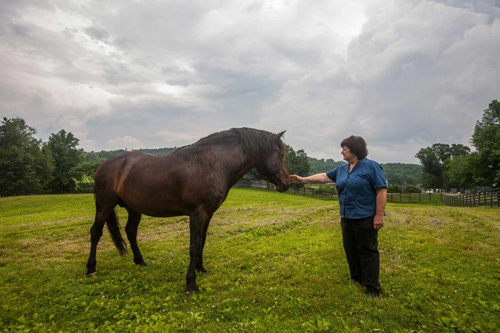
Susan Wagner with Nelson, a wild American mustang who had been chased down by a helicopter and captured by the Bureau of Land Management in Wyoming. (Courtesy of Susan Wagner)
CHATHAM, N.Y. — Henry, a dark-brown mule, comes up to the fence when Susan Wagner calls him. On a midsummer afternoon his companions in the pasture are standing in the shade and waiting for the day to cool before they come out to graze.
When Wagner found Henry at auction, he had a halter embedded in his skull. She had to have it surgically removed.
Henry is one of the most severely abused animals Wagner has brought to Equine Advocates.
Wagner and her team of volunteers care for 83 equines — horses, mules and donkeys — on her 140-acre property, and she has worked with organizations across the country to find homes for many more.
The animals at Wagner’s sanctuary are not ridden. Many of them cannot be ridden, she explained. They arrived with serious injuries. She makes sure that they are as free from pain as possible, comfortable and well-fed. Some have worn teeth, and one cannot digest hay or grass.
“We have five sound horses here,” she said. “Most have physical or behavioral problems” because of the way they were treated. “Some came from auction. Some were bought to keep them from auction.”
A thoroughbred rescued from the track, she said, will need two years of quiet turn-out in the pasture just to get the drugs out of her system — the steroids and pain-killers and stimulants. She will need two years to detox to let her sharply trimmed feet grow out and strengthen, two years to recover, before she can be ridden at all.
Wagner will adopt out sounder horses that can be ridden to carefully vetted new homes, and with the understanding that if the new owner cannot keep a horse, the horse will come back to her. More than a third of the horses who are adopted do come back to her, she said, because an owner becomes ill, or loses a job, or at times finds a horse too much to handle.
At the sanctuary, the pasture-sound horses are turned out to grass in small groups. As she came up to each paddock, she would call a horse
over to be introduced.
The sounder and more energetic animals are also turned out periodically in a larger pasture with room to run together, she said.
Wagner herself comes to horses by way of racing, advocacy and caring for wild animals, rather than through riding stables.
She grew up in the Bronx, a child watching horses in pastures pass by on car trips. She rode her first horse at 5 years old, she said, but she began working with horses as an adult, the day she went to the Belmont Stakes to watch Secretariat win the Triple Crown. She got a job as a hot walker on the back stretch the next day.
She spent 15 years in the racing industry, she said, and left to work as a wild animal keeper in a zoological setting. She rescued her first horse from the zoo where whe worked, a horse that bit a child. She asked a zookeeper what would happen to the horse and was told “he’ll probably go for meat.”
“I felt punched,” she said. “In all those years in the racing industry, I had not heard of horse slaughter.”
She began to research, and to conduct undercover investigations into animal cruelty, scoping out auctions for an investagative and sensational news television series, “Hard Copy,” in the mid ‘90s.
Wagner founded Equine Advocates in 1996 and established the sanctuary in 2004.
Since then, she has rescued mares — kept constantly pregnant and confined — to extract an estrogen replacement drug (Premarin, or PMU) from their urine thoroughbreds injured on the race track, horses, mules and donkeys seized by police on their way to slaughter.
Selling horses for meat, she argued, is dangerous for people as well as for horses. Many medicines that work simply and effectively for horses are toxic to people, and many of these medicines stay in a horse’s system indefinitely.
This is not the only abuse of horses that she finds harmful for people. In a field near Henry the mule, a golden draft horse mare wears a white brand on her haunch.
Wagner now cares for several mares like this one who lived for years in Canadian stables, confined to unclean stalls and kept constantly pregnant. Their foals were slaughtered.
These mares are kept to produce a drug. Premarin, derived from pregnant mares’ urine, is used in the hormone replacement therapy drug Prempro, given to women during menopause.
The number of PMU stables has fallen sharply, Wagner added, since a study published by the Women’s Health Initiative in 2002 revealed that the drug itself carried a high risk for breat cancer, heart disease and blood clots. But Wyeth, the pharmaceutical giant that makes Premarin and Prempro, has now merged with Pfizer, and Pfizer has not given up the practice.
She sees these mares when they have newly come from these barns (by way of a veterinary hospital for quarantine). They are injured and terrified.
“They’re crazed,” she said. “We start out by leaving them alone and letting them feel safe.
“We take the horses that have nobody to speak for them,” she said.
If you go …
What: Equine Advocates Open Day
When: Saturday, 11 a.m. to 4 p.m.
Where: 3212 Route 66, Chatham, N. Y.
Admission: Free
Information: (518) 245-1599, http://www.equineadvocates.org
Categories: Equine Rescue, Horse News, Horse Slaughter, Wild Horses/Mustangs






 Straight from the Horse's Heart
Wonderful to know of one more Awesome home for wonderful horses, donkeys, & mules. Would love to visit and feel the positiveness of what has been developed here. May it continue for evermore because all of the denication & work that this individual has given. God Bless Susan Wagner!
LikeLike
Bravo Susan!!….What a Beautiful place….
Your living a dream I’ve had for years of owning a rescue facility for horses and other critters….The joy to rescue and save so many would be incredibly fulfilling!…..
Hats off for all your hard work…..knowing the “Joy” that comes with it……. beyond words..
LikeLike
I have always said that if I were wealthy, I would wish to run a horse rescue. To be able to help and care for horses with special needs and to find them deserving homes with people who would love them and appreciate them, well, nothing could be so rewarding! Thank you to all of those who so tirelessly and loyally work towards protecting our horse’s well-being, just like horses have been doing for humans throughout history!
LikeLike
Thank you Susan and Equine Advocates. I know that this kind of work is 24/7 and 365 days a year and involves both sorrow and joy … but anyone that can and does do it is a giant in my mind and heart.
LikeLike
I give a monthly tithe to Susan and her horses and it makes me feel good to know I am covering a tiny bit of her expenses. She runs a wonderful rescue and the amount of money I am giving is not so much that it would get frittered away anyhow! Please consider this regular giving to help rescues have a dependable income stream for budgeting their work
LikeLike
Ugh. I have to wonder about the necessity of drugs like Premarin, and to put horses through that kind of suffering to make the drug. Surely there must be a synthesized alternative to these kinds of drugs, and menopause is a natural part of a woman’s life since the beginning of humanity.
Yes, God bless people like Susan Wagner.
LikeLike
Alarmed by the comment that PMU farms have decreased. Yes it is true that they have decreased in North America because that is where they were held to be the most accountable. Pfizer has now taken the PMU farms to China and other countries where humane treatment is not so closely monitored. They are also trying to get a new drug Arpela approved here in North America, so far without success, but it has been approved in other countries. The abuse of pregnant mares and their foals for urine to produce cancer causing drugs has not slowed down it has increased, just not on our soil. Please ensure that everyone you know involved in humane work is aware of Pfizers new enterprise and the continued abuse of horses. Here is a link for more information http://tuesdayshorse.wordpress.com/2012/02/13/pfizers-love-affair-with-carcinogens-continues-with-aprela/
LikeLike
Thank you. Good God, is there no end to human cruelty, taking it to another county where there are no laws to protect them. I really don’t think these drugs are necessary, and would never uses them knowing the suffering to another creature they cause.
LikeLike
Theresa, thank you for sharing the additional information.
LikeLike
I have to admit that years ago I took premarin for about 9 months – until I learned where it came from. Stopped right then. This would have been probably 20 years ago. How sad that this abuse has been going on all that time & probably before. This company moving their abuse factories to other countries so they can continue slaughtering the foals & I’m sure the mares when they can no longer produce the urine – and to top it off, endangering women’s lives – this should cause people to react against it. But then, their publicity beats ours! That needs to change.
LikeLike
Bravo indeed, thank you from all of us to you…. I just said the other day IF I had the resources I would help those horses who need it the bad ones, I would LOVE to do that, what a rewarding feeling it must be!!!! See THIS is what the GOV. should be doing helping Recues not Slaughter, oh but that would make to much sense wouldn’t it??? Nice Story…. 🙂
LikeLike
I’m happy to see the article about Susan Walker and her sanctuary has been written. She is the nicest person you ever want to meet and her dedication and compassion for the safety and protection of equines goes without saying. I was not aware of Pfizer taken the PMU farms to China and other countries…a big red flag for Pfizer!
LikeLike
As long as all are happy & healthy , being cared for properly Great !
LikeLike