

SOURCE: Science World Report by Samantha Goodwin
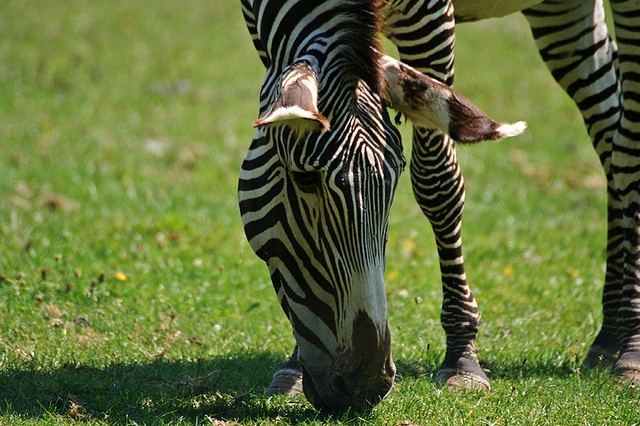
The fossil of a new horse species has been discovered from 4.4 million-year-old fossil-rich deposits in Ethiopia by a group of researchers.
It is as big as a zebra and has three-toed hooves. Evidence also suggests that the animal grazed on grasslands and shrubby woods in the Afar Region. Teeth and bone remains of the species were first discovered in 2001 in the same region. The fossil not only fills a gap in the evolutionary history of horses but can also help researchers document how old a fossil locality is. This fossil horse was among the diverse array of animals that lived in the same areas as the human ancestors, Ardipithecus ramidus, commonly called Ardi.
“This horse is one piece of a very complex puzzle that has many, many pieces,” Scott Simpson, professor of anatomy at Case Western Reserve’s School of Medicine, and coauthor of the research said in the statement. “The fossil search team spreads out to survey for fossils in the now arid badlands of the Ethiopian desert. Among the many fossils we found are the two ends of the foreleg bone-the canon-brilliant white and well preserved in the red-tinted earth.”
Now, almost a year later the team has found part of the connecting shaft, which though split lengthwise, still showed the full length of the bone. Judging from the slender bone, it is clear that the species was a great runner like modern zebras. The teeth reveal that they grazed heavily on the grassy woodlands in the region.
Researchers also noted that the newly discovered horse species had longer legs than horses that lived 6 to 10 million years ago. This development of longer legs has helped modern horses run faster, fleeing lions and other predators and hunting hyenas. An analysis of the teeth fossil revealed that the species had adapted to grazing over time as their teeth were longer than ancestral horses. The isotopic composition of the enamel also confirms that the animal was a grass-eater. The bones clearly show that the horse was significantly different than horses that existed more than 5 million years ago.
The species has been named Eurygnathohippus woldegabrieli, after the geologist Giday WoldeGabriel. Researchers of the new project decided to name the species after the geologist because of his immense contribution in unraveling the geological complexities of the deposits in Ethiopia where fossils of some of our oldest human ancestors have been found.
Categories: Horse News







 Straight from the Horse's Heart
This sort of puts a kink in the old feral horse theory, huh? Actually – bigger than a kink…..
LikeLike
MAGGIE is it going to help the horses now? if so we need it bad, with the courts saying slaughter can start up again . I called and wrote an prayed so hard.
LikeLike
Daryl, honestly don’t think the people who NEED to be educated will listen any more than they already have. They only see their way – don’t read the NAS report or RTs or John Hollands or Vickery Eckoff’s blogs – because as far as they’re concerned anyone who doesn’t agree doesn’t matter. If we don’t find a way to stop them – there wont be any wild horses or burros or wolves or mountain lions left. Their whole agenda seems to be removing any creature that’s in their way. I don’t think changing their minds is possible – we just need to outnumber them and outvote them.
LikeLike
The BLM will look at this information and give a ” I don’t believe it look at the article” like they have always done. They know themselves that this is something that they can’t sweep under their dirty rug. They have their friends that they like to give millions of tax payer dollars to that would lose out if this could be shown in court with a honest judge and some scientists sitting there telling the judge what this means. This is 100% proof that the horse evolved in North America and they are native. There is information out there as to what happened to all of the large mammals such as the cave bear that went extinct 15,000 years ago. It is now believed that it was caused by hunter gathers that came across the then dry Bering Straits 800 years earlier than thought. These hunters killed and ate any animal they found including the horses. I believe that this is the reason horses were extinct. If they hadn’t grazed their way into Asia there would not be horses on this planet today.
LikeLike
Barbara, I am researching this very topic but am not understanding how finding 4.4 million year old equid bones in Ethiopia confirms that horses evolved in North America. Can you explain what you mean by this? Also, the “Overkill Theory” for horse extinction already has had many holes poked in it, though it is a convenient postulation. Thanks.
LikeLike
R.T., thanks for posting stories like this. I love reading about archeology and the evolution of all kinds of Life.
LikeLike