

SOURCE: thelocal.dk
Kerry Sheridan/AFP
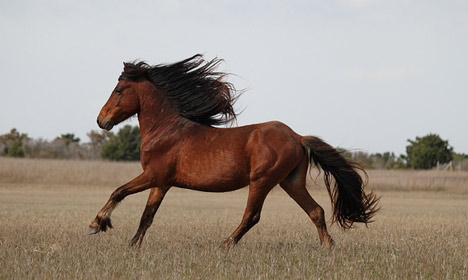 Photo: FireLizard5/Flickr
Humans tamed horses some 5,500 years ago, and an international study of ancient and modern horse genes Monday sheds light on the traits people saw as valuable, including speed, vigor and learning ability.
Researchers also discovered that a long-gone and previously unknown population of wild horses contributed a large chunk of genes to contemporary horses, according to the findings in the Proceedings of the National Academy of Sciences, a peer-reviewed US journal.
“We have identified at least 125 genes that have been modified between ancient and modern horses,” lead researcher Ludovic Orlando, associate professor at the University of Copenhagen’s Centre for GeoGenetics, told AFP.
“These are candidates for domestication genes, ie. genes that humans have selected in the course of horse domestication andmanagement .”
.”
.”Their functions, Orlando said, are associated with locomotion, physiology and behavior.

Ludovic Orlando. Photo: Nicola Lo Calzo
Of course, the Romans and Hittites who tamed horses to pull chariots and run in the cavalry thousands of years ago had no inkling of the specific genes they were manipulating. But researchers can now tell that breeding domestic horses with wild ones, a practice known as restocking from the wild, appears to account for at least 15 percent of the domestic horse genome, and possibly up to 60 percent.
for at least 15 percent of the domestic horse genome, and possibly up to 60 percent.They can also tell that the wild horses whose genetic signatures remain in contemporary horses were not related to the only breed of wild horses alive today, known as Przewalski’s horses, an endangered species native to Mongolia.
Analyzing ancient DNA
Orlando’s team, which in 2013 decoded the genome of a horse that was around 700,000 years old, this time set about analyzing horse DNA from about 16,000 to 43,000 years ago, long before domestication occurred.
They used fossilized bone dug up in Russia’s Taymyr Peninsula, where frigid conditions allow for DNA to be preserved, and compared the finding to modern horse DNA.
“We provide the most extensive list of gene candidates that have been favored by humans following the domestication of horses,” said co-author Beth Shapiro, head of the University of California, Santa Cruz Paleogenomics Lab.
She called the list “fascinating” because so many genes on it are involved in the development of muscle and bones.
“This probably reveals the genes that helped utilizing horses for transportation,” she said.
Researchers also found a high level of harmful genetic mutations in modern horses, compared to their ancient ancestors, that likely accumulated as a result of inbreeding.
While the information may not help scientists find new treatments for diseases or ailments that horses face, Orlando said the study does help draw a more complete picture of the history of horses, mankind, and evolution, and could help improve the fate of the few remaining wild horses that exist today.
may not help scientists find new treatments for diseases or ailments that horses face, Orlando said the study does help draw a more complete picture of the history of horses, mankind, and evolution, and could help improve the fate of the few remaining wild horses that exist today.“Similar studies on Przewalski’s horses could help monitoring this population and inform biologists about the best genetic path towards their conservation,” he said.
Categories: Horse News





 Straight from the Horse's Heart
I started to see this coming when Putin came to power and began flexing his muscle on the world stage, especially by using gas as a weapon against Europe. It accelerated when the situation in Ukraine arose and threatened our NATO allies, so we have a dog in this fight.
The Saudis have joined the US in a strong effort to damage the Russian economy – which requires about $105 a barrel to break even. Sanctions are working, but not fast enough. Using oil as a weapon could work, or it could cause Putin to strike back in other areas. His strength is the support of his people, especially the older generation who’ve already faced deprivation and survived. I believe all the Russian people want their country to return to its superpower status and even restore the Soviet Union by expanding it’s actual territory rather than as a federation.
I also suspect part of normalizing relations with Cuba is to ensure Russia doesn’t have a platform to threaten us 90 miles off our coast. I don’t think it’s a coincidence Tom Udall was deeply involved in those negotiations. Increased trade goes hand in hand with security.
So what do we do? Use our natural resources to retain/increase our strength or risk our own economy and status as the leader of the Free World – which is already in question? Plus deriving energy from within our own country is a national security priority.
That said, is there an opportunity to make deals that would save our wild horses and burros? The oil and gas companies have already made concessions to prevent Sage Grouse from being listed. Maybe advocates could band together and follow the lead of Western Watersheds’ successful efforts. Maybe leases, land exchanges, reassessing zeroed out HMAs, and looking at HAs as well. Banding together is key. The Advocacy is often referred to as “splintered”, but it’s increasingly “split”. I don’t think that’s any secret to the BLM. It makes me want to shake advocates and bring them to their senses. This is SUPPOSED to be about the wild ones – not egos, recognition, and donations. Let’s “agree to disagree” and move forward!
LikeLike