

Opinion by Willis Lamb from the Alliance of Wild Horse Advocates
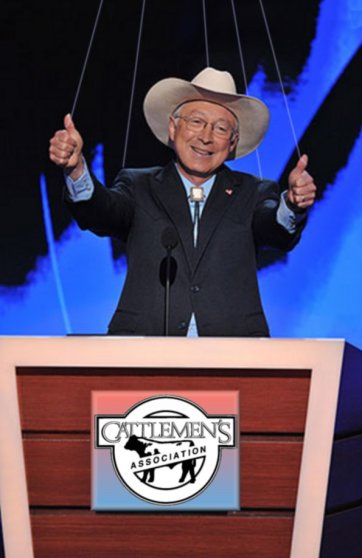
Salazar: Special Interest Puppet or BLM's Puppeteer?
The old adage goes, if you’ve dug yourself into a hole, your first step should be to throw away the shovel. The BLM apparently doesn’t see the logic in this bit of wisdom and instead of throwing away the shovel, they’ve called for a backhoe.
BLM’s handling of the Pryor Mountains (Cloud) gather on the heels of the West Douglas court decision started BLM’s slide down the slippery slope to disaster. The agency’s handling of their proposed Calico Mountains Complex roundup of some 2,700 horses will only add speed to BLM’s downward plunge.
While the Pryor Mountains gather brought BLM’s activities into the media spotlight, the Calico Mountains Complex may very well bring to the forefront the incredible levels of incompetence and arrogance involved in the agency’s overall wild horse management policies, priorities and activities. BLM’s announcement that the 10,000 plus comments it received from the public are irrelevant and that BLM District Manager Gene Seidlitz will sign a finding of “no significant impact” with respect to BLM’s roundup plans is pure political lunacy.
While some of the animosity towards the agency may be based on perception, BLM is nonetheless responsible for projecting the image that it is little more than a massive roundup machine on a never ending obsessive path of gobbling up horses in an operation fueled by huge amounts of our tax dollars. Instead of working with the various parties of interest and seeking some form of practical compromise, BLM’s arrogance has motivated thousands of American citizens, through the groups that these citizens support, to drag BLM into court and expose every flaw and act of misconduct that they can. If the Obama administration and Secretary of Interior Ken Salazar won’t straighten things out, very likely the public will as the groundswell of outrage continues to grow.
The unfortunate side to all of this is that some adjustment to the horse populations in the Calico Mountains Complex may be warranted. However BLM’s range data appears to be so unreliable and contradictory that the public has no confidence that they know what they are doing, or that the number of horses scheduled to be removed is justified. When BLM conducts itself as it recently has, the conflicts produced can be harmful to the horses, the range, other range users and the taxpayers.
In a previous editorial I called for the replacement of Secretary of Interior Ken Salazar. I did so because I perceived that he would entrench his agencies in a battle against the American public. This is exactly what appears to be happening. Such conduct is un-American and an embarrassment to the Obama Administration. However if Mr. Salazar and Mr. Obama don’t get it, the citizens and advocacy groups may just get their points across.
This is a completely unnecessary battle. However BLM created this situation and it’s up to BLM to take a new track and try to create a more cooperative range management environment. The agency’s first positive step would be to cancel the order for the backhoe.

![Reblog this post [with Zemanta]](https://i0.wp.com/img.zemanta.com/reblog_a.png)
Categories: The Force of the Horse, Wild Horses/Mustangs





 Straight from the Horse's Heart
Excellent!
LikeLike
What a tart assessment, Mr. Lamm! Wouldn’t it be nice if the BLM would understand this wholeheartedly and avoid further alienating the American public! Mar
LikeLike
Mar, yes, it would be nice also if Prsident Obama and his staff and cabinet, and congress realize how this alienates our trust in them as well. This continueing to allow this agency to not just business as usual, but to escalate it in the face of the will of public opinion, and then insult the public at the advisory boards, will only make everyone suspicisous of all thier other efforts as well –
public trust is easy to lose, winning elections is not so easy to do!
LikeLike
LAMB, my pardon, please?
LikeLike
Bravo! I see no need for the ongoing “battles” between the wild horse advocates and the BLM. We all want what is best for our public lands and our public horses. Right? I have always contended that there will be times when wild horse populations would need to be “managed”. But until reliable data is gathered and presented how can the public and government agencies trust each other? Perhaps arbitration is what is needed.
LikeLike
S 1570 ROAM – I have e-mailed as asked by Madeleine Pickens this week and will continue doing so everyday. And IF Roam does not go through I will continue e-mailing to them that “this has not gone away”, and I will continue filling thier heads with facts about their unproven facts, every day that I can.
LikeLike
I was just skimming through the ROAM act again. Section 5 (g) is pretty much what I’ve been going on about on the TCF blog. Getting motivated to get more horses in holding facilities adopted. I was looking for something about returning the horses in captivity to the range. Sec 5 (i)&(j) says they will be able to continue removing horses if needed. Is this part only for temporary removal?
LikeLike
kas, I believe the intent is that, if the advisory board included adequate wild horse biology and ecology represntation, that only emergency removals, based on real evidence and real science would happen. I believe if you read the 1971 act, removals are intended when needed. Perhaps they should have said
“when really needed”. A rational and educated group should be able to make those unbiased decisions. At this time we do not have a rational bunch anywhere involved in decision making or actions for the horses, or at least they are being instructed to conduct themselves irrationally.
Congresswoman Mary Landrue (spell?) has made a very strong statement about the adooption program, that the government itself should adopt a wild horse first for thier purposes before looking elsewhere as one point. I wish I could direct you, it was a tag to an approved GAO budget and is listed somewhere on TCF, perhaps here also. Another point about adoption, I have read so many reports of sd outcomes of adotpion, these horses have been so traumitized by humans in the rundup process, that they really need persons who can handle them, and they really need special training and desensitizing – See Gingers experiences with her wild horse.
I don’t believe the current S 1579 does specifically address returning already captive horses. But through other means advocates are working toward that end and, again, with a rational BLM (or perhaps other agency) and properly manned advisory staff one should be able to expect that would become one of their conclusions.
It has been asked and discussed if the captive horses could or should be returned, or perhaps that some would not survive. My personal answer, based on my current level of understanding is – that they are not actually surviving now with any quality of life, and even subjected to inhumane practices to take care of thier hooves and teeth (and some go missing over night to what most believe is the slaughter houses, no way to know – since there is no accountability or transparency).
So in my opinion, at least most should be returned (especially those that are not adoptable) and left to their natural fate, accompanied by the return of natural predation. I personally would not even mind if these particular horses were sterilized, if that is the ony way to get them out of prison – but perhaps other more knowledgable persons would provide a rebuttal to this (regarding herd dynamics, etc). There have also been questions should those born in captivity be considered wild? If they have not been domesticated yes, I believe they are wild.
One point to remember there are “self proclaimed” wild horse advocatees that are breeding Pryor horses as a “Rare” breed, and one of their statements was so that should something devastate the wild herd there would be stock to put back on the range. Though I personally believe the greater motive is greed, I could be wrong about this, so they can get more money for selling them. Someone else will perhaps provide direction to that report here, a while ago from Mary, and gets you to that Pryor horse breeders site – research the Rocky Mountain Wild Horse breed also.
Another point is that these were domesticated horses 500 years ago when the Spanish brought them back here, and 200 years ago again when Lewis and Clark brought them back – and they fit into the environment then, so whay not again?. Most currently in prison have been so only since the escalation started in 2002, 2003 (?) in answer to the Bush administration (see You Tubes “Bush, Oil, and Wild Horses”, the one with “Diane Stillman”, and “Robert Redford BLM”) so they have not been in captivity all that long, but if they were there longer, yes I beleive they should be returned to live or die in freedom. When you read the reports of those few personas who have actually seen the prisoned horses over the years, that particular special light in the eyes of the wild horse is just gone and has not been replaced with knowing love and partnershp from a human as the better off adopted ones now know. Anyway that is my speel.
But, I would leave those decisions to “REAL wild horse and ecology” scientists and biologists anyway, based on REAL science and REAL investigation, as you have so aptly called for on many occasions.
Perhaps S 1579 isn’t perfect, but, as IT understand it, it guts Burns pro slaughter legislation back out of the Wild Horse and Burro legislation, and it is what is on the table TODAY.
Geeze, I only seem to be able to write a book!
LikeLike
Roxy- If it takes a book to get some action then keep writing and writing and writing! I just hate to see the horses just standing around in corrals and even pastures with no quality of life. They are merely existing, not living. I guess the blessing if there was to be one, would be they don’t know what they are missing. I think what a miracle it would be to see them experience freedom, some of them for the first time! So we need to kick up our heals or plant our feet, whatever gets the job done! KEEP ON BUCKING!
LikeLike
Kas, Thanks – I keep promising myself to get better at checking typos. I actually have a blog program – better learn how to use that to check spelling – apologies to all for this lapse!
An yes, perhaps they don’t know what they are missing. I must admit I am more in tune with dogs than horses. I know dogs are only “in the moment” (Thanks Ceasar!).
So I’ll ask the rest of the group to repond to this, I am curiouse too – what is the knowledge about this from “wild horse bioligists”?
Are they just going along in an OK mode, or are they in “kennel depression” – because dogs, left in kennels too long without enough attention, can become very derpressed and some go nuts, as we have seen in some of the no kill shelters – the outcome is not good.
LikeLike
Sorry for the delay in response to your possible kennel depression theory. I have looked at hundreds of photos (as well as adoption event) of horses in BLM facilities. Some just seem to be “there”. Newer horses show excitement and interest in what’s going on in the pens next to them. But older inmates, just seem to stand and stare. Domestic horses look to their caregivers as friends and family for stimulation, wild ones have their own herds and families for companionship. I believe horses in long term confinement may very well lose their ability to bond, just like kids and dogs. This is just my theory.
LikeLike
I just can never get that article out of my head at the thousands of cheering, hope filled eyes of BLM and DOI employees as Salazar took the helm – thinking that a change was comming – as he proclaimed there was a new “Sherrif in Town”.
And, as much as I hold them all responsible, I can’t help but feel the real tragedy, a real sadness, for them all of how this has played out. Years ago I worked in a “hell” job – but it was never the job, I loved the “job”, it was the leadership and what the leadership allowed, even promoted, told us to do. It tears at ones soul.
What I want for Christmas is that all those employees will be blessed with what they had been hoping for – real change, that the Don Glenns ans Suzies will no longer have to tell those lies, and that all of our wild horses will be home one day soon – there will just be empty holding pens.
LikeLike