

by Lesa Jensen of CNN ~ Live Link
Wash Your Minds Out with This
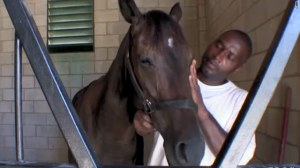
Click on Image to View Video
Sykesville, Maryland (CNN) — It’s the dirty little secret of the racing industry. Thoroughbreds who don’t make the winner’s circle, are injured or simply too old to race are discarded by their owners, auctioned off — sometimes to the slaughterhouse. Now these horses are getting new lives.
The twist? Prison inmates looking for their own second chances are helping save them.
In the rolling hills of Carroll County, Maryland, is Second Chance Farm. Alonzo Pickett leads a horse to the pasture to graze.
“Greek is a beautiful horse. I love him,” says Pickett. “I think he’s a gentle giant.”
The 7-year-old gelding came to the farm after a leg injury ended his racing career.
Each year thousands of racehorses in the United States like Greek are sent to slaughterhouses and their meat sold overseas, according to the nonprofit Thoroughbred Retirement Foundation. That’s why the foundation funds programs in eight prisons across the United States to rescue these abandoned horses and train prisoners to “gentle” them so they can be adopted.
The inmates also have duties beyond grooming the horses. They maintain the farm buildings and the grounds.
Pickett, 44, figures he has spent at least 14 years of his life behind bars. It is his third prison sentence, this time for drug possession.
“It could have been a lot worse,” he confides. “A lot of guys that I grew up with … are deceased.”
But Pickett maintains this will be his last time in prison and he thinks working with Greek as part of this program is what has changed him.
“It gave me a chance to really evaluate who I am,” he says.
“Everybody thinks it’s about the horses,” says Gary Maynard, Secretary of Public Safety for Maryland prisons. Maynard saw the benefits of the program in other prison systems where he worked and brought it here.
“It’s really about the men that work with the horses and what changes they go through as they learn to care for an animal, as they learn mutual trust and self-respect.”
The bond between Pickett and Greek is evident as the inmate gently prods the animal for grooming and softly speaks to him. Pickett calls the bond they share a mutual support system.
“I have a chance to face my obstacles head on and to overcome [them],” he says, and “[Greek] knows we are here for him … [that] we love him.”
Conni Swenson worked with racehorses many years ago before coming to work for the Maryland Department of Corrections. She is the program coordinator for Second Chance Farm and says she daily observes the unconditional acceptance the horses have for the inmates as each come to trust the other.
“They learn compassion. They learn patience,” says Swenson. “If you have a 150-pound gentleman and you have a 1,200-pound horse and you need the horse to do something, you’re not going to teach that horse to do it through brute force.”
There is a striking difference between the farm and the prison, where the inmates return each night. There are guards at the farm but no bars, no razor wire. Pickett notes the atmosphere of serenity at the farm, far from what he calls “negative conversations” at the prison.
“You look at these grounds, the meadows, the horses grazing in the field,” says Felicia Hinton, assistant commissioner, Maryland Department of Corrections. “It can only put gentleness inside of you,” she says, smiling. It’s her responsibility to make sure each inmate is ready to begin life outside the prison walls.
“It gives them a sense of humanity,” she says. Hinton calls the program an opportunity to change a life.
Pickett agrees. He will be released from prison in just a few months. He plans to move to his grandfather’s farm to care for his aging father.
“If I could come out here and take care of Greek every day,” he says, “then I can go home and take care of my father.”
Hinton considers that a measure of the success of the program. “Our responsibility is to send a man or woman out of prison a better person.”
As Pickett cleans and scrapes Greek’s hooves, he speaks with pride about his time at Second Chance Farm.
“I love the work and I love to know that I have a responsibility and they can depend on me for that responsibility being met.”
Swenson says she believes in each of the inmates who has gone through the program. She likes to quote visitors her favorite Winston Churchill passage, “There is something about the outside of a horse that is good for the inside of a man.”
“That is absolutely true here,” she says. “I see it every day.”
Related Articles
- Maryland Prison Inmates Volunteer Helping Abused Horses (huffingtonpost.com)
Categories: Equine Rescue, Horse Health





 Straight from the Horse's Heart
This is fantastic. I think I saw a TV programme about this place or one similar. It was very moving.
I have been trying in my way to get a better deal for ex racehorses for years. I loathe cruelty of any kind but especially to animals as they are innocent.
I also write to prisoners in Zambia as I know that people can change given the chance and we all need encouragement.
God Bless all involved in this project and all those who help to make lives better for both animals and people.
Best wishes
Abbie
LikeLike
This is a wonderful program. More and more, it is being understood the tremendous capacity for healing that comes from animals. Institutional prisoners healing one another.
LikeLike
Yes, in theory, this is great…but we also know from studies that most psycopaths start by abusing and killing animals..and not all criminals are salvagable…and their are statistics that prove they reoffend…what works for the normal person as therapy may not work in these cases..and i have serious concerns as to who gets access to these horses and do we ever hear if they do kill or abuse the animals in their care…the downside has too many consequences for the horses.
LikeLike
Well, I’m going to beg to differ on this, knowing a number of people who work with horses and people in therapy situations. There is no opportunity for offenders to harm these horses physically. If they even try to get rough with the horses, they’re out of the program. Period. And offenders are screened pretty carefully before entering this kind of program to begin with.
My larger concern is that some horses aren’t good candidates for coaching or counseling, yet some are put into emotionally stressful situations anyway. I’m particularly mindful of the emotional stress on horses, as I offer Equine Guided Learning as a coach. Most coaching clients don’t come with intense, therapy-level baggage, but I still keep my eyes open for anything that could cause my horses distress. So far I haven’t had an issue with emotional over-load with my horses.
LikeLike
Good point , Sandra. Nothing behind closed doors is safe. It does all sound good.
LikeLike
Problem is–most of the real psychopaths aren’t behind bars, yet. They are living the life of luxury.
LikeLike
Yep, at the BLM
LikeLike
I simply love thoroughbreds .My first equine rescue at 14 years old was an OTTB.I also owned and bought my first real horse myself with my own money.He was a Thoroughbred that lived to be 37 years old and is buried at my old farm in Massachusetts.The Thoroughbred Industry is ANTI-SLAUGHTER.The best TB breeders and trainers DO NOT send thier OTTB’s to slaughter.The OTTB;s that are sent to slaughter are made by the lowlife trainers, most come through Texas and are held at 1 of the 6 bordering feedlot areas before they are brutally butchered at 1 of the 3 Mexican butchershops.The Thoroughbred industry and the Jockey Club is remarkable in being the only leaders and innovative breeders of equines to publicy announce that they are ANTI-SLAUGHTER.Maybe some of the Quarter horse,Paints and arab breeders should take notice and stop breeding thier QH for horsemeat with intent to be killed.Gotta love my rescue tb’s and my personally owned Tb’s.Thoroughbreds are numero uno.The scumbags that send them to kill eventually get caught and are penalized by the Jockey Club.They mangae thier TB breeding programs very well with absolutely great incentive programs and they monitor where the TB’s go.God made the Thoroughbred as a fast,talented, regal,royal nobel majestic athelete,none can compare except maybe a warmblood is 2nd.LOVE My THOROUGHBREDS
LikeLike
This is a wonderful program – for the horses and the prisoners. We all know how much horses teach us, all of us. Horses heal.
LikeLike
There are many sociopaths that are never caught because they tend to be quite intelligent and crafty. They have no inner “governor,” but they are smart enough to keep that hidden most of the time.
Many are indeed in government. And then there’s Dave Cattoor.
LikeLike
Nora, you hit on a good point. The horses chosen for the program. That would take some real expertise. Most horses in these programs have already endured a great deal of stress or they wouldn’t be there is the first place. I know that the intent is good, yet I do worry about the horses. It takes collaberation between people who understand horses AND people who understand people.
LikeLike
collaboration–correction–funny how you don’t see it until you push the submit button.
LikeLike
Hi Kat,
Totally agree the good trainers, owners, breeders and most definitely those who actually look after racehorses do love them, and that is true the World over. I ceratinly do not crirticise them. But i do strongly dislike any scumbags who ill treat horses or indeed any animals! I hope and believe things are improving!
Don’t much care to see people being ill treated either. People can change. But yes care must be taken as some are evil and corrupt. I certainly would not like any animals to suffer because the measures taken to protect them are not stringent enough.
God Bless all those who truly love animals because the odds are they will love people too.
Best wishes
Abbie
LikeLike