

By Jerry Finch ~ President/Founder of Habitat for Horses
“The total economic value of a dead horse is zero.”
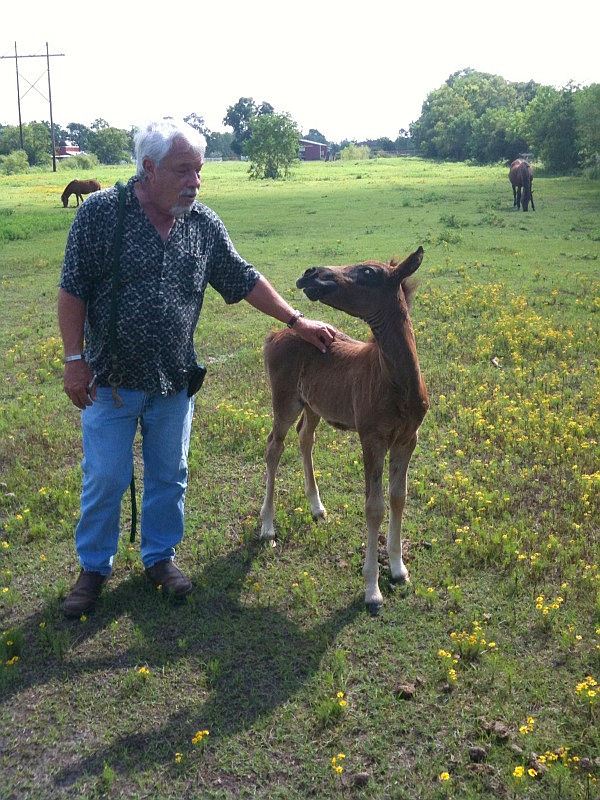
Jerry with baby Audi born at Habitat for Horses of a mare rescued from 3-Strikes – Photo by R.T. Fitch
Yesterday, myself and many others had a chance to testify before the Texas Senate Committee regarding the possibility of bringing back horse slaughter to Texas. The testimony stared at 1pm and lasted until around 6:30. If you want to watch the whole video, click here
http://www.senate.state.tx.us/avarchive/
Item 4, the horse slaughter part, starts at about 1:43 – just use the slider to move it to that time. The State uses Real Video to record these sessions.
I’ll have a lot of comments to make about this session, but I wanted to get this out to you as quickly as possible.
~~~~~~~~~~~~~~~~~~~~~~~~~~~~~~~~~~~~~~~
Senate Committee on Agriculture and Rural Affairs
Senator Craig Estes, Chairman
Tuesday, July 10, 2012
Testimony of Jerry Finch, Habitat for Horses:
Good afternoon. My name is Jerry Finch. I am President and Founder of
Habitat for Horses, Inc, a Non-profit Equine Protection Organization started in 1998 here in Texas.
I have been Involved in horses since 1958
I am a Level Three Equine Cruelty Investigator – receiving my training through the University of Missouri School of Law Enforcement
Since 1998, over 5,000 horses passed through the organization, averaging 350 incoming equine per year.
The majority of our horses come from various law enforcement agencies throughout Texas, from cases involving abuse, neglect and abandonment. Rehabilitated horses are returned to service by adoption, averaging around 340 horses per year.
Our primary goal is to provide education to horse owners on the best methods of care for their animals. By doing so, we have touched the lives of thousands of horses.
Habitat for Horses is accredited by the Global Federation of Animal Sanctuaries, an international organization that has established clear, specific standards for the humane care of equine and other species in captive facilities and for sanctuary governance and operational issues.
All of this is done on 100 acres in the Galveston area. We are in the process of purchasing an additional 600 acres to expand our operations.
Thank you for giving me the opportunity to speak with you today.
First, please note that I am not an ANIMAL RIGHTS RADICAL. I fully support the meat industry and work closely with any number of ranchers on equine welfare issues. While my organization is committed to the humane treatment of equine, the subject before this committee is about money, the dollars made from selling horses for slaughter – nothing more, nothing less.
Those who want horse slaughter to continue, either as an outlet for the over production of horses or to rid themselves of excess horses, are in a complete panic. The reason? If nothing changes, horse slaughter for human consumption comes to an end on July 31, 2013.
On that date, the regulations of the European Union will prevent the slaughter of American horses in both Mexico and Canada because of the complete lack of traceability of the medication given to American horses.
The report from the Government Accountability Office, GAO 11-228, states “…additional certification may affect Canadian and Mexican exports of horsemeat to Europe and, in turn, may affect the future export of horses intended for slaughter from the United States to these countries. For example, Canadian requirements went into effect on July, 2010, banning specific medications, such as phenylbutazone—the most common anti-inflammatory medication given to horses—and requiring a 180-day withdrawal period for other medications. Also, since November, 2009, Mexico has required an affidavit by transporters that horses have been free from certain medications for 180 days prior to shipment. Furthermore, effective July 31, 2013, the European Union will require lifetime medication records for all horses slaughtered in non-European Union countries before accepting imports of horsemeat from those countries.”
Translated, that means that without a complete passport system for horses in which ALL medication given to horses from birth to slaughter are entered into a massive database, the animals cannot be imported into the EU for human consumption. All EU horses sold for slaughter for human consumption now must have a passport. Without that passport, the horse will not be slaughtered.
The US has no such system in place, nor will we by July, 2013. Nor will the unsubstantiated 100,000 unwanted horses be accepted, because their history is unknown.
Currently, killer-buyers at the border are signing their own affidavits stating that the horses they present are drug free for a minimum of 180 days. Presently, 48% of those are accepted without any such statements, a violation of current EU regulations.
The establishment of a fully functional passport system in the US means that our government must spend massive amounts of taxpayer money on a National Identification System for equine, duplicating what now exist in the EU countries. I probably don’t need to remind this committee of the uproar over the Federal Government’s attempts at a National Animal Identification System. It failed when they attempted it before and it will fail again.
In that same GAO report is this recommendation: “Congress may wish to consider instituting an explicit ban on the domestic slaughter of horses and export of U.S. horses intended for slaughter in foreign countries.”
Asking a state full of horse owners to spend hundreds of dollars per animal, to register each animal and each premises into a National Database and to fine us for any failure to comply, in addition to asking taxpayers to fund another massive government system just so three foreign companies, namely Chevidico, Bovery and Richilieu can make a profit by selling horsemeat to consumers in Europe is absolute folly.
But that is the sole purpose of horse slaughter. There is no honorable attempt to help our country rid itself of unwanted horses. The numbers of horses sold for slaughter is determined by a demand for horsemeat in other countries, not the numbers of abandoned, neglected or abused horses. There is absolutely no relation between the two.
In fact, a USDA study conducted by Dr. Temple Grandin found that 92.3% of horses sent to slaughter are healthy. Slaughterhouses do not want and will not take thin, sickly horses. At the six Mexican Border Inspection Offices involved in imports of live horses from the US, 5,336 live horses in 631 consignments were rejected out of 62,560 animals presented for import between January and October 2010.
Over 5,000 horses were rejected in a brief eight month period. What happened to these horses? Are these the “abandoned” horses that are so often thrown out as an example of the need for slaughter?
If this committee’s goal is to Review the impact of state laws relating to the closure of horse slaughter facilities across the United States and Analyze the impact on the equine industry and agricultural sector of the Texas economy, then I ask that you consider these facts:
In a recent survey, 80% of the American people are opposed to the slaughter of horses for human consumption.
In a 2005 study for the American Horse Council, Deloitte Consulting found:
The horse industry in the United States contributes $39 billion in direct economic impact to the US economy and supports 1.4 million jobs on a full-time basis. When indirect and induced spending are included, the industry’s economic impact reaches $102 billion. The study also estimates the horse population in this country has reached 9.2 million. This was 7 years ago.
The total economic value of a dead horse is zero.
The costs to the American taxpayer to establish a fully functional National Horse Identification System will run into the millions and add another government department filled with inspectors, managers, programmers and database clerks to an already overburden budget. The return on the investment will be a few low paying jobs and a very negative environmental impact – except for the bottom line of those three foreign companies.
Those who are seeking to reverse the Texas law of 1949 forbidding the sale and transport of horsemeat are here because it means money in their pockets at the financial costs and against the wishes of those you represent.
I ask you to submit your report as finding that the re-establishment of horse slaughterhouses in Texas should not happen.
I am open to any questions either now or at any point in the future.
Thank you.
Click (HERE) to visit HfH and to Comment
Related articles
- Law Catches Up with Horse Slaughter Trafficker (rtfitchauthor.com)
- Breaking News: FRER Discovers Documented Efforts to Begin Horse Slaughter in Missouri (rtfitchauthor.com)
- Spread the Word: Members Push for Passage of American Horse Slaughter Act (rtfitchauthor.com)
- Horse Slaughter Increased 38% Over Past Year (rtfitchauthor.com)
- A Stroll Down “Horse Slaughter” Memory Lane (rtfitchauthor.com)
Categories: Horse News, Horse Slaughter





 Straight from the Horse's Heart
is that why they are rounding up and getting their greedy hands on the wild horses- because they are drug free so therefore eatable ??
LikeLike
WOW! What an excellent statement. Thank you Jerry Finch.
LikeLike
now THAT”S good reading!
LikeLike
Ditto!! EXCELLENT Testimony!!! VERY Well done!!
LikeLike
The truth has been spoken. Loudly. May the legislators hear it. Clearly. As Kathryn Baker said, “Thank you Jerry Finch.”
LikeLike
My daughter and I were at the meeting also. I’m sad to say that NONE of the folks I contacted attended the meeting. There was turn out from Ft. Worth-Dallas, and Houston, and Representatives from the East Coast. The moderator, Sen. Craig Estes, was exceptionally good. When the timers (each speech allowed 10 minutes. ) went off, he allowed the speaker to wind up with the important parts of his/her statement. Then a prepared transcript was handed in to him to be gone over later by the whole committee. I am assuming that, as by the time it reached Part #4 (the slaughter question) most of the senators were gone. So I just guess they will read the statements later. .that is the longest I have sat in one place for many years. Daughter says you can see me in the video. Front row center in green.
Oh, yes, they took cards that we filled out with our names and such and whether we were for or against the slaughter. Almost said hello to Jerry, but I felt he had enough on his mind.
LikeLike
Thank you Jerry Finch for setting the record straight!
LikeLike
God bless you, Jerry. And the horses of course. God bless.
LikeLike
It just doesn’t make sense for anyone to invest money now, when the whole thing could be over in a year. The only thing I can imagine is that if they get slaughter restarted they will start lobbying for a passport system in the US, because then it would involve financial hardships and loss of investments to stop it. And, my goodness, shouldn’t we feel more compassion for the EU owners of the slaughterhouses than we do for the horses?
LikeLike
Jerry has follow-up post on Habitat for Horses, and he’s discusses this question as well. WHY is this happening? As you and all of us know, it’s a terrible investment, what with the Moran Amendment pending, the national bills re-offered every year, 80% of American opposed, the EU going to stop accepting our horses in a year, the HSUS to file lawsuits the moment any permit is approved…. WHO would invest in such a thing? WHO is behind this mighty push that keeps going and going – who’s paying for all this? How can they ignore the EU’s shutdown?
I’m no conspiracy buff at all, but there must be more than meets the eye. Otherwise, it makes NO sense at all. We know one of the biggest spenders for lobbying against anti-slaughter legislation is the Cattlemen’s Beef Association. WHY? Slippery slope? Do they really believe that nonsense? That’s hard for me to believe.
LikeLike
One day when we were trying to meet with the AQHA (we really have tried to sit down with the opposition) I mentioned the stupidity of the “slippery slope” argument. The suits laughed and said they knew, but it was working. Charlie Stenholm keeps bringing it up – “Don’t let what happened to the horse processing industry happen to the rest of the meat industry.” They know, but they also play excellent poker and that’s all it is to them, a PR game.
LikeLike
Debbie Coffey asked the same question. We should ALL be asking these questions? More than 80% of Americans are opposed to Horse slaughrer. Where IS that money coming from?
http://ppjg.me/2012/02/22/horse-meat-snake-oil-salesmen-fool-cattle-ranchers/
Horse Meat “Snake Oil” Salesmen Fool Cattle Ranchers
Debbie Coffey PPJ GAZETTE
February 22, 2012
Cattlemen who fought against the USDA’s National Animal Identification System (NAIS) and thought they squelched it until the USDA revived it as Animal Disease Traceability (ADT) , are donating money to the United Horsemen and the International Equine Business Association (IEBA), which, ironically, seem to be bringing in NAIS/ADT through the back door.
These two new organizations, promoting the sale of horse meat, primarily to foreign countries, and the reinstatement of (probably foreign owned) horse slaughter plants in the United States, are muddying the waters by trying to tie this to property rights.
Let’s just grab this bull by the horns.
CACD is partners with the USDA, Forest Service, EPA (all partners of the IUCN, the International Union for the Conservation of Nature, which “links its mission” to Agenda 21) and the BLM. The BLM recently appointed Callie Hendrickson to their Wild Horse & Burro Advisory Board.
Retired Texas Congressman Charlie Stenholm, a lobbyist with the law firm Olsson, Frank & Weeda , will be a speaker at the Summit.
Last year, when Stenholm hollered “Lets feed China” during his Summit speech, did one patriotic American in the audience think about the implications of this? I mean, China owns about $1.1 trillion in U.S. bills, notes and bonds.
Stenholm’s firm also represents Biotechnology Industry Organization (BIO), whose member companies recently sponsored a big biotechnology convention in China and seem to be partnering with Chinese companies.
United Horsemen is apparently looking into “other innovative and cutting edge technological solutions” for development. Where are they getting the money to do this? About year ago, they couldn’t even collect enough money to buy a truck for a raffle.
LikeLike
Debbie connects more of the dots. She has a great many references at the base of her article, so you can see that she has done her homework:
http://ppjg.me/2012/02/22/horse-meat-snake-oil-salesmen-fool-cattle-ranchers/
Horse Meat “Snake Oil” Salesmen Fool Cattle Ranchers
Debbie Coffey PPJ GAZETTE
February 22, 2012
Stenholm’s firm also represents ESRI Contracts and Legal Services. ESRI seemed to be involved in the development of NAIS and offered to provide services for it. http://www.nonaiswa.org/wp-content/uploads/2009/01/nais-esri-gis-mapping-technology-2006.pdf
ESRI does the GIS mapping for the BLM (ArcGIS), other government agencies, and other countries. According to ESRI’s winter 2011/2012 newsletter, ArcNews, ArcGIS is even being used in Uruguay for Livestock Traceability.
Stenholm’s firm lobbies for the National Cattlemen’s Beef Association, Livestock Marketing Association, National Meat Association and the Professional Rodeo Cowboys Association while also lobbying for the Agriculture Geospatial Coalition, Texas Alliance of Energy Producers and Biotechnology Industry Organization, to name a few.
LikeLike
Its about time the cattle & sheep ranchers started to sit up & take notice – because they will be next – I would think if they paid attention to Stenholm’s agenda the light would begin to dawn that the horses indeed are like the canaries in the coal mines. If they disapproved of the ID system before – its time they took notice of things to come before they agree wholeheartedly with these horse killers.
I know this is reaching, (and I’m really dreaming here) certainly would be helpful if some of the independent cattlemen moved over to the RIGHT side, huh?
LikeLike
And with all the information above who is at the top of this conspiracy getting her hand greased? Why good old Sue Wallis, a representative paid by American tax payers, while using her position for personal gain. I ask when will we uphold the laws of this land, remove this shyster and prosecute this woman to the fullest extent of the law for corruption?
LikeLike
Excellent job done Jerry! May God always be with you in our journey to stop this madness!
LikeLike
Thank you, Jerry — I think all the speakers did a great job in covering the various issues and why slaughter just does not make sense. I was one of the three minute speakers, btw., and talked about the recent decision of two Canadian slaughter plants to refuse thoroughbreds due to drug histories. Hope to meet you again someday.
LikeLike
Hopefully the committee listened to these facts & figures loud and clear.
LikeLike
This needs to be posted here, where all of you can read it. It is a comment that was posted in THE ATLANTIC, under Andrew Cohen’s excellent article.
COMMENT:
Former Interior Department employee during the Reagan Administration, fifth generation rancher married to a fifth generation rather, Cheyenne, Wyoming, attorney Karen Budd-Falen is the author, or one of the main authors of H.R. 1996, an amendment to the Equal Access to Justice Act know originally as the Government Litigation Savings Act sponsored in the House by her Cheyenne compatriot and fellow fifth generation rancher and University of Wyoming Law School graduate Wyoming Representative Cynthia Lummis. Representative Lummis is known as the Representative who tried to offer an amendment during the House floor vote on the 2012 Agriculture Appropriations Bill that would have offered a way around the 1967’ 1969 Federal Meat Inspection Safety Act so that horses could be slaughtered by a fee for service plan. She walked out angrily when told to sit down before she caused the entire bill to fail. Representative Lummis also told Madeleine Pickens that she had nothing against wild horses, but that there were just too many of them on Public Lands, a statement that likely will still be true when the number of wild horses is only one.
Mrs. Budd-Falen’s bill would prohibit attorneys representing tax payers without a direct, personal financial interest in the outcome of the litigation against government from being able to receive compensation through the government’s fee shifting programs that is supposed to help citizens without the massive resources of the federal government, nonetheless, hold the government accountable when the government over-reaches its power, breaks the law, or acts incompetently. In order to receive compensation, the plaintiff must first prevail, of course. Mrs. Budd-Falen commented off-handedly to the audience at Wyoming state Representative Sue Wallis’s anti-wild horse/pro-horse slaughter/pro-puppy mill breeder Summit of the Horse in January 2011 that she had made a living for 22 years suing the government when the government was wrong.
So here we have a Wyoming attorney from a fifth generation rancher married to a fifth generation rancher whose family and their families of origin managed to build their family wealth at the public trough through ranching and farming subsidies as well as the fees she has been awarded through the Justice Act and the same EAJA that she would have Congress deny the very people who have contributed to her ability to build her wealth at least one of the rights that she has enjoyed. At first glance H. R. 1996 does not appear to have much to do with horses, but when the author talks about it as part of the overall strategy plan for ranchers to remove wild horses and burros from public lands and to support efforts to return domestic horse slaughter to our borders, the legislation gets an exclamation mark. For the record, Mrs. Budd-Falen’s appearance at the Summit of the Horse is not promoted, and her name was not listed on the video where she appeared. Like just about everything else involved with horse slaughter and the BLM’s mismanagement of our wild horses and burros, Mrs. Budd-Falen’s appearance involves some misdirection. An environmental lawyer who specializes in representing ranchers, Mrs. Budd-Falen is labeled as an attorney fighting against animal rights abuses. A curious observer wonders if this label is intended to mislead the audience at the casino where the meetings took place or the larger public. Of course, it is unlikely that the larger public would have been watching were Mrs. Budd-Falen not addressing the group. http://vimeo.com/19145473
Mrs. Budd-Falen’s father-in-law, Public Lands Council President John Falen, has successfully lobbied the House of Representatives to extend the length of years that grazing permits are issued for from ten years to twenty years without an accompanying increase in grazing fees.
We have such a thing in this country known as Congressional Oversight, but when it comes to the BLM, ranchers, and wild, free roaming horses and burros, effective oversight is nonexistent.
LikeLike
I did read Mr. Cohens article & the comments – So now the grazing permits will be issued for 20 years ? This is just wrong.
Its true – as far as these money grubbers are concerned one wild horse WOULD be too many…
These idiots wont be satisfied until the whole country is one big desert covered with gas & oil derricks AND in between a few uranium mines!!!
LikeLike
Thank you, Jerry Finch!
LikeLike
Fact is truth is the real answer and the truth is the horses are not intended for food! What a fantastic article one the news media should be covering. Thank You for all you do for the horses and our country!
LikeLike
http://news.yahoo.com/missouri-town-hopes-first-u-horse-slaughter-plant-225135573.html?_esi=1
This was on Yahoo today, does anyone know if it’s true? It sounds like a bunch of Sue Wallis’ lies, and who ever the reporter was, they stink, they didn’t bother to research or do any fact checking.
LikeLike
They have been articles about this “proposed” slaughter plant in MO for weeks, and all I have really seen is that Sue has filed for a permit and is griping because she’s had no answer from the USDA/FSIS. Personally, I think the USDA is stalling until either Congress makes up their collective minds or the EU stops taking our horses at the end of next July.
You KNOW SSue ain’t going to put HER money into something this shaky!
LikeLike
The USDA wouldn’t even be able to bring the equine slaughter industry up to compliance with EU standards by the deadline if they started tomorrow. Not a single one of all the `unwanted’ horses she claims slaughter will take care of will be able to be used for human consumption. Every time anybody asks a question about banned drugs or something, the standard answer is to quote some obscure study that only address withdrawal measures for competition horses. While traces of the drug may not read for competition level, the threat of carcinogens will remain forever. It doesn’t occur to her or any slaughter advocate that IF it was safe to consume animals that have had Bute or any of the banned drugs, they would not have these guidelines in place. It would be far more profitable and less labor intensive for everybody involved to just hold the horses in pens for the appropriate quarantine time and eat them all afterwards. The EU regulations are a logistical nightmare for NA slaughter houses and I have my doubts that Canada will mange to be in compliance by the deadline either. It’s a gong show on all fronts.
LikeLike
Agree. Canada has at least started, but the breeders hate it, and none of them seem to have a clue as to the importance of keeping stuff like bute out of the human food chain. It makes you wonder sometimes.
LikeLike
Thank you both for the responses. I guess I’m so sick of hearing more Wallis lies that I’m about to scream. Then when you read the article, which is word for word Wallis propaganda, and read the comments, and realize that some of these people buy into the lies…
LikeLike
Some do, or they’re in with her and post that stuff as shills for the horse slaughter industry. Since many of their posts are copy/paste Wallis too, it looks as if they are just mindless trolls.
LikeLike
Wish I could have attended. If not to support R.T and to further educate myself on the matter. not to mention how screwed up our politics are. ._. eh.. such is a game with out rules.. eh?
LikeLike
Is there a follow up to this story? What happen and what is the current situation on this? I have been told from a few in Austin that the votes will NOT be there come January so just wondered what y’all have heard!
LikeLike
More coming soon…
LikeLike