

Source: By John M. Glionna as published in the LA Times
“The agency removes horses, but you don’t see them taking cattle off the range,”
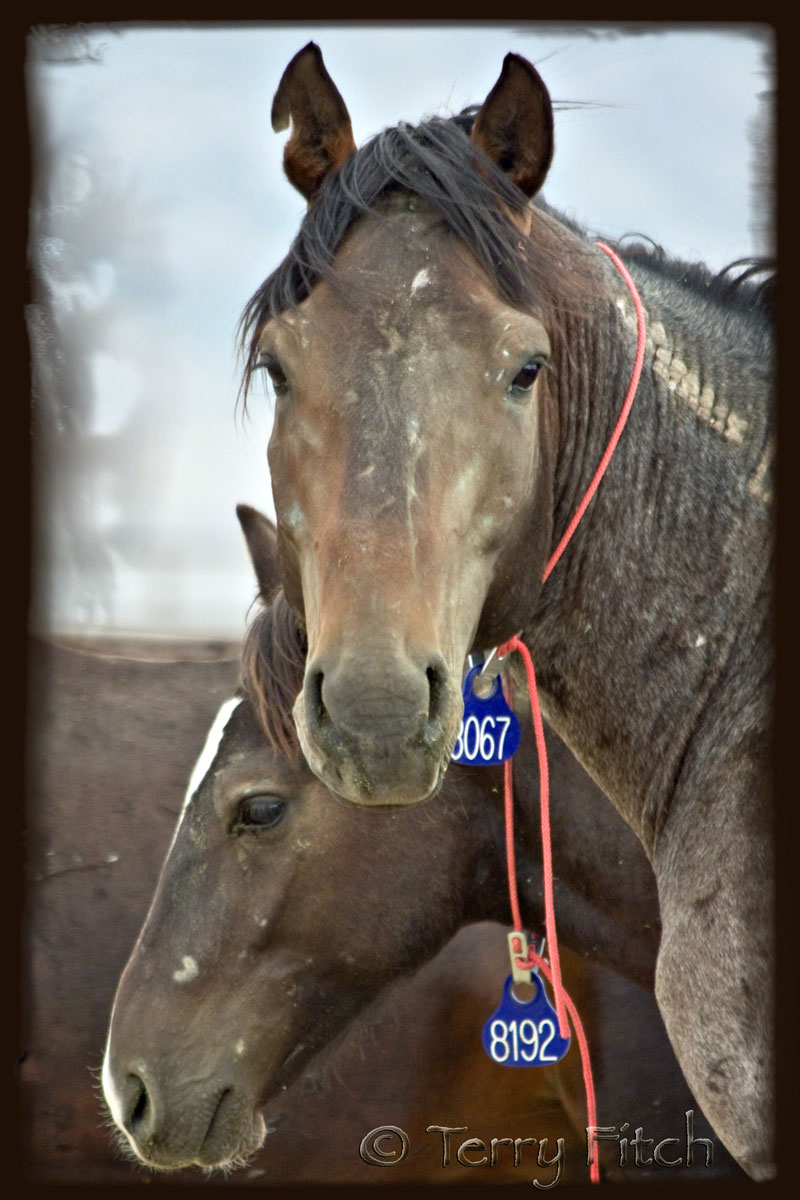
BLM Captives ~ by Terry Fitch of Wild Horse Freedom Federation
The gate swings open and the wild mustang rushes into the auction pen. Yearling by its side, the big mare paces the muddy floor, neck craning, nostrils flaring. Graceful creatures that have never known saddle or rider are now biddable commodities.
The unluckiest of America’s wild horses end up in places like this: a livestock yard in rural Nevada, where potential buyers coolly assess each animal’s physique, looking for a deal.
On this day, 23 mustangs that state officials removed from public rangeland outside Reno will have their fates determined in the crescent-shaped bidding theater.
A showdown looms. In the crowd are so-called kill buyers scouting product to ship to a foreign slaughterhouse. Also on hand are animal activists who, checkbook in hand, plan to outbid the kill buyers.
The mood is prison-yard tense, with armed state Department of Agriculture officers looking on. Sally Summers, an activist in Wrangler jeans and hiking boots, suspiciously eyes a well-known kill buyer named Zena Quinlan.
Then the auctioneer begins his racing beat.

The federal Bureau of Land Management says the mustang population is out of control. Activists say the BLM has scapegoated an animal whose poise and dignity make it a symbol of the West.
The two sides disagree on just about everything: on how to stem the growth of mustang herds, whether domestic cattle or wild horses do more damage to rangeland, whether mustangs are a native or invasive species.
Critics say the bureau bends to the interests of ranchers, who for generations have grazed their livestock on public lands leased for below-market cost.
“The agency removes horses, but you don’t see them taking cattle off the range,” said Bob Edwards, a former BLM Wild Horse and Burro Program official.
Officials counter that it’s the animal activists who are inflexible. When the BLM proposed gelding more males, activists sued, saying it robbed stallions of their spirit.
Each year the BLM rounds up thousands of mustangs — pintos and bays, roans and grays — and trucks them off to be readied for adoption or sent to fenced-in Midwestern tracts, where ranchers are paid by the government to house the horses for the rest of their lives.
The BLM estimates that 49,000 wild horses are held in such facilities. In 2012, holding costs of $42 million devoured more than half of the BLM’s $72-million budget for its horse and burro program.
About 31,500 remain on the range. On June 5, a panel from the National Academy of Sciences‘ National Research Council blasted the bureau’s emphasis on roundups as “expensive and unproductive.” The report called for more birth control — a vaccine for mares, chemical vasectomies for males — and urged the agency to show greater transparency in how it operates…(EXTENSIVELY CONTINUED)
Please click (HERE) to read the “rest of the story” at the LA Times and to Comment
Related Articles
- “Horse experts call for end of federal mustang roundups” (rtfitchauthor.com)
- Nevada Governor Sandoval signs landmark bill to work with wild horse advocates (rtfitchauthor.com)
Categories: Horse News, Horse Slaughter, Wild Burros, Wild Horses/Mustangs





 Straight from the Horse's Heart
As detestable as the BLM is in it’s extermination efforts of our wild horses and burros I think there has been some confusion in this story. The horses at this auction were wild horses from the Virginia Range which is state land not BLM land. These horses were not under the jurisdiction or protection of the federal government but the state of Nevada.
Since this auction took place major changes in the state of Nevada’s handling of their wild horses have been implemented. They are to be commended.
LikeLike
As a resident of Los Angeles, and a disgusted subscriber to the Times (supposedly under scrutiny for take-over by the notorious Koch brothers cartel) I was pleasantly surprised by the accuracy of this story and the fact that, for once, the BLM and its PR spin was not front and center. I would guess this story was assigned and written before the events with the state of Nevada. So many people are completely unaware of the federal agency doing anything with wild horses, it is always a coup to get any attention at all. By the way, Salazar’s photo is in the same issue today. He is tearing up some sand-dunes in a 4 wheel ATV in a contested area of desert habitat conservation called the Imperial Sand Dunes.
LikeLike