

Source: by Riley Johnson as published in the Lincoln Star Journal.com
“Today is not only ‘Feel Good Sunday’ but it is also ‘Draft Horse Sunday’! Sorry, there is a great, big, beautiful Belgian Draft TB Cross in our barn who is my new soul-mate so please allow me the pleasure of sharing some cool Draft horse stories with you.
First up is a print piece and then we slide on over to a video on the Budweiser Clydesdales.
Hope that all of you are doing well and enjoying your day of peace as tomorrow is another day and with the rise of the sun we are back in the battle to ensure the future safety and well being of our beloved equine companions. Keep the Faith my friends.” ~ R.T.
~~~~~~~~~~~~~~~~~~~~~~~~~~~~~~~~~~~~~~~~~~~~~~
“Across North America, draft horses help at about 400,000 farms…”
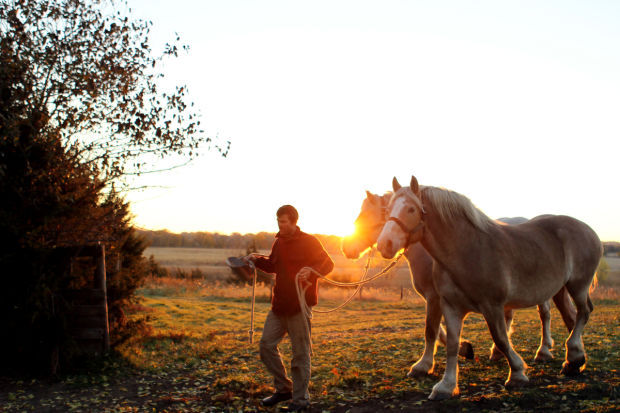
Alex McKiernan works with Duke and Duchess at Robinette Farms near Martell on Saturday, Nov. 2, 2013.
With the Saturday morning sun rising, Alex McKiernan guided draft horses Duchess and Duke up through the pasture, past rusted machinery and into the small stable on his farm near Martell.
The 13-year-old Belgian horses — weighing about a ton each — moved onto McKiernan’s farm Friday. The three still are getting acquainted: McKiernan with the horses and the horses with him.
“You’re going to have to start trusting ole Alex,” McKiernan told Duke as he brushed the gelding coat.
Built on budding trust, the 33-year-old and his wife, Chloe Diegel, will employ the draft horses to help them around their 40-acre vegetable farming operation known as Robinette Farms.
Across North America, draft horses help at about 400,000 farms in some capacity, Lynn Miller, editor of the Small Farmer’s Journal, told The New York Times earlier this year.
For Diegel and McKiernan, who didn’t grow up farming, Duke and Duchess provide them with soil-saving help for back-breaking work and allow the organic farmers to experience a bygone agricultural lifestyle.
“We don’t make a lot of money,” he said. “It’s a lifestyle choice for us.”
Surrounded by dwarfing 900-plus acre farms, Robinette’s organic operation grows a variety of vegetables ranging from parsnips and potatoes to beans and bok choy.
The two 17-hand-high horses will disc new fields this fall and help move water for animal chores and do “as much work as possible” during the winter, McKiernan said. That work should prepare the sandy-colored pair for their first big goal: helping weed the five acres where most of the vegetables are grown.
“They’ll free us up to do a lot of other things that are on our list but don’t get done,” said Diegel, 32.
But don’t confuse their move to hoof-power as a slam against machinery, they say. The farmers have a 50-horsepower John Deere tractor they’ve worked hard. They admit replacing that tractor with the horses will be difficult, but they plan to phase it out in the next few years as the horses’ ability to carry the workload grows.
They see the value of tractors on their neighbors’ large-scale farms. But McKiernan said he spends more time trying to start their other two Allis Chalmers tractors than they’re worth.
On their small-scale operation, tractor tires compact the dirt — and vegetable farming is hard enough on the soil already, he said. Horse power eases stress on the soil, he added, and horses help keep it fertile, too.
“What comes out of the rear ends of these guys can go on the field,” he said. “What comes out of the rear end of the tractor cannot.”
Not only that, but a farmer can’t develop a relationship with a tractor, he said.
“You can get a lot done with tractors,” he said. “But they’re loud and smelly, and you can’t get engaged with the machine.”
To aid their endeavor, Diegel and McKiernan launched a crowd-funding campaign to pay for their farm’s transition to horse power. So far, they’ve raised $17,187 of their $22,000 goal. The money would help them buy horse-driven equipment and pay for repairs to the stable. The campaign runs through Nov. 30, and donors can receive perks that top out with a lifetime membership to the farm’s produce.
Diegel and McKiernan don’t claim to be experts in horse-driven farming, and he doesn’t plan to sell the tractor just yet.
Saturday morning, McKiernan harnessed Duke and Duchess. He put on their bridles and tied them to his makeshift hitching post — a trailer hitch. Once settled, he untied them, backed them up and hitched them to a pull cart. They rode around the farm leisurely until Duke caught sight of the pigs.
“Duke, you gotta learn to like those pigs,” McKiernan said.
His wife of five years put it this way: “It’ll be a learning experience for everybody, and we’re ready.”
Click (HERE) to comment directly at the Journal Star
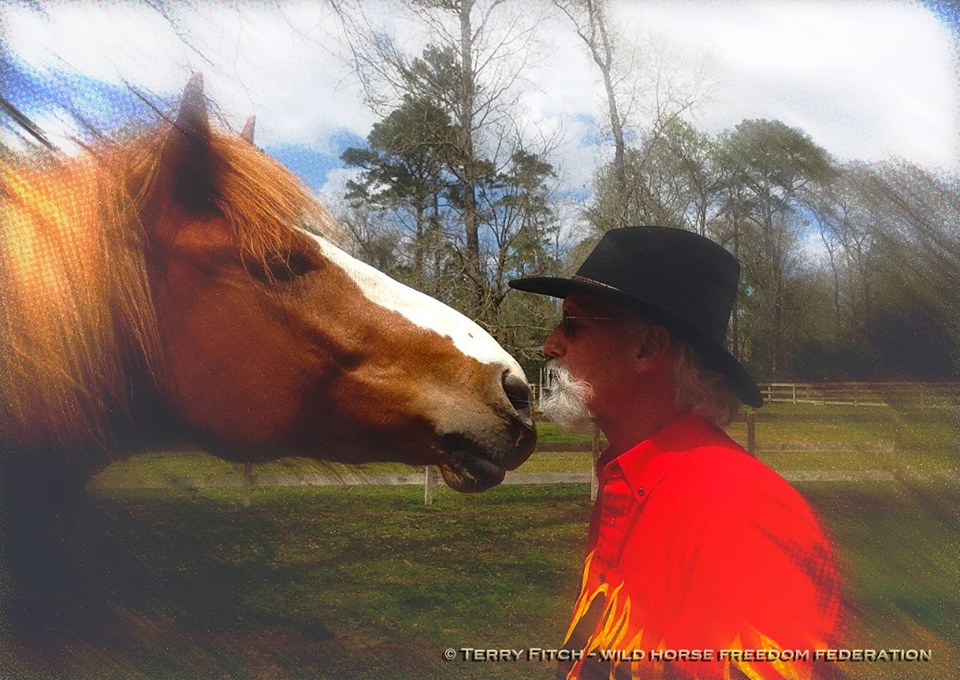
Moose and Me ~ photo by Terry Fitch of Wild Horse Freedom Federation
Categories: Horse News, The Force of the Horse





 Straight from the Horse's Heart
I know why its done, but I HATE they cut their tails.
LikeLike
From the AVMA on tail docking. Amazing that Belgium wants a ban, but not the U.S!
https://www.avma.org/KB/Resources/Backgrounders/Pages/Horse-Tail-Modifications-Backgrounder.aspx
LikeLike
My Moose’s tail is NOT docked. As one who is struggling to maintain what hair I have left I respect every single inch that either myself or anyone else can grow. Scissors are not my friends.
LikeLike
Horses over their life are just a little less fuel efficient as tractors. (calories equate to work be it diesel or hay). However come replacement time the scale tips in favor of horses because to manufacture a tractor takes quite a bit of energy. One reason they cost so much. In any case oil is finite and at some point this century it will be done. If we are to survive we better learn to live as we did before oil. BLM be careful what you wish for.
LikeLike
I researched this when I compiled SOLUTIONS TO THE EXCESS HORSE DILEMMA
~ Without Slaughter ~
“Economics of Farming with Horses – Career Cost of Horses versus Tractor” This is from 2005. Considering how costs have changed since then, I would think horses are even more valuable as traction animals for small to medium-sized farms.
http://ruralheritage.com/back_forty/economics_career.htm
LikeLike
For anyone who hasn’t read Solutions, shared it, or sent it to their legislators no matter what their position, there’s a link on this page.
http://hippies4horses.wordpress.com/2013/11/03/solutions-to-the-excess-horse-dilemma-without-slaughter/
LikeLike
I just realized I didn’t include horses as traction animals in Part I, but it will be included in Part II.
LikeLike
A song just for these big guys
LikeLike
Yay! What a great post – there’s no more natural way to farm, IMO.
LikeLike
Loved Both Of Them. Thanks RT.
LikeLike
Just please keep them out of auctions so they are not shipped alive or dead to Japan.
LikeLike
Years ago when I moved Chico to a different barn – there were more draft horses there than saddle horses. They were Belgians – pulling horses (yes, I do know the downside of that). But they were big, kind sweet boys and a joy to be around and were very well cared for. The owners put in an indoor and about 16 more stalls & the “big guys” owner got older, so they were sold. Its now a dressage & hunter-jumper barn. As you can tell, I guess, the first years we were there were just great. Was a wonderful place & my boy is buried there. We didn’t use the arena much- we rode on the trails. But the big horses will always occupy a warm place in my heart.
LikeLike
It was a nice story. I LOVE watching these BEAUTIFUL animals. I was wondering if they send any Clydesdale’s to slaughter? I watched video on them, they sure breed a lot. They can’t use all they breed, so where do they go? I got to see them when I was a kid, first moved to Vegas. They are magnificent. With so much on the slaughter issue, I wouldn’t make this company exempt from sending there excess to slaughter.
LikeLike
Priscilla, if something like that was ever discovered, the outrage it would create vs. the pittance they’d get would be a PR nightmare. This is where the retirees go: http://cs.thehorse.com/blogs/old-horses-better-with-age/archive/2012/09/17/this-bud-s-for-you.aspx Then you have the “actor types” in the Superbowl ads and other commercials. I doubt any of them, no matter what their age, end up “unwanted”.
LikeLike
Where do many of the draft horses go?
Learn about it here:
LikeLike
I LOVE the draft horses and have seen some in action – both ridden and with wagons. They are a beautiful “work of art”.
LikeLike
And a very sad, sick testament of meat for ANYTHING to eat.
LikeLike
Thanks for sharing
LikeLike