

SOURCE: azcentral.com
by
HEBER-OVERGAARD
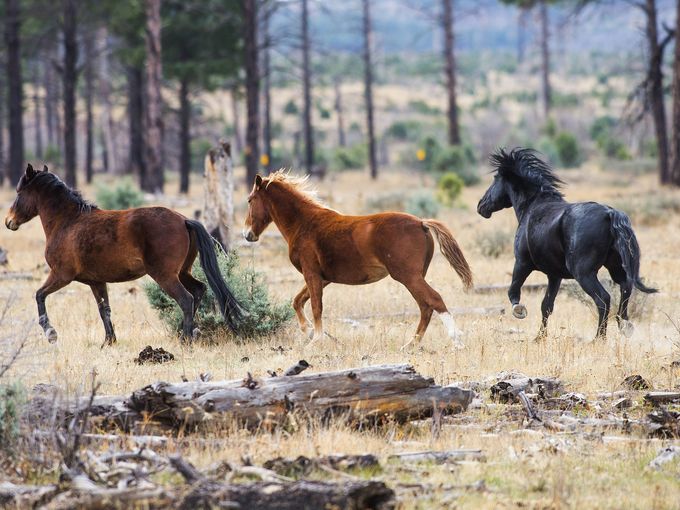
Three young chestnut, black and chocolate-colored stallions from the wild herd that roams the forest here spent a recent Friday morning lazing in a clearing, offering no clarity on where they came from.
The animals — known by their backers as the Heber wild horses — have drawn support from residents, visitors and an Arizona congressman who say they were born in the wild and should stay there as a federally protected symbol of the West.
But the U.S. Forest Service says few of the horses, whose exact herd size is under survey, are actually descended from the original free-roaming creatures. Instead, the agency argues that lost and abandoned horses have proliferated on public land to the point that the population needs to be controlled.
Rumors of a roundup have swirled in these small Navajo County communities on the Mogollon Rim, where about 2,800 people live. Trucks in the forest, helicopters overhead and unanswered questions led some to fear capture of the animals was imminent.
The Forest Service addressed those concerns in a public e-mail this month. The agency said that it’s developing a management strategy for the horses, but that a plan likely won’t be completed until at least 2016.
That’s little comfort for advocates who have fought for the horses before and say they are ready to do it again. A Facebook page started in June with photos and stories of the horses has more than 2,000 “likes” from animal-rights activists worldwide.
Mary Hauser, 61, printed red, white and blue fliers, reading, “THEY NEED OUR HELP!!!!” for the restaurant bulletin boards and shop doors here. Hauser, who has been tracking the horses for years, said she has distributed 500 fliers since September.
“Our American spirit spikes up,” she said.
Wild status
Horse advocates and the Forest Service disagree about the horses’ ancestry. Animal-rights groups took the agency to court over the issue in the early 2000s.
The federal Wild Free Roaming Horses and Burro Act — passed in 1971 to protect the animals from sale and slaughter by hunters and ranchers — led to the creation of the Heber Wild Horse Territory on about 20,000 acres in the Apache-Sitgreaves National Forests.
The Forest Service says the original wild herd likely no longer exists.
The seven horses recorded in the 1974 census dipped to two mares in 1993, according to the agency. It argues that federal protection under the act applies only to the original wild horses and their progeny — not the strays that currently live in the forest.
Wild horses are a genetic mix of the domestic breeds that once escaped from Spanish explorers, Western settlers, ranchers and Native American tribes. They’re not a native species but were determined by Congress to be an integral part of the landscape under the landmark federal act.
“Wild” is a legal status given to unbranded and unclaimed horses on public land.
All the free-roaming horses and burros on public land in 1971, when the act was passed, were designated as wild.
The U.S. Bureau of Land Management manages two herds in Arizona totaling about 200 wild horses, according to the agency’s website. The Forest Service also manages several horse and burro territories in the state.
The agencies have the authority to determine how many horses the land can support and whether the herd’s population is managing itself.
In some cases, federal agencies say, domestic horses enter the wild after escaping from or being abandoned by private owners.
“I would estimate a substantial portion of horses out there. … God knows where they came from,” said Ed de Steiguer, a University of Arizona professor and author of a book about the history and politics of wild horses in the U.S.
In 2002, the Forest Service says, the Rodeo-Chediski fire burned fences near Heber, allowing a large number of horses to wander from neighboring White Mountain Apache tribal land and other owners.
Many of them live on forest land not included in the horse territory, the agency said.
Without the legal status of a wild horse, the animals are treated as unauthorized livestock and are “subject to impoundment,” the agency told The Arizona Republic in a statement.
That was the basis of Forest Service plans in 2005 to gather about 120 trespass horses for relocation and sale. At the time, advocates estimated 300 to 400 horses lived on the forest land.
Activists took the agency to court, arguing the horses were descended from the original Heber herd.
Plans were halted under a 2007 settlement requiring the development of a Heber Wild Horse Territory management plan under the National Environmental Policy Act, which allows for public input.
U.S. Rep. Raúl Grijalva, D-Ariz., spoke about the horses that year during a speech in the House of Representatives. He called them “a most precious natural resource to be preserved for our children and grandchildren who will be able to see them for generations to come.”
The Forest Service says it was consumed with other land-management issues and recovering from the 2011 Wallow Fire, delaying work on the plan until now.
Grijalva said in an e-mail that the horses are a public asset and that he will be monitoring the management plan as it moves forward.
The Forest Service hasn’t proposed a roundup yet. But it did say in a statement to The Republic that the increase of horses has “created conflicts with other landowners and users” of the forest. Parts of the forest are also used for livestock grazing allotments and recreation.
Throughout the West, it’s still unclear what effect wild horses have on the land, de Steiguer said. But Heber advocates argue that there is plenty of space and grass for the herd.
“It’s like taking a drop of water out of a 5-gallon bucket,” said Robert Hutchison, who has lived in Overgaard for nearly 25 years.
On a recent drive through the forest, Mary Hauser spent nearly two hours before coming across the three young horses in the clearing.
“They have not trashed this place,” she said.
Still collecting data
A Forest Service team is still collecting population and environmental data and expects to complete its management plan by 2016.
Backers fear the agency will identify a limited number of horses to stay on the land and gather the rest for euthanasia or adoption.
Federal management of wild horses is controversial throughout the country.
The BLM estimates there are nearly 50,000 wild horses and burros on its land in 10 states. The Forest Service manages an additional 37 horse and burro territories.
The number of free-roaming wild horses and burros is already almost double the number the BLM has determined ideal for a healthy ecological balance. That’s not counting the nearly 50,000 captured wild horses and burros in corrals and pastures as of November, according to the agency.
There’s no long-term fertility vaccine to stop the growth of the free-roaming herds, BLM spokesman Tom Gorey said. The agency does use a short-term drug that lasts about a year.
And adoption rates are down, he added, straining the agency’s holding capacity.
The BLM rebuts claims of using inhumane practices to gather the horses and says it does not sell them to slaughter. But after an adopted horse’s title is transferred to the owner, the BLM no longer tracks the animal.
“There are a lot of success stories with adoption,” UA’s de Steiguer said. “There are a lot of unhappy stories, as well.”
But wild horses have few natural predators and spend most of their time eating and breeding, de Steiguer said. He added that herd populations can double in five years and that it’s likely that — if left unchecked — growth could lead to problems.
“It’s one of those wicked public-lands issues,” he said.
Attachment to Heber horses
The public has sentiment for free-roaming horses, wild or not, de Steiguer said. It gets more complicated when people identify with a specific herd.
Overgaard resident Donna Doss said she first remembers seeing the Heber horses during childhood hunting trips with her father.
“That’s an animal that’s part of Arizona history,” said Doss, 70, during her shift at the Lone Eagle Outdoor Shop. “I go out once a week to see them and the beauty of the freedom of them.”
Hauser frequently follows the washes, meadows and clearings where the “Magnificent Seven,” a band of male horses, and Old Buck, her personal favorite, spend their days. She said she has never touched or fed the horses but has seen births, deaths, fights and tender moments.
The Forest Service plan will be open for public input under the federal process. Advocates are collecting stories about the horses and searching for proof of how long they’ve been there to present to the agency.
“These are my horses, in my forest, on my land,” Hutchison said. “There are some stubborn people that are going to go to bat.”
Categories: Horse News, Wild Horses/Mustangs





 Straight from the Horse's Heart
Ye Gads!!!! Leave these horses alone!!!! There aren’t that many. Bothering noone!! Thanks to the Facebook, page, the word will spread.
LikeLike
“These aren’t wild horses”???? Just how many “lost or abandoned” horses can learn to exist with no human interaction? I find that whole argument really hard to believe. Just one more excuse to wipe out a herd of wild horses – per the Forest Service. Oh, and by the way, there are grazing allotments in that area – sound familiar?
LikeLike
IT DOES NOT MATTER. Wild is unclaimed and unbranded. Fight the distraction! There is only a need to manage domestic public land grazers and extractive industries. They’ve been managing this land for generatiojs – why 2016 for a deadline?? TO ALLOW spoilation and blame on the horses and other wild life, such as predators. Nevertheless, until then the work and reultant plan had better be Rules for repair and rehabilitation of the damage they do, the overgrazing and spoilation of OUR (including their’s but too ignorant and too stubborn to acknowledge) naturall world.
LikeLike
It should not matter, but unfortunately corrupt elected and appointed officials who want to control the natural resource wealth on western public lands snuck the exotic species listing into two treaties, two EO’s, one national invasive species plan linked to an international invasive species plan. The whole scheme can only succeed because our government presumes we are scientifically illiterate. US law says wild, but 42 thought we were dumb enough not to notice that most weeds don’t neigh.
LikeLike
De Steiguer (whose book I have read) may be right in declaring that “God knows” where these horses came from, since the author does not.
Even these today are “genetically equivalent” (per hard science) to the ancestral horses who originated in the Americas.
Claiming all wild horses are strays or descended from those introduced from Spain requires a great leap of faith, one I doubt their creator would endorse.
LikeLike
We always fight this wall. The wall that humans put up as “masters” of the universe. The humans did not invent any animal, now create any earth, gold or water. Everything we do is from borrowed resources and it shall all return when we are done. Living in tune with the Earth is our greatest challenge, and yet so many fight for the convenience of not living spiritually. It is sad, but it is a truism that those who know the TRUTH must lead. We must.
LikeLike
Doesnt matter where they have been , or why it only matters that they are !!!!!!!!!!!!
LikeLike
I WILL JUMP UP AND DOWN WHEN THIS FOREST SERVICE IS GONE AND IT SHOULD NOT BE TO LONG NOW. THEY ARE TRYING TO GET ALL THE HORSES SOLD OR SLAUGHTERED IT IS TOO LATE FOR THEM. WHAT THEY WON’T DO TO GET MONEY IN THEIR POCKETS.
LikeLike
There are some good advocates fighting to save these horses.
LikeLike
Never give up ! Save the wild horses & burro’s !
LikeLike
There are too many government agencies thinking they have the right to decimate our beautiful wild horses that are this Country’s icon. These are despicable agencies that have an agenda – leasing rights to cattlemen, etc. These ranges, these wild horses and burros BELONG TO THE AMERICAN PEOPLE. THEY DON’T BELONG TO THESE HORRIBLE AGENCIES AND THEIR EMPLOYEES. IT’S ABOUT TIME THAT WE, THE AMERICAN CITIZENS, DEMAND THAT OUR ICONS BE LEFT ALONE AND THESE AGENCIES BE DISMANTLED AND WE, THE AMERICAN PEOPLE AND THESE ANIMAL LOVERS, CONTROL THESE ANIMALS FATE, WHICH IS TO HAVE THEIR FAMILIES AND LIVES LEFT ALONE. NATURE WILL TAKE CARE OF THEIR SURVIVAL AS IT HAS DONE IN THE PAST, WITHOUT INTERFERENCE FROM MAN..
LikeLike
The Forest Service claims that these horses are not native will not stand up to scrutiny. The federal government does not have one single credible scientific authority to support this position invented by the US FWS, The Nature Conservancy, and the International Union for the Conservation of Nature and Natural Resources. It’s time that Congress brought in geneticists for a hearing like they did with a plant the FWS claimed was an endangered species found only in one stretch of highway. The geneticist determined that his was not even a species, but a not particularly unique or distinct subspecies representative of the species.
The USDA used a broken Internet link to two New Zealand universities for at least 13 months as its allegedly authentic source for alien, invasive species. Massey University’s web site states that this paragraph is for New Zealand only. The fact that this web site was broken and took the viewer to a silly web site where you could make up a species is just one of the ways the USDA attempted to deceive the American and global population about the origin of the horse. It is time that the USDA quit treating the American people as if we were too stupid to do a computer search for scholarly articles with threads that contain evidence with a high degree of probability.
CAST rejected a report on invasive species based on the precautionary principle co-authored by Al Gore’s favorite alien brain-trust in 2002. No person with scientific aptitude or educated in acceptable research documentation policies for research specific disciplines would accept what the federal government is asking the American people to swallow hook, line, and sinker. Any fact that contradicts common knowledge which the position USDA has taken on the horse, must provide an authentic source. It cannot be considered factual even if it is written by a person with scientific credentials—-particularly when discussing the eradication of the most important species in human history. This is beyond contempt.
LikeLike
Excellent! I totally agree. The reliance on acronyms (degrees) for authoritative knowledge is misplaced and has given power to those who abuse for their own gain.
It is our duty to take back that power and you have just done that.
LikeLike