

Source: Multiple
“BLM is crafting an exception Congress didn’t write.”
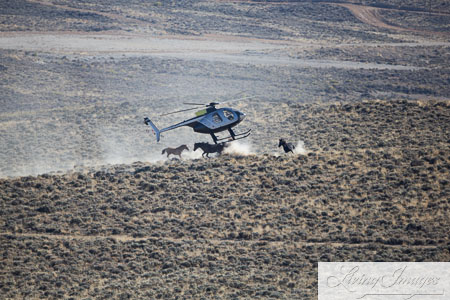
BLM terrorizing what’s left of Wyoming’s wild horses. ~ photo by Carol Walker of Wild Horse Freedom Federation
Attorneys argued Monday over whether a wild horse roundup on western Wyoming rangelands conducted last year complied with or violated federal law that carries different requirements for such roundups depending on whether the horses are on federal or private land.
The roundup of 1,263 horses in late September and early October occurred in what is called a Checkerboard, a vast area of sagebrush high desert named for its square-mile squares of private land interspersed with same-sized squares of public land.
Wild horse advocates from the Cloud Foundation and Carol Walker from Wild Horse Freedom Federation, who digitally documented the roundup, sued alleging the stampede violated laws including the Wild Free-Roaming Horses and Burros Act. The act requires the U.S. Bureau of Land Management to maintain wild horses on public land yet round them up from private land when asked to do so by private landowners.
Few fences exist in the vast Checkerboard area east and south of Rock Springs and wild horses crisscross the public-private boundaries at will.
The BLM violated the wild horse act first by failing to determine beforehand the area had too many horses and then by rounding up more horses than their herds’ pre-established minimum population thresholds, attorney William Eubanks told U.S. District Judge Nancy Freudenthal.
Both are requirements under the wild horse act for roundups on public land.
“There are few statutes which are as clear as the provisions in this statute are,” Eubanks said. “BLM is crafting an exception Congress didn’t write.”
He suggested the BLM could have carried out a roundup that met the requirements of the act and then released some horses outside the Checkerboard, but still within their herd management areas, to maintain the required minimum in each herd.
An attorney for the federal government argued the horse advocates’ case is moot because the roundup is over and done with and no further roundups in the Checkerboard are planned.
“Do we have a reasonable expectation we’re going to bump into this again? We don’t know,” attorney Coby Howell told Freudenthal.
He said the wild horse act doesn’t address what to do about wild horses in an area like the Checkerboard and suggested that horses rounded up and released could be back on private Checkerboard lands owned by the Rock Springs Grazing Association within days or even hours.
“He wants to capture those horses, move them a couple hundred yards and turn them loose,” Howell said of Eubanks’ argument.
Not so — the BLM could release rounded-up horses up to 70 miles away from any private lands, Eubanks said on rebuttal.
The grazing association, a ranchers group, sued in 2011 to force the BLM to remove all wild horses from the association’s lands, including the Checkerboard lands, in accordance with the wild horse and burro act. The BLM resolved the lawsuit by generally agreeing to the demands.
Now the grazing association and state of Wyoming have intervened in the case on the federal government’s side. Disputes between the BLM and association over wild horses in the Checkerboard date to the 1970s. In 1981, they were resolved, at least temporarily, by a federal judge’s order that applied to horses on both public and private lands in the Checkerboard, pointed out grazing association attorney Connie Brooks.
“You could argue that BLM should have redone the agreement but that’s not what was done,” Brooks told Freudenthal.
Freudenthal took the arguments under advisement and will rule later.
Categories: Horse News, Wild Horses/Mustangs







May I add:
Are all of those captured wild horses dead?
If not, then the case is not moot.
BLM has records that could “today” find all of those wild horses and they could be returned to their legal land – be it in Wyoming or otherwise.
I am aware that multiple-use is part of the BLM’s mission but I am also aware that it is legal and legally required to remove private livestock if it will protect the wild horses and burros – which is the law.
As made clear by the Wild Horse and Burro Act’s implementing regulations, the BLM “may close appropriate areas of the public lands to grazing use by all or a particular kind of livestock . . . if necessary to provide habitat for wild horses or burros, to implement herd management actions, or to protect wild horses or burros from disease, harassment or injury.” 43 C.F.R. § 4710.5(a).
https://www.law.cornell.edu/cfr/text/43/4710.5
LikeLike
And do you think the BLM even understands anything about regulations? They are planning another roundup in what is called the Red Desert Complex area between Lander and Rawlins in Wyoming. Mainly because a few of the horses wander onto private land that is not fenced off. The area is so big that all they would have to is move those out in the middle of the hma area to solve the so called problem!
LikeLike
Wyoming is supposedly a FENCE OUT state.
LikeLike
A few days ago in Arizona:
“The court took a close look at the record and determined that BLM had not adequately explained or provided scientific support for its determination that grazing was not causing harm…”
http://us8.campaign-archive2.com/?u=dd756eff39647fa96ffa30f16&id=184febd1e3&e=6e4c0e0ad3
LikeLike
Yea!!!! This is one of the big weaknesses and absolutely bizarre elements of the exotic species theory. Of course, the horse is not exotic, but this entire theory was taken from NAZI Germany when the NAZI’S discovered Russian impatient growing in their forests. They were at war with Russia and they saw the flowers as invading Bolsheviks. Since the IUCN and The Nature Conservancy have European roots, this helps to explain how this whacko theory—never proven, and in the case of the horse, disproven—any disturbance to soil or plants is not permanent and this has been proven again and again. However, millions of dollars have been spent trying to sell this, and every effort has been made to get this into the text books of school children—which is why it is so important that we find scientifically principled leaders. I don’t mean people that use science for political purposes, but people who will find experts who can explain the science and show research like the House did when it hired a plant geneticist to testify whether a plant was a rare, endangered species or a run-of-the-mill subspecies.
LikeLike
WHY and HOW is it that this is being brought before the same judge that allowed the roundup in the first place?
There appears to be disturbing conflict of interests here.
http://www.wywf.org/nancyfreudenthal.html
Energy and environmental issues have been Freudenthal’s catalyst for thought. She was a partner in the law firm of Davis & Canon before being nominated to federal judgeship.
Perhaps the most notorious tidbit of her career springs from partnerships. Her husband, Governor Dave Freudenthal, nominated her along with two others to President Barack Obama for the position of federal judge for the United States District Court of the District Court Wyoming with the missive that “I thought about that long and hard, and the question really came down to (was) should she be penalized for having married me.”
LikeLike
Who nominated her?
LikeLike
How the Department of the Interior Sold Out America’s Wild Horses
A federal judge in Wyoming is now reviewing a dubious agreement between local ranchers and the BLM that would eliminate millions of acres of wild horse habitat.
http://www.theatlantic.com/national/archive/2013/03/how-the-department-of-the-interior-sold-out-americas-wild-horses/274159/
The former governor is no friend to the wild horses http://www.leg.state.nv.us/74th/Interim_Agendas_Minutes_Exhibits/Exhibits/Lands/E102407Q-1.pdf
LikeLike
The creation of a checkerboard or the failure to modify the checkerboard years ago which is a mistake that human managers made, not the horses, is a curious thing. If this is land between Rock Springs and the Utah and the Colorado borders, it is possible that the grazing association has planned for a very long time to hold onto this land. Is there a public list of the members of the Rock Springs Grazing Association. There are corporate energy interests tied to at least parts of this away. However, the horses don’t need to be completely removed from the area in order for the extractible energy to be accessed. Horses adapt. I think these people are trying to violate the Act and have planned to violate the Act, but don’t want too many people to understand what they are doing and why they are doing it.
LikeLike
INTERESTING information in the LAST paragraph
(Rachel’s comment in answer to a question from one of her readers):
Rachel Reeves Photography
An Open Letter to the BLM Regarding their Consent Decree with the RSGA
reevesimagery says:
This particular area is a little different than other herd management areas. In the mid-1800s the government came up with this bass ackwards plan to give the Union Pacific every other square mile of land for 20 miles north and south of railroad. So half of the land these horses/livestock graze on public and the other half is private.You would think that this would balance out since neither side can keep their animals out and they all freely wander between the public and private.
The RSGA agreed during their first lawsuit against the wild horses in the 1981 to allow a number of wild horses in this region. They are now withdrawing that agreement, saying the BLM hasn’t held up their end of the bargain because the BLM has not removed enough wild horses to keep them satisfied.
This may not sound unreasonable to the non-wild horse fan *but* there is one other interesting aspect of this. Very little of the land in this area is owned by members of the RSGA.
Most of it is owned by the Anadarko Petroleum Corporation. So even the private land is land that the RSGA members lease. It doesn’t belong to them. They just think that it does.
LikeLiked by 1 person
Connecting the Dot$
Rock Springs Field Office NEPA Documents
http://www.blm.gov/wy/st/en/info/NEPA/documents/rsfo.html
Great Divide Basin HMA Wild Horse Gather – 12/06/13
Click to access FONSI.pdf
FINDING OF NO SIGNIFICANT IMPACT December 19, 2013
Bureau of Land Management
Rock Springs Field Office
Project Title: Monell-Arch Units Oil and Gas Development
Under the Proposed Act, AP will develop up to 125 wells over 9 years: 105 oil wells, 18 carbon dioxide injector wells and 2 water injection wells.
The total well life would be approximately 30 years. Drilling operations would utilize a combination of vertical and directional techniques, as appropriate, and all producing wells would be hydraulically fractured.
Anadarko Petrouleum Corporation (APC) proposes to develop new oil and gas wells in the Monell and Arch units, approximately 31 miles east of Rock Springs in Sweetwater County, Wyoming.
Click to access EA3.pdf
Monell/Arch Units Oil and Gas Development EA
Oil and Natural Gas. The Monell and Arch units are located in an area with abundant oil and natural gas resources. The Greater Green River Basin is estimated to contain undiscovered resources of 84 trillion cubic feet of natural gas and 131 million barrels of oil (USGS 2002). The proposed project is located in the vicinity of several oil and gas fields, which are listed in Table 3-2.
3.4 Water Resources
This section addresses surface water and groundwater resources that may be affected by the proposed Monell and Arch Units Project. The assessment of potential impacts to these resources was based on desktop analyses of existing information.
3.14.2 Wild Horse Herd Management Areas
The portion of the project area that is within the Rock Springs Grazing Allotment ALSO OVERLAPS WITH THE SALT WELLS CREEK HERD MANAGEMENT AREA (HMA).
LikeLike
Protection of the Wild Horses and Burros is of great concern to the American people. The Cattle Ranchers should be responsible for keeping cattle on their own land. That they pay for and fence in!!! The American People are not interested in Tax Dollars funding the Cattlemen’s interest and inhumane treatment of America’s Wild Horses!
LikeLike
Thank you and thank all new and old (this has nothing to do with our age!) commentors and true wild horse spokespeople – we learn from each other and ignorance is NOT bliss.
LikeLike
How the Department of the Interior Sold Out America’s Wild Horses
http://www.theatlantic.com/national/archive/2013/03/how-the-department-of-the-interior-sold-out-americas-wild-horses/274159/
The last word here goes to Lloyd Eisenhauer, born and raised in Wyoming, still a resident there, and a former BLM official with direct and extensive knowledge of the conditions in Sweetwater County as well as the relationship between the wild horses of the Checkerboard and the ranchers and livestock operators in the southern part of the state. In opposing the Consent Decree,
Eisenhauer swore an affidavit which ought to be the first thing that Judge Freudenthal reads as she decides what to do here.
Judge Freudenthal should not accept this backroom deal between regulators and those they purport to regulate. She should not accept the fruits of a deal from a lawsuit the government itself invited. The horses deserve better. And the rule of law demands more.
LikeLike
I hope that this judge acts impartially…her husband is the ex-governor of Wyoming and has many friends in the ranching community. Just sayin’.
LikeLike
I filed an Appeal to the IBLA in this WY Checkerboard case. IBLA responded and named me an Appellant. So, I (like Borba in the NV Fish Creek case) am a named Appellant in this Checkerboard case. My time is tolling pending resolution of AWHPC. I have no Lawyer and no money just a golden Opportunity which may well fall by the wayside unless i get some help.
LikeLike