

SOURCE: KATC.com
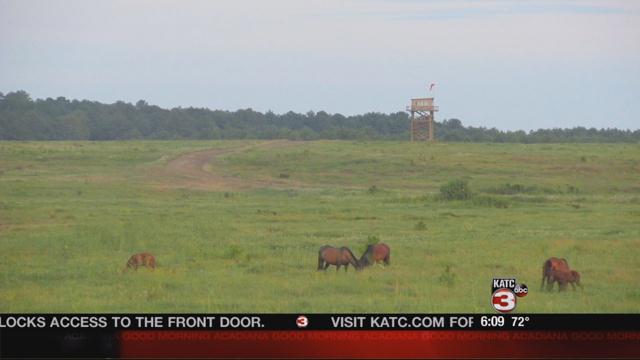
Horses at Kisatchie National Forest
by
Amy Hanchey has been fighting for months to make sure the hundreds of wild horses that roam Kisatchie National Forest in north Louisiana stay there.
“There are generations of horses that are truly wild and lived in that wilderness…it’s a matter of ethics.”
Hanchey, along with many others fighting for the same cause, they claim the horses are descendants of Calvary Horses from World War II.
“The Second Calvary was enacted at Fort Polk or Camp Polk and they let the horses go once the war was over,” Hanchey explained.
But—with no paperwork backing them up…army officials said there is no way to prove that these horses are descendants of the 2nd Calvary.
The Army believes that the majority of these horses have actually been abandoned in the forest.
“I think it would take a DNA test and I’m sure there are veterinarians out there that can provide that kind of test and potentially tie them back,” Hanchey said. “Even if they’re not, if we can’t prove it for whatever reason, it’s still a matter of—the fact that these horses have been able to live there self-sustained for 70 plus years.”
Despite being a part of Kisatchie for 75 years —army officials said the horses are now ‘trespassing’ on their land.
“We try to base everything that we do on fact as well as examine the situation through multiple eyes and come to the right conclusion as to what we do with this problem,” Col. David Athey said.
But even if the Army ultimately decides to remove these horses—Hanchey questions how long it will be before they are back again discussing the same issue.
“Even if they remove the horses what measures are they going to put in place to prevent the community from dumping their horses there? That’s part of the problem as to why there are so many horses.”
A decision will not be made until January.
Categories: Horse News, Wild Horses/Mustangs





 Straight from the Horse's Heart
What a crock of crap all this is , yet they keep on making us go to court and the courts keep letting them gather wild horses any way , horses are the most mis -handled animals in the world, they have rights and they keep having them taken away from them by the government…..BLM is a horrible group who hate the horses, not take care of them the right way they can’t even count proper..
LikeLike
US cavalry horses in Louisiana -1941
http://www.sfasu.edu/heritagecenter/9246.asp
LikeLiked by 1 person
21 Cavalry photos – these horses deserve to live free
http://www.horsenation.com/2013/07/25/18-cavalry-photos-you-have-to-see-to-believe
LikeLiked by 1 person
Very interesting, Geri. Thanks for sharing….they truly are incredible animals that will do anything to please.
LikeLike
Thanks, geri.
LikeLike
Czechs deploy wild horses from Britain to save biodiversity
Originally published March 23, 2015
http://www.seattletimes.com/nation-world/czechs-deploy-wild-horses-from-britain-to-save-biodiversity/
By KAREL JANICEK
The Associated Press
MILOVICE, Czech Republic (AP) – Twenty-five years ago it was a military zone where occupying Soviet troops held exercises. Today it’s a sanctuary inhabited by wild animals that scientists hope will improve biodiversity among local plants as well as save endangered species.
“Alternatives to wild animals are very expensive and their impact on the environment is not very good,” Dostal said.
Domestic animals such as sheep were ruled out because they would feed on the endangered plants, and mechanical cutting costs too much.
“(The horses) will move freely on the pastures the whole year. If they have a source of water and enough space, they don’t need any care. They are able to care of themselves,” Dostal said.
Environmentalists are already planning to expand the territory and use other big-hoofed animals such as European bison.
The Soviet army that stayed after the 1968 Soviet-led invasion of then-Czechoslovakia was the last armed force in the area. Dostal said the soldiers’ activities actually simulated the impact of hoofed animals, a reason why “military zones in the Czech Republic are the places with the best biodiversity.”
LikeLike
Stop messing things up!!!!!!
LikeLike
There has to be historical records either at the fort, locally, or even in DC that substantiates the release of the calvary horses into the forests. Even personal historical diaries of local people maybe at local and state historical societies that may document the history. I know it is a lot of reading, fact gathering, and time consuming, but, it may be the important link to saving the horses and leaving them where they are. The elderly love to spend time volunteering for projects such as this research would require. Just a thought. There maybe 70 years of history there worth saving. But, who am I to say. I have a BA in History, so preserving history is important to me.
LikeLike
Fort Polk’s Historic Cavalry War Horse Herd Guardians
http://www.petition2congress.com/18445/fort-polk-descendants-wwii-cavalry-horses-in-immediate-danger
LikeLike
Once again, thanks, Louie – commented and signed!
LikeLike
This is a small excerpt from an excellent article complete with old photos
Horse Tales of the US Cavalry in Louisiana -1941
http://www.sfasu.edu/heritagecenter/9246.asp
By Rickey Robertson
There are literally thousands of stories that have come from the local folks throughout Louisiana concerning the Great Louisiana Maneuvers. Even today, when visiting with the old timers, just sitting on the porch drinking coffee with them, invariably the conversation will come up about the Louisiana Maneuvers. The rural inhabitants of this section of Louisiana could not comprehend the vast number of troops and vehicles that invaded them during the maneuvers. One thing they all remember is the magnificent cavalry horses that were used by the mounted units and the big Missouri mules used by the field artillery units. B.D. (Bud) Robertson tells a story of a beautiful cavalry horse coming up the lane to their farm late one afternoon. The horse was running lickety-split, as fast as he could go, without a rider, but with full cavalry gear on him. Sometime later a dusty cavalryman, obviously a “Yankee” (who had no knowledge of the South or its insects) came trudging up and asked if his horse had came by and was told that it had. He replied that he had tied his horse to some bushes and that all of a sudden it was covered by “little yellow flies”, which made his horse run away. Little did he know that he had stopped and dismounted on a yellow jacket nest and these little insects had stung his horse and made it run off ! Later in the day he came trudging back with his mount in tow.
LikeLike