

Source: Bloomberg
The fight over preserving public land during the Trump era is taking a strange, angry twist in Montana’s Crazy Mountains. Both sides are armed.
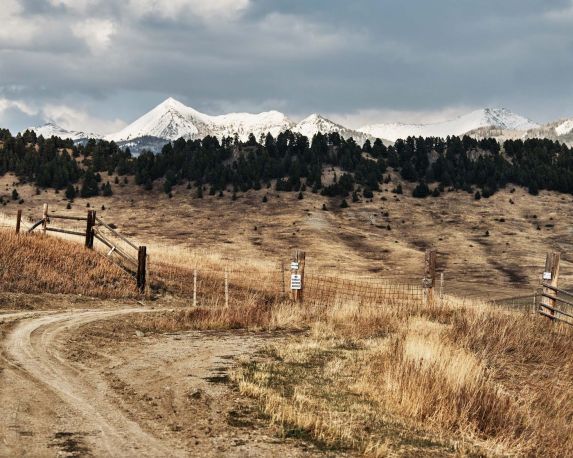
In Park County, Mont., North Fork of Horse Creek Road with a “No Forest Service Access” sign. Photographer: THOMAS PRIOR FOR BLOOMBERG BUSINESSWEEK
Brad Wilson is following a forest trail and scanning the dusky spaces between the fir trees for signs of movement. The black handle of a .44 Magnum juts prominently from his pack. If he stumbles on a startled bear at close range, the retired sheriff’s deputy wants to know the gun is within quick reach, in case something stronger than pepper spray is needed. Wilson isn’t the type who likes to take chances; he’s the type who plans ahead.
Before setting foot on this path, he unfolded a huge U.S. Forest Service map and reviewed the route, Trail 267. He put a finger at the trailhead, which was next to a ranger’s station, then traced its meandering path into the Crazy Mountains, a chain in south-central Montana that’s part of the northern Rockies. Like many of the trails and roads that lead into U.S. Forest Service land, Trail 267 twists in and out of private properties. These sorts of paths have been used as access points for decades, but “No Trespassing” signs are popping up on them with increasing frequency, along with visitors’ logs in which hikers, hunters, and Forest Service workers are instructed to sign their names, tacitly acknowledging that the trail is private and that permission for its use was granted at the private landowners’ discretion.
Wilson hates the signs and the logbooks, interpreting them as underhanded attempts by a handful of ranchers to dictate who gets to enter federal property adjacent to their own. Several of the owners operate commercial hunting businesses or rental cabins; by controlling the points of ingress to public wilderness, Wilson says, they could effectively turn tens of thousands of acres of federal land into extensions of their own ranches. That would allow them to charge thousands of dollars per day for exclusive access, while turning away anyone—hikers, anglers, bikers, hunters, locals like Wilson, or even forest rangers—who didn’t strike a deal.
Categories: Uncategorized






 Straight from the Horse's Heart
The article states, “public land management is being filled by cronyism that rewards wealth and connections above all else.” What an understatement!
LikeLike
While these are complicated issues all around, the last paragraph is very telling:
“But this past July, while public land advocates were protesting the Interior Department’s pending move to downsize the national monuments and hikers were cursing the new No Trespassing signs in the Crazies, Zinke traveled to Denver to speak at the annual conference of the American Legislative Exchange Council, or ALEC. The group, a conservative lobbying coalition that helps lawmakers draft legislative proposals, has energetically pushed for the potential transfer of federal lands to the states. Whether Zinke’s speech clarified the government’s general, overarching philosophy on public-vs.-private control of lands that are currently federal, only members of the lobbying group can say for sure. Unlike several other speeches delivered at the conference, Zinke’s wasn’t transcribed or published, and it was closed to the general public.”
Sounds a lot like what happened at the “summit” in Salt Lake City this summer.
LikeLike
We, US taxpayers, are now being treated as though we don’t deserve to be privy to or informed of information that pertains to OUR public (at least for the moment) lands – oh yeah, I keep forgetting – we’re just the little people! Who incidentally, pay these characters! Apparently that no longer matters.
LikeLike
Agreed. Why should we pay for Zinke to be privately lobbied with no public accountability, especially when he offers no similar public accessibility. Wonder what it cost to fly to Denver, for instance, and who paid for it. Not sure if it’s worse that taxpayers paid for it, or lobbyists.
LikeLike