

by Lauren Frayer as published in Parellels
“Our idea is to just let them manage the ecosystem themselves. It’s a wild horse…”
“We blogged this article two days ago because we felt that it brought to light the realization of other countries regretting the loss of their native wild horses while our “Great Government” continues to manage our wild horses and burros into extinction. BUT, for the first time ever, our blog was sucked up into some mystical vortex version of the cyber-world’s land of Oz and “Doink”, it disappeared.
So after many upset and angry emails later we promised to re-blog it on ‘Feel Good Sunday’ so here it is; at least someone “GETS IT”. Keep the faith.” ~ R.T.
~~~~~~~~~~~~~~~~~~~~~~~~~~~~~~~~~~~~~~~~~~~~~~~~~~~~~~~~
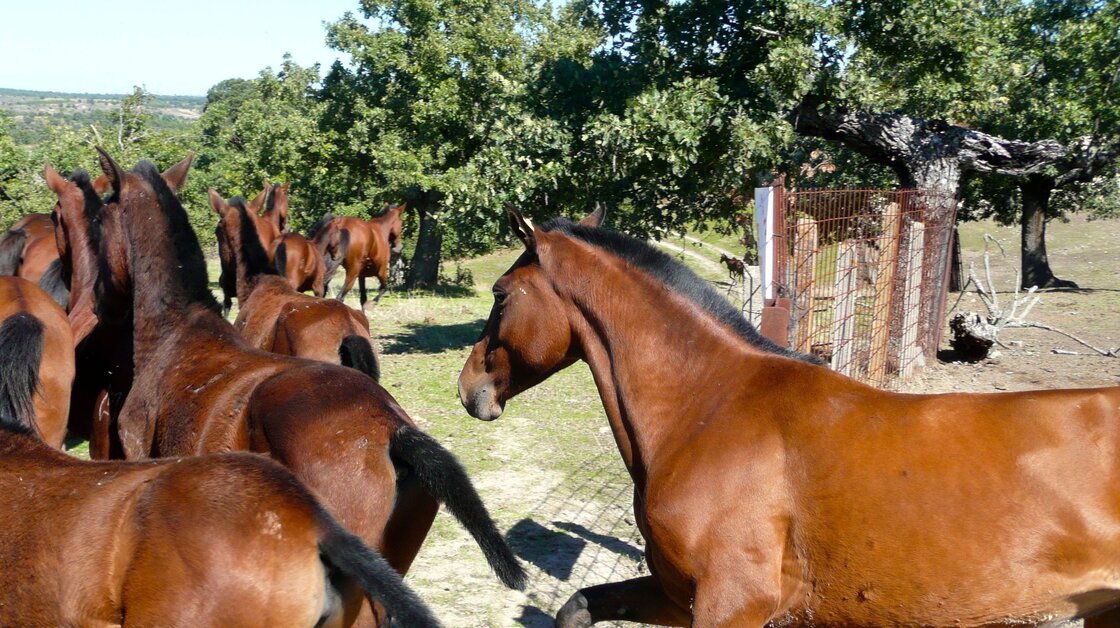
Two-dozen Retuerta horses, the second of two batches, are released into the Campanarios de Azaba Biological Reserve in western Spain. The animals’ DNA closely resembles that of the ancient wild horses that once roamed this area before the Romans began domesticating them more than 2,000 years ago.
For the first time in two millennia, wild horses are once again galloping free in western Spain, countering what happened when the Romans moved there and domesticated the animals.
Four-dozen Retuerta horses have been released into the wild in western Spain over the past two years as part of a project by , a nonprofit group that seeks to turn the loss of rural farming life into an opportunity to boost biodiversity.
The endangered Retuerta is one of the oldest horse breeds in Europe and most closely resembles the race of ancient Iberian horses that populated this region before being domesticated.
Retuertas are nearly extinct, with only about 150 remaining in Doñana National Park in southern Spain. Living in a single cluster there, the entire species could be wiped out by any potential disease or calamity.
So wildlife experts arranged to have two batches of two-dozen Retuertas each brought to the Campanarios de Azaba Biological Reserve, an unfenced area of western Spain that’s believed to have once been native territory for the horses.
“Our idea is to just let them manage the ecosystem themselves. It’s a wild horse. So it’s in its DNA to roam free in the wild,” said Diego Benito, a forestry engineer who lives and works at the reserve.
“Of course it is endangered — close to extinction — and we’re conservationists,” he added. “So if one of them gets ill, we could call the veterinarian. That’s not the idea in the future — we’ll treat them like wild horses. But for now they could use a little care.”…(CONTINUED)
Please Click (HERE) to read the story in it’s entirety and to comment
Related articles


Categories: Horse News, Wild Horses/Mustangs





 Straight from the Horse's Heart
International Society for the Protection of Mustangs and Burros, the oldest wild horse and burro group in the United States. Velma Johnston (Wild Horse Annie) was its first president.
http://www.ispmb.org/
ISPMB HERDS SHOW THAT FUNCTIONAL SOCIAL STRUCTURES CONTRIBUTE TO LOW HERD GROWTH COMPARED TO BLM MANAGED HERDS
As we complete our thirteenth year in studying the White Sands and Gila herds, two isolated herds, which live in similar habitat but represent two different horse cultures, have demonstrated much lower reproductive rates than BLM managed herds. Maintaining the “herd integrity” with a hands off management strategy (“minimal feasible management”) and no removals in 13 years has shown us that functional herds demonstrating strong social bonds and leadership of elder animals is key to the behavioral management of population growth.
ISPMB’s president, Karen Sussman, who has monitored and studied ISPMB’s four wild herds all these years explains, “We would ascertain from our data that due to BLM’s constant roundups causing the continual disruption of the very intricate social structures of the harem bands has allowed younger stallions to take over losing the mentorship of the older wiser stallions.
In simplistic terms Sussman makes the analogy that over time Harvard professors (elder wiser stallions) have been replaced by errant teenagers (younger bachelor stallions). We know that generally teenagers do not make good parents because they are children themselves.
Sussman’s observations of her two stable herds show that there is tremendous respect commanded amongst the harems. Bachelor stallions learn that respect from their natal harems. Bachelors usually don’t take their own harems until they are ten years of age. Sussman has observed that stallions mature emotionally at much slower rates than mares and at age ten they appear ready to assume the awesome responsibility of becoming a harem stallion.
Also observed in these herds is the length of time that fillies remain with their natal bands. The fillies leave when they are bred by an outside stallion at the age of four or five years. Often as first time mothers, they do quite well with their foals but foal mortality is higher than with seasoned mothers.
Sussman has also observed in her Gila herd where the harems work together for the good of the entire herd. “Seeing this cooperative effort is quite exciting,” states Sussman.
ISPMB’s third herd, the Catnips, coming from the Sheldon Wildlife Range where efforts are underway to eliminate all horses on the refuge, demonstrate exactly the reverse of the organization’s two stable herds. The first year of their arrival (2004) their fertility rates were 30% the following first and second years. They have loose band formations and some mares are without any harem stallions. Stallions are observed breeding fillies as young as one year of age. Foal mortality is very high in this herd. Generally there is a lack of leadership and wisdom noted in the stallions as most of them were not older than ten years of age when they arrived. In 2007, a decision to use PZP on this herd, a contraceptive, was employed by ISPMB. This herd remains a very interesting herd to study over time according to Sussman. “The question is, can a dysfunctional herd become functional,” says Sussman who speculates that the Catnips emulate many of the public lands herds.
In 1992 when Sussman and her colleague, Mary Ann Simonds, served on the National Wild Horse and Burro Advisory Board, they believed that BLM’s management should change and recommended that selective removals should begin by turning back all the older and wiser animals to retain the herd wisdom. Sussman realizes that the missing ingredient was to stop the destruction of the harem bands caused by helicopter roundups where stallions are separated from their mares. “Instead, bait and water trapping, band by band, needed to be instituted immediately,” says Sussman. Had this been done for the past twenty years, we would have functionally healthy horses who have stable reproductive rates and we wouldn’t have had 52,000 wild horses in holding pastures today. BLM’s selective removal policy was to return all horses over the age of five. When the stallions and mares were released back to their herd management areas by the BLM, younger stallions under the age of ten fought for the mares and took mares from the older wiser stallions. This occurs when there is chaos happening in a herd such as roundups cause.
Sussman also believes that when roundups happen often the younger stallions aged 6-9 are ones that evade capture. This again contributes to younger stallions taking the place of older wiser stallions that remain with their mares and do not evade capture. She is advocating that the BLM carry out two studies: determining the age of fillies who are pregnant and determining age structures of stallions after removals.
Currently Sussman is developing criteria to determine whether bands are behaviorally healthy or not. This could be instituted easily in observation of public lands horses.
Taken from BLM’s website: “Because of federal protection and a lack of natural predators, wild horse and burro herds can double in size about every four years.”
White Sands Herd Growth: 1999-2013 – 165 animals.
BLM’s assertion herds double every four years means there should be 980 horses or more than five times the growth of ISPMB’s White Sands herd.
Gila Herd Growth: 1999-2013- 100 animals
BLM’s assertion herds double every four years means there should be 434 horses or nearly four times the growth of ISPMB’s Gila herd.
Sussman says that BLM’s assertion as to why horse herds double every four years is incorrect. The two reasons given are federal protection of wild horse herds and lack of natural predators. ISPMB herds are also protected and also have no natural predators, but they do not reproduce exponentially. She adds that exponential wild horse population growth on BLM lands must have another cause, and the most likely cause is lack of management and understanding of wild horses as wildlife species. Instead BLM manages horses like livestock. “According to the Wild Horse and Burro Act of 1971, all management of wild horse populations was to be at the ‘minimal feasible level’,” Sussman says. “When the BLM’s heavy-handed disruption and destruction of wild horse social structures is the chief contributing factor in creating population growth five times greater than normal, than the BLM interference can hardly be at a ‘minimal feasible level.’”
Sussman concludes that ISPMB herds are given the greatest opportunity for survival, compared to the BLM’s herds which are not monitored throughout the year. “One would assume,” Sussman says, “herds that are well taken care of and monitored closely would have a greater survival rate. Yet, even under the optimum conditions of ISPMB herds, they still did not increase nearly 500% like BLM herds.”
LikeLike
How sad the BLM doesn’t encourage input from Karen & other experienced people who have actually studied the herds. Its certainly obvious that these roundups are done for one reason & one reason only. What happened to get Karen & Mary Ann removed from the board? I’d be interested to know how that was arranged.
LikeLike
Wow, how exciting!
LikeLike
Reblogged this on "OUR WORLD".
LikeLike
How did this vast land come to be? What was before people? What created the bread basket of the world? The great eastern forests? The diversity? What mammal competed with the dinosaurs and eventually prevailed? Is the greatest social animal of all time? Is the living symbol of freedom? Is one with nature? Can adjust to any environment? Can restore a broken land by bringing insects, birds, predictors, finds water for the others and causes restoration? Was eaten to extinction on this continent and returned to conquer those who failed to realize what they were till they also learned, then went on to build this place. God if anything on this planet is meant to be wild and free it is the horse. I give thanks for it and vote let it be. It’s the future.
LikeLike
I tried many times to share you posts from here, and it was blocked. I shared from FB. I also mentioned it there. I hope it works now.
LikeLike
This is wonderful. But it amazes me that humans have to destroy and bring to extinction the animals that are so beneficial to us. How about all the wildfires that have been consuming our western states. Could this principle apply to
To us? I only hope that we can stop this madness before it is too late. I feel our warrior efforts on all fronts are being noticed by other Americans and some of our politicians. Its time for our legislators to work for us both dems and repubcns. I am going to find more about this reintroduction. In the mean time, I will continue my advocacy for all our equines both domestic and wild. As usual thank you so much rt. Rt and all my fellow horse warriors out there –
Have a very blessed Sunday and may god keep you safe?
🙂
🙂 us?
LikeLike
Certainly looks as tho another country is attempting to “put back”. I’ve read about this earlier. Of course it wouldn’t work here (!) with all the fracking & drilling etc AND
cattle & sheep. But then must be there are no grazing allotments in Europe! There is another area in Europe that also was written about. Cant remember exactly where. I believe they had just kind of blocked off a huge section & weren’t allowing any kind of industrial development there. (sound like a good idea?)
LikeLike
Thanks. Reported. Something Equine to feel good about.
LikeLike
If only the US Government was this wise
LikeLike
Thankfully, they have the wisdom and commonsense to help preserve these magnificent horses, before becoming extinct. Thanks RT, as always for sharing and keeping us up to date in the equine world.(-: So happy to hear their native wild horses will be protected.
LikeLike
Most of us did not need the PNAS Report on the BLM’s Wild Horse and Burro Program to know that valid, reliable scientific knowledge and practice are of no interest to those calling the shots at Interior, the USDA, the White House, and New York City where the UN is located.
The only scientific part of the PNAS Report that decision makers were concerned about was making sure that the North American origin of the horse still remained obscure. This was the question that the NAS Agricultural Board prohibited the NAS committee from exploring. On further reflection, the board decided that rather than completely ignoring the question knowing that the scientists themselves could not report on it themselves, so someone on the board contacted a Penn State taxonomist via email that apparently answered whatever question she was asked with a “it hasn’t been settled yet.” Nonetheless, this same professor was a member of a team that published the November 2, 2011 article on Species Specific reasons for late Quatenary mega-fauna extinctions. This paper contained the following information: Scientists decided to use the species identification of Equus ferus or wild horse for the North American horse to replace the previous species designation of Equus lambei. The authors state there is no genetic difference between the two species. Equus lambei as we know is the name assigned to North America’s Equus caballus by the Canadian Geologic Survey to honor the scientist, Dr. Lamb, that discovered this species in Alaska. This horse is a caballoid, which is a short version of Equus caballus. Caballus is a noun form for the Latin description of the horse’s tooth. The words caballoid or caballine can be used as adjectives when combined with a noun such as horse or as nouns that take the place of the words Equus caballus, but do not make the horse any less a member of the species Equus caballus.
Had the U.S. ratified the 1992 UN CBD, Article 8 (h) would have overturned the 1971 Wild Horse and Burro Act when the treaty went into effect on December 30, 1993.
LikeLike
The importance of the Iberian horses for so many hundreds of years while Europeans were attempting to domesticate the horse is that when breeders realized that they needed to introduce new, “unattained by human management” stock into the herd, it was there living successfully in the wild on the Iberian penninsula. One of the facts that horse breeders are coming to grips with is that the female lineage is more important than the male lineage. The failure of human’s to understand that the female is the only one that can pass on its mitochondrial DNA, and that this DNA is more stable than the nuclear DNA both male and female members of the species contribute. Horse breeders in this country have also had access to horses that have self-chosen their mate for survival, not for pretty little feet, which is the genetic diversity found in wild horses is so important.
LikeLike
“El Caballo: The Wild Horses of North America”
LikeLike
I wonder How Long It Will Take This Country To Realize The Damage They Are causing And Correct It…Or Will The US Become A Vast Wasteland…
LikeLike
they must pray for miracle water & rain & have trees …..am so happy to hear this – thank-you however decided this !!!!!!!!!!!!!!!!!!!!!!!!!!!!!!!!!!!!!
LikeLike