

Range Observation by Carol Walker ~ Director of Field Documentation for Wild Horse Freedom Federation
Part One is located (HERE)
Photos by Carol Walker music by Opus Moon (available on iTunes)
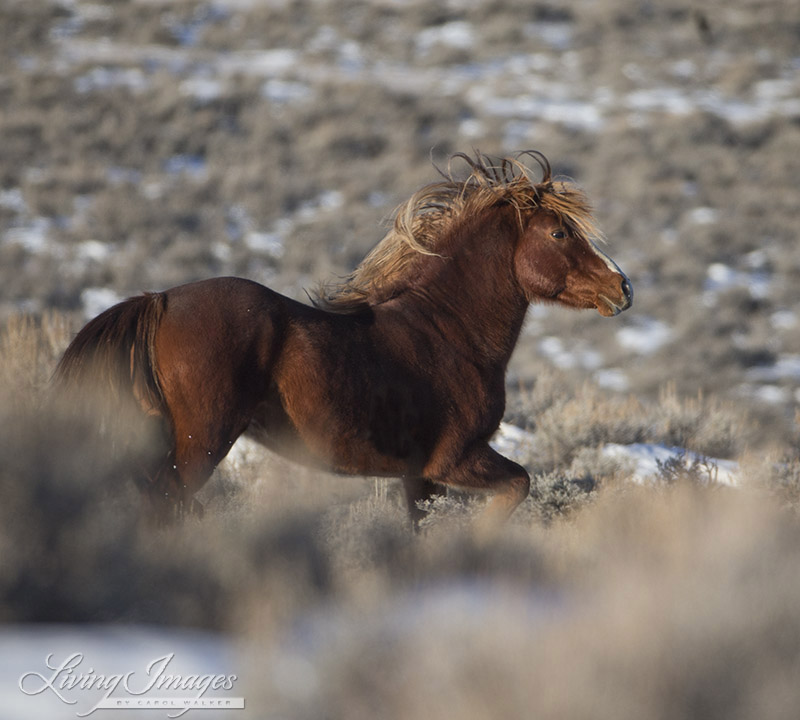 The next cold morning I head into Adobe Town before dawn. The light is starting to color the sky pink in amongst the blue, and it is silent and still. I pass a wooden ramp used to load cattle and sheep into big trucks, and it is a reminder of the fiercely dominant livestock interests in this area.
It is Sunday, and I see only a few other vehicles today in the area.
I continue driving, looking for wild horses. I pull over and pull out my binoculars as I see a flash of white over a ridge. I see several horses, but have to hike out to them to get a closer look. My boots crunch on the snow, and I am grateful that the wind is still for now. As I get closer, even though I am hidden from their view by a small hill, the horses know I am coming. It is a familiar band which I saw in the summer just after the little sorrel colt was born. He looks healthy and very fuzzy, and his red roan mother who had been thin after his birth has filled back out. This band has two stallions which is uncommon, the older grey stallion, and a younger bay who seems to be his lieutenant, staying alert for intruders. The two stallions get along surprisingly well. They look up as I slowly approach, but go back to grazing as they realize I am not coming any closer.
I walk back to my car and keep driving. Next, I see another familiar face – a gorgeous sorrel stallion with a flashy splash of a blaze on his face. I had watching him dogging a grey stallion’s large family in the summer, and here he is still waiting for an opportunity to steal a mare or two. The grey stallion is unconcerned by his presence, and moves his family across the road and up the hill as I watch and enjoy the sight of them moving out in the early morning light. There are several greys in this family, which is a common sight in Adobe Town. The two stallions peek over the hill at me as I drive away.
When I drive to another area of the range, I see fresh sheep droppings all along the road and on the sides, and I also notice that the ground has been stripped bare by the sheep. The hundreds of sheep I had seen a day ago must have been moved out of the area. All they leave behind is their droppings.
The landscape in this area is incredibly dramatic, especially with a fresh coating of snow.
As I turn and pass the reservoir, I see a group of horses, and the stallion is a sorrel. Can it be? I have not seen the gorgeous sorrel stallion with the distinctive markings for over a year and half. This is the area I used to see him in, and the area where I first encountered his family and his son Mica, the weanling colt that I adopted after he was rounded up in 2010. It is indeed Mica’s father, and his new family. His gorgeous grey mare has a long flowing mane, and she wants nothing to do with me. He also has a sorrel mare and foal, and an older black colt. The group stares at me before running into the sagebrush. I actually get a second look at them the next morning, and Mica’s father moves protectively between me and the mars and foals, and after they move away, he wheels around and stares at me, bringing up the rear, before following them over the hill.
I am thrilled by the sight of them, by the proof that they are still wild and free in Adobe Town, after the 2010 roundup as well as after the roundup of two months ago. They are healthy and strong and beautiful, uniquely suited to their home in the Red Desert.
As I leave the area, I see more antelope, and two bachelor stallions standing together in the wind. One is white, clearly older, his hide littered with scars from many past fights. The other stallion is much younger, his coat is still a dark grey, not yet lightened with age. I wonder if they are father and son, or simply two bachelors keeping each other company. I drive away knowing I will be back tomorrow.
Related articles


Categories: Horse News, Wild Horses/Mustangs





 Straight from the Horse's Heart
What a joy to hear that some of these bands endure as mustangs can do despite attacks from man. But how disgusting that large numbers of domestic sheep are permitted to mow down the range in winter when plants cannot revive quickly. Is this because of the checkerboard of private land? Surely BLM’s goal of “maintaining a healthy range” would not permit this type of blanket grazing in winter?
LikeLike
There is actually very little checkerboard in Adobe Town, whereas Salt Wells has a large amount of checkerboard. This is the first time I have seen sheep there in the winter – usually mainly in the spring, and last year in April just as the grass was beginning to grow the sheep were there, then immediately when they left there were cattle, and the range in this area looks the worst I have ever seen it. It is not possible to blame the wild horses – currently in Adobe Town the population is the smallest it has ever been.
LikeLike
Then the sheep were on taxpayer owned range? Which would make one think that BLM is allowing lessees to graze out of normal seasons – where are those lease details posted, do you know?
LikeLike
Arlene, for what it’s worth some of the legal “normal” grazing seasons are through the winter months, especially for sheep. They typically pull out in spring. You have to look at the terms of each individual lease.
LikeLike
Is there still room? Of course there is! Our wild horses and burros are the victims of a brutal propaganda campaign waged by greedy ranchers and dishonest politicians. It’s a “Land Grab” pure and simple. Similar in so many ways to the crusades of the ‘White Man’ westward into the vast hunting lands of American Natives.
The greed was thick. Free land, an seemingly endless supply of game animals for meat, water, and of course GOLD. The natives that inhabited this territory never took the land or it’s abundant wealth for granted…a lesson the whiteman has never learned. They had already forgotten how the natives had helped the original settlers in the east to survive. They took advantage of their good nature making promises they never intended on keeping in exchange for land and all it had to offer.
A plethora of treaties were agreed to by the tribes because they took the whites at their word. They had never developed the skill of lying like the whites. They didn’t tell lies. The whites, on the other hand, were quite skillful at the art of fabrication.
When the treaties no longer suited the intruders they were broken. Attempts at new treaties with the european descendents best interest at heart were written. Often the natives agreed only to be disappointed over and over again.
When they finally became distrustful the army was sent in to enforce the desires of the invaders. The killing began.
Once their numbers were dwindling towards extinction they were herded to reservations. They were told they had to farm to make a living when the ground they were forced to inhabit would barely support a jack rabbit. The idea was to break their spirit, their since of self worth and eventually eliminate their culture.
The Federal Government still uses these same tactics today not only in dealing with our wild horses and burros and other native wildlife but the poor, the elderly, our veterans and our children. The Wild Free-Roaming Horse and Burro Act, Social Security, Medicare, Medicaid, the S.N.A.P. program, the G.I. Bill have all been ‘treaties’. Promises made to protect yet are methodically altered or forgotten.
Yes, some people sneer at the comparison of our animal’s needs to those of humans. Unlike our Native brothers we have not learned how to be a part of the earth. We’ve never bought into the ‘cycle of life’ and that we are but one cog in the chain. In our infinite ‘Wisdom’ we’ve only learned how to systematically destroy the very environment that supports us.
The propaganda machine is still in high gear…”the national debt is too high so lets break promises to those who trusted us to honor our word”. When do We the People learn that a promise made by our government is only as good as long as it suits the wealthiest among us?
Our Federal Government, and many in society, have developed a sense of self importance so high that micromanaging ‘nature’ is now believed to be their inherent ‘right’. Snatching up everything of value the earth has to offer not only to their generation but that which was intended for generations to come and destroying any and everything that stands in the way.
We must stand up for our wildlife (yes that includes wild horses and burros), our seniors, our poor, our veterans, our children as they have all become pawns in a deadly game being played by those who have way too much. Those who the ‘green-eyed’ monster has enveloped. Those who care nothing of others or the gifts of nature.
The same cycle has begun to repeat…make promises, alter the promises, defeat their sense of self, and round them up in a corral of despair. “Despair” is the perfect word to describe the look in the eyes of our captive wild horses and burros. The same look is in the eyes of veterans begging on the streets, the hungry children without a home or proper clothing and wanting an education, and seniors who have to decide whether to buy food or medicine.
All is not lost. There are those among us who can right these wrongs if only the American people had enough sense to elect them. The ones who won’t trade their values for a briefcase full of money. Those who would protect and preserve rather than demonize and destroy.
Those are the folks we have to find or maybe cultivate. Without them America is lost. The freedoms that so many have died for are already diminishing for the masses. We have to get ‘greed’ out of politics. Elect ‘people’ rather than ‘politicians’. The men who founded this great nation were farmers, tradesmen and merchants but remembered tyranny and it’s effects. They weren’t men who made promises they had no intention of keeping.
Today tyranny abounds and we, like the founders, must be willing to revolt!
IMHO
LikeLike
BRAVO STEVE, WELL SAID. WILL YOU RUN FOR OFFICE PLEASE?
LikeLike
THANK YOU Carol. We are indebted to you for braving the elements and keeping us informed.
Sheep…but no room for Federally Protected Wild Horses? It sounds as though those grazing leases are a means of holding land (and resources) for other possible “multiple uses”.
We have to keep after this until we get to the bottom (or top) of WHAT and WHO is behind it. We know some of it, but there is more and the public needs to know.
From AMERICAN HERDS
http://americanherds.blogspot.com/2008/05/at-root.html
At The Root
Whether you’re passion is wild horses and burros, wildlife or just someone who loves to go hiking around in nature, eventually we all run into the same issue; the degradation of public lands by poorly managed livestock grazing and our government authorizing unsustainable numbers for decades.
The question becomes why…..
Why does public lands ranching have such a death grip on our natural resources? How is it that after all these years, little has changed despite overwhelming evidence of the damage? Why, despite all the laws and many, many good dedicated people in the government agencies themselves that have tried to effect change, nothing substantial can be done? Why is it that report after report submitted to Congress clearly outlining the mismanagement and malfeasance of livestock grazing to our resources, including wild horses and burros, is met with indifference as they not only continue to support livestock grazing but will viciously fight for the rights of ranchers time and time again? And how is it possible that just a handful of ranchers who produce less than 3% of America’s beef on public lands continue to wield so much power over our Nation?
Well, the answer is, they don’t. The banks do, just like everything else these days and it’s the banks that continue to dictate American policy and cause Congress to ask “How high?” when they ask them to jump.
In Mike Hudaks’ Western Turf Wars – The Politics Of Public Lands Ranching, an interview with Mike Sauber sums it up in a nutshell and what he describes should send chills down anyone’s spine who cares for America’s resources, “our” public lands and why the current system has eternally doomed us to failure until there will be nothing left but dust.
Mr. Sauber so aptly and clearly describes America’s real predicament in this powerful truth so often hidden from public view when he states: “People typically assume that ranchers have a lot of power, but it’s not really true. It’s the banks holding the estimated $2 billion that’s loaned out on grazing permits on western public lands that have the power. Our public lands are being used as collateral for bank loans. Our wilderness areas, archaeological sites, watersheds, wildlife habitat is being mortgaged – used as collateral for bank loans of ranchers that are buying base properties with grazing permits attached to them.”
If you really want to know the truth about America and our resources, Western Turf Wars is just an amazing public service. If you already care about what you see going on around you, it has incredible insight on multiple levels as to why our public resource system is such a mess. If you didn’t give it much thought before, by the time you finish this book, you might find yourself suddenly caring very much!
To order a copy or read other reviews of Mike Hudaks’ Western Turf Wars – The Politics of Public Lands Ranching, Click Here. http://www.westernturfwars.com/
LikeLike
Thank you Carol & Louie C for the update and insights. Louie – does anyone know, what is the status of REVA (Rural Economic re- Vitalization Act) that was introduced by a Congressman from Washington State in 2013 ? It would allow 3rd party buyouts of grazing allotments specifically to end livestock. Not sure if it could turn out to be a double-edged sword for wild horses & burros, but it might break the current gridlock on PL grazing. Craig Downer’s Reserve Design Proposal should be given serious consideration. How do we get the big PL conservation organizations to set aside their species bias against WH&B’s and look at the real science in support of WH&B as a Native Species
LikeLike
Louie:
A very important, yet largely unknown point….public lands leases are set in 5 (formerly) -10 (most recent approval reg?) year blocks, almost rubber stamped as long as the lessee continues to extract and graze AND THEY CAN GET LOANS WITH THESE AS COLLATERAL, NOT TO MENTION INCREASE OF THEIR PRIVATE LANDS VALUE WHEN THEY SELL.
This is just wrong…leases shouldn’t transfer this easily and yet Pickens had a hell of a time keeping hers. Go figure.
LikeLike
Dear Carol, a beautifully written report on the awesome mustangs i almost felt i was there with you !!!!! how envious I am , it must have been wonderful to be there and see them !!!!!
LikeLike
Carol’s photographs truly are living images. The horses are beautiful& FREE! which is more than can be said for almost 50,000 of them.
Louie, have to admit I never thought past the ranchers themselves. But makes sense that the banks don’t want to let go of this “collateral”. Wrong…
LikeLike
Maggie, the notion that public land can be used as loan collateral is egregiously wrong. If I want to buy a place next to something you own, I cannot legally claim your property as part of the value of my purchase, nor can I control what you do on your property! Just wishing it to be true doesn’t make it legal. How this public lands takeover somehow became legal would make a worthwhile documentary. You can’t blame ranchers for taking advantage of what a system offers them… we have to change the system to see results.
LikeLike
Well, that IS the system and exactly who do you think set it up????? “Ranchers”!
And you really need to define “ranchers”, especially in the West. Do some homework and you’ll find they own the state houses, state banks (before deregulation), slaughterhouses, transports, feed mills, etc…not rocket science.
This has bee going on since the 1850’s.
And you are right. This has to stop. We can start with eliminating BLM (a Great Depression vestige that has overstayed it’s need) and greatly restricting DOIs oversight on many issues/areas. Domestically, DOI is the most wealthy asset the US has; DOD is the most powerful.
LikeLike
Thank you, Carol. These wild horses are precious treasures to be protected and preserved but, as we all know , this is not being done. Will share this and wish it could be on TV.
LikeLike
We will be posting Carol’s final installment, complete with photos, on Monday after “Feel Good Sunday”!
Thanks again, Carol!!!
LikeLike
Thank you Carol for the beautiful images of these magnificent creatures. Your report while traveling in the Red Desert was so very interesting….wish we all could have been there with you! (-: What a wonderful opportunity to see them up close and find them looking healthy and above all, free to roam. Thanks again for making this available and looking forward to your next installment Monday.
LikeLike
how beautiful,wish i could be there,. ya know, as i look at all these pic.’s i;m looking at groups of 6 an 5 horses … where is the blm coming up their numbers.? can any one tell me that.??sorry for wwritng ,hands not working well today
LikeLike
Sure does make you wonder, doesn’t it? How is it that none of these little bands are more than just a few horses? And we ALL wonder how the BLM is coming up with their numbers. Certainly not by an actual head count. Its all by guesstimates!
LikeLike
Connecting the Dot$
Rock Springs Field Office NEPA Documents
http://www.blm.gov/wy/st/en/info/NEPA/documents/rsfo.html
Great Divide Basin HMA Wild Horse Gather – 12/06/13
Click to access FONSI.pdf
FINDING OF NO SIGNIFICANT IMPACT December 19, 2013
Bureau of Land Management
Rock Springs Field Office
Project Title: Monell-Arch Units Oil and Gas Development
Under the Proposed Act, AP will develop up to 125 wells over 9 years: 105 oil wells, 18 carbon dioxide injector wells and 2 water injection wells.
The total well life would be approximately 30 years. Drilling operations would utilize a combination of vertical and directional techniques, as appropriate, and all producing wells would be hydraulically fractured.
Anadarko Petrouleum Corporation (APC) proposes to develop new oil and gas wells in the Monell and Arch units, approximately 31 miles east of Rock Springs in Sweetwater County, Wyoming.
Click to access EA3.pdf
Monell/Arch Units Oil and Gas Development EA
Oil and Natural Gas. The Monell and Arch units are located in an area with abundant oil and natural gas resources. The Greater Green River Basin is estimated to contain undiscovered resources of 84 trillion cubic feet of natural gas and 131 million barrels of oil (USGS 2002). The proposed project is located in the vicinity of several oil and gas fields, which are listed in Table 3-2.
3.4 Water Resources
This section addresses surface water and groundwater resources that may be affected by the proposed Monell and Arch Units Project. The assessment of potential impacts to these resources was based on desktop analyses of existing information.
3.14.2 Wild Horse Herd Management Areas
The portion of the project area that is within the Rock Springs Grazing Allotment ALSO OVERLAPS WITH THE SALT WELLS CREEK HERD MANAGEMENT AREA (HMA).
LikeLike
Yes, and isn’t the President of the Rock Springs Grazing Assoc also the President of the Rock Springs Bank which has vested interest in the O&G development in the area ?
LikeLike
Dots connected by our own government. So what do we do about it?
LikeLike
lmccormick56, I don’t know the answer to your question, but we should do some research and find out.
Craig Downer’s RESERVE DESIGN should definitely be given serious consideration and Wild Horses and Burros ARE native to North America.
Click to access 10.11648.j.ajls.20140201.12.pdf
American Journal of Life Sciences
The horse and burro as positively contributing returned
natives in North America
Craig C. Downer
LikeLike
Imccormick56, I don’t know the answer to your question, but we should do some research and find out.
Craig Downer’s RESERVE DESIGN should definitely be given serious consideration and Wild Horses and Burros ARE native to North America. I think the “non-native species” argument is used mainly as a diversion. It serves to dodge the main point….. our Wild Horses and Burros are FEDERALLY PROTECTED.
Click to access 10.11648.j.ajls.20140201.12.pdf
American Journal of Life Sciences
The horse and burro as positively contributing returned
natives in North America
Craig C. Downer
LikeLike
I guess the native species controversy is a non-issue – look at how they are managing the YNP Buffalo herd. They won’t even allow the Tribes to obtain “live” cull bison. The banks control the PL resources. I heard a rumor the other day that the PL’s resources are being held as collateral against our debts to China. Can anyone elaborate on that rumor ?
LikeLike
Also, why doesn’t Western Watersheds Project take on the RSGA ? That would be the case of the century !
LikeLike
A closing quote by Paul Salopek from the Out Of Eden journey
(Natl. Geo. Dec. 2013)
“Humanity is remaking the world in a radical and accelerating cycle of change that strips away the memory of place as well as topsoil. Our era’s breathtaking changes flatten collective memory, disrupt precedence, sever lines of responsibility. (What so disconcerts us about suburbia? Not only its placelessness but a void of time; we crave a past in our landscapes.)”
Yes, landscapes of wild horses and bison and ALL wildlife roaming free. LM
LikeLike
The decision to remove Wyoming’s Wild Horses should be challenged.
http://scholarship.law.umt.edu/cgi/viewcontent.cgi?article=1074&context=plrlr
Public Land and Resources Law Review
A. The Leading Case: Roaring Springs
The foremost case defining the parameters of § 1334 is Roaring
Springs Associates v. Andrus.3 9 The plaintiff organization owned unfenced
land in eastern Oregon. When wild horses roamed onto its parcels,
the association asked federal agents from the Department of Interior to
remove the trespassing animals. After the government refused, the
plaintiff petitioned a United States Magistrate to issue a mandamus
order.’ 0 The court ruled that the defendants owed the private landowner a
“ministerial duty” under § 1334 to return the wild horses to the public
range.41 The government’s defenses of sovereign immunity,42 of incorpo-
rating state estray laws into the Act,43 and of limiting the scope of § 13 34 4
did not neutralize this mandatory requirement.
Undoubtedly the court was correct in stating that agency discretion is
inappropriate when property owners request removal of strays. 5 Congress
must have intended § 1334 to protect wild horses from private, unauthorized
culling”6 by allowing landowners an inexpensive and expedient
method of retrieving the horses.4 Since the Act was primarily enacted to
prevent the atrocities of private roundups,48 it is unlikely that Congress
would have permitted § 1334 to function at the whim of agency officials.
B. The Usurpation of § 1334: Excessive Horse Management
In Mountain States Legal Foundation v. Andrus, 50 the federal
district court of Wyoming utilized comparable factual circumstances-
wild horses straying onto private parcels-to launch exorbitant
regulation amounting to a blatant distortion of the purposes and requirements
of § 1334, which was not even cited in either the original or amended
opinions.51
LikeLike
PUBLIC LAND AND RESOURCES REVIEW
http://scholarship.law.umt.edu/cgi/viewcontent.cgi?article=1074&context=plrlr
The court erroneously assumed that § 1333(a) of the Act compels the
Bureau of Land Management (BLM) to round up wild horses from both
public and private tracts whenever the animals stray onto the landowner’s
parcels. Section 1334 is designed to remedy Mountain States’ factual
situation, 59 but it applies only when wild horses stray onto private lands.60
Horses on the contiguous public portions of the checkerboard are not
subject to the provision. 61 Landowners could exploit this precedent and §
1334 to coerce the BLM into gathering wild horses from all public and
private plots in an entire region to eliminate forage competition with
livestock.
However, the BLM’s “ministerial duty” does not apply to public
lands, even if private interests hold grazing permits and leases to use
certain federal tracts.62
Leasing arrangements do not alter the public
ownership of the range,63 so wild horse management on federal sections
should conform to the purposes pervasive throughout the Act, as well as to
PRIA and FLPMA’s “multiple use-sustained yield” concepts.
LikeLike
There is another book that everyone should read its called The Sixth Extinction by Elizabeth Kolbert they have it on amazon.com Ms. Kolbert explains about the ongoing extinction of wild animals all over the planet. I haven’t read it yet but from what I understand about the contents it wakes up the reader to just what damage humans have done and are doing to our natural world. The elephants in Africa are a good example, if their wholesale killing can’t be stopped they will be extinct in another ten years. This government has added Chimps to the endangered species list because of their diminishing numbers in Africa. These animals have been killed by the thousands for years and sold as bush meat. All a person has to do is look around the globe to see the disaster mankind is causing with no end in sight.
LikeLike
Barbara, I have also heard that we are witnessing Earths 6th mass extinction. Who’s to say the human species is exempt ? I recommend following Paul Salopek’s journey, “Out Of Eden” (Natl. Geo. Dec. 2013) He states that a demographer’s calculations actually prove that over 90% of the hominid species has already gone before us – imagine that !
PS also quoted, “Humanity is remaking the world in a radical and accelerating cycle of change that strips away the memory of place as well as topsoil. Our era’s breathtaking changes flatten collective memory, disrupt precedence, sever lines of responsibility. (What so disconcerts us about suburbia? Not only its placelessness but a void of time; we crave a past in our landscapes.)
LikeLike
Denise and Imccormick56, it looks as though you are both correct.
http://treasurer.state.wy.us/advisory.asp
WYOMING STATE TREASURER’S
ADVISORY COMMITTEE
JOHN HAY, President
Rock Springs National Bank
P.O. Box 880
Rock Springs, WY 82902
307-362-8801
john.hay.iii@rsnb.com
LikeLike
Thank you Carol. If only more people could actually experience wild horses and wild burros and the wild land itself then 99% of them would understand and know that they are not “numbers”, they are living, breathing, feeling wild animals … and thank you for helping us to achieve that feeling.
LikeLike
Arlene Gawne and others. The information for grazing allotments is on this website: http://www.blm.gov/ras/ (BLM Rangeland Administration).
Look at Rangeland MAP (zoom in for Adobe or wherever you are interested in) and it will show you the HMA and an overlay of the allotments. Check the boxes on the right hand side.
Then you can go to back to RUN REPORTS and chose the field office and it will show you allotments you are interested in (authorized use by allotment).
It looks like there are about a dozen allotments in the Adobe Town HMA? I don’t know exactly where Carol was so I just picked one of many – the Adobe Town allotment that specifies 1833 sheep between 10/01 to 2/28.
Then noting the authorization number, you can go back to RUN REPORTS – operator information and find out the name of the permittee.
This can be a little confusing at first but experiment with it and I think you will want to use it often.
LikeLike
BLM does land swaps all the time. Why wouldn’t this be an option in WY ?
LikeLike