

By Dylan J. Darling / The Bulletin
Six horses were found shot in Ochoco National Forest last fall
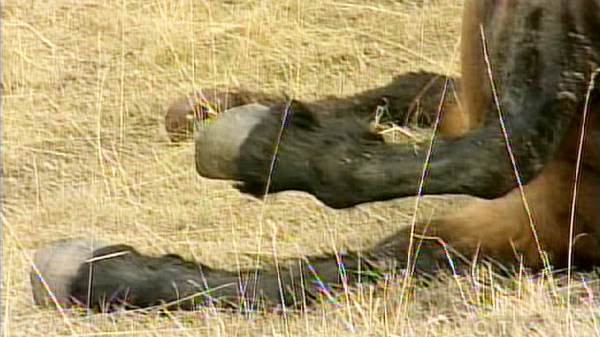 Nearly five months after a half-dozen wild horses were found shot along a road in the Ochoco National Forest, who killed the controversial animals and why remains unknown.
No one has stepped forward with a tip solid enough to lead to the arrest and conviction of the shooter or shooters, despite a reward of nearly $10,000.
“We are still desperate for information,” Patrol Capt. Dan Smith of the U.S. Forest Service said Wednesday. Smith is the top law enforcement officer for the Deschutes and Ochoco national forests.
The horses were all members of a group of wild horses known as the Big Summit Wild Horse Herd. Three were found shot — two dead and one severely wounded — on Oct. 12 along Forest Road 22 near the junction with Forest Road 500, east of Prineville. The injured horse was euthanized. On Oct. 18, three more horses shot dead were found nearby by a Forest Service law enforcement officer investigating the first case. Smith has said the six horses probably were all shot at the same time.
Protected by the Wild Free-Roaming Horses and Burros Act of 1971, it is illegal to harm, harass or kill wild horses.
 Wild horses elicit strong emotions from people on opposing sides of the debate in the West about federal management of the animal. Whether anger about the animals was a factor in the shootings, though, remains a mystery.
“I would say that I think it was a deliberate act,” said Gayle Hunt, president of the Central Oregon Wild Horse Coalition in Prineville. “It was not random.”
The wild horse shooting wasn’t the first in recent years in the Ochoco. In March 2011, six wild horses, four adults and two younger animals, were found shot dead. That case also remains unsolved. The shooting scenes from 2011 and last fall are about 10 or 15 miles from each other.
Hunt said she thinks the 2011 shooting was not a random act either, with both shootings possibly done by people who hate the horses. People opposed to wild horses on public lands include some elk hunters and ranchers, she said.
The Central Oregon Wild Horse Coalition, Redmond-based Mustangs to the Rescue, the Humane Society of the United States and individual contributors are offering a combined reward of $9,200 for information leading to the arrest and conviction of the shooter or shooters of the horses…(CONTINUED)
Click (HERE) to read the rest of the story and to comment at The Bulletin
Related articles


Categories: Horse News, Horse Slaughter, Wild Horses/Mustangs






 Straight from the Horse's Heart
Poachers and Illegal Loggers Beware: Now Whistleblowers Can Bring You Down
http://www.care2.com/causes/poachers-and-illegal-loggers-beware-now-whistleblowers-can-bring-you-down.html
Poaching and other wildlife crimes represent the single greatest threat to at-risk species, including tigers, lions, elephants, rhinos, apes and many more. Illegal logging of precious forested areas destroys habitat and ruins ecosystems. These crimes often go unreported because poachers and illegal loggers are a danger to the people who know what they’re up to.
A new website, which launched on Feb. 7, hopes to solve that problem. WildLeaks lets anyone who knows about wildlife or forestry crimes report online what’s going on, anonymously if necessary.
“WildLeaks is a venue for those with pertinent information to share their knowledge while remaining anonymous and without going directly to law enforcement officials,” project leader Andrea Crosta told National Geographic. “We’re hoping to receive information that can help us launch or continue an investigation.”
WildLeaks is the joint project of a coalition of groups led by the Elephant Action League. Joining EAL are the U.K.’s Environmental Investigation Agency, the Netherlands-based EcoJust, South Africa’s Oxpeckers Center, 100Reporters, GlobalEye, and a number of other groups.
“Public tip-offs to enforcement is the key to shutting down wildlife crime,” Kevin Bewick, head of the Anti-Poaching Intelligence Group of Southern Africa, told National Geographic.
Going After the Major Players in Illegal Wildlife and Forestry Crime
Worldwide, wildlife crime is considered the fourth largest transnational crime. It’s a $17 billion industry, following closely on the heels of narcotics, counterfeiting and human trafficking. That’s why WildLeaks is not looking to bust small-time poachers and loggers. Rather, its aim is to stop the big fish — traffickers, traders, dealers, shipping companies, corrupt businesspeople and government officials, and major criminal operations.
LikeLike
These ae horrible acts.
LikeLike
These are horrible acts and the perpetrator should receive a very stiff sentence and a life time of misery for his/her/their actions. These horses were not harming anyone and they should NOT have been shot. It takes a twisted mind to do something this terrible to a beautiful horse. May God see that they deserve eternity in the hole below.
LikeLike
Ten to 15 miles is close enough in area for these herds to be considered geographically contingent to one another because the horses can travel this distance within a day and often travel more than this in a day. So for population viability purposes, it appears that they are essentially one larger population. Still, earlier studies of genetic viability based on who knows what wildlife biology have proven to greatly underestimate the humber of individuals that are necessary to maintain genetic variability for wild horse herds.
LikeLike
Typical sick, macho human behavior cloaked in mmense evil hate.
Somebody knows something but is probably terrified to say anything for fear these bullies will come after them.
Don’t they do firearm forensics????? No cameras in or out of the forest???? This is probably a regular, lives nearby…NOT rocket science. What about pulling hunting permits???? Guess that would take effort on the part of USDA.
Can I claim the reward for reporting USDA and DOI in violation of harassing and killing wild equines????? And if I do, who do I report it to; certainly not the perpetrator organizations themselves, right????
LikeLike
Good idea, Denise. We should all file a crime report at the same time. Maybe get some press.
LikeLike
PROTECTING OUR WILDLIFE
Thirty-three year old Damien Mander served as a special operations sniper and clearance diver for Australia. Whilst deployed in Iraq he project managed the Iraq Special Police Training Academy, overseeing training of up to 700 cadets at one time. Following three years on the frontline of the Iraq war he departed in 2008 with no new direction in life. A trip to Africa left him face-to-face with the horrors that the world’s wildlife is dealing with. Liquidating all personal assets acquired from 12 tours of duty, he founded the International Anti-Poaching Foundation. The organisation focuses on ranger training, operations and integrating modern technology into conservation.
LikeLike
As always Louie – you provide such great information. This Ted show was super. If I had any extra cash (which I don’t) this would be one of the places I’d send it. He sure does have the right mindset. If only the BLM could be headed by someone with his background – of course that’s out of the question.
LikeLike
UP THE REWARD!!! The pond scum will be exposed…
LikeLike
Has anyone considered whether the BLM itself is actually doing the killing? There are just too many coincidences in these stories – wild horses and burros being shot and killed and not just in Oregon. Given the attitudes and agendas of the BLM should this be considered? The BLM wants horses dead and gone forever. Is it much of a stretch that where and when they can they might be the actual culprits? I’m not “accusing” I am asking if there is a possibility that stealth murders are being committed–as opposed to the terrible injuries and deaths from gathers and penning where cameras are often rolling. Just sayin’…..
LikeLike
Rox:
That thought has crossed my mind; kinda like the town firebug being a volunteer fireman….psychiatric pathology is there.
LikeLike