

“To all of our loyal long-time SFTHH readers and supporters,
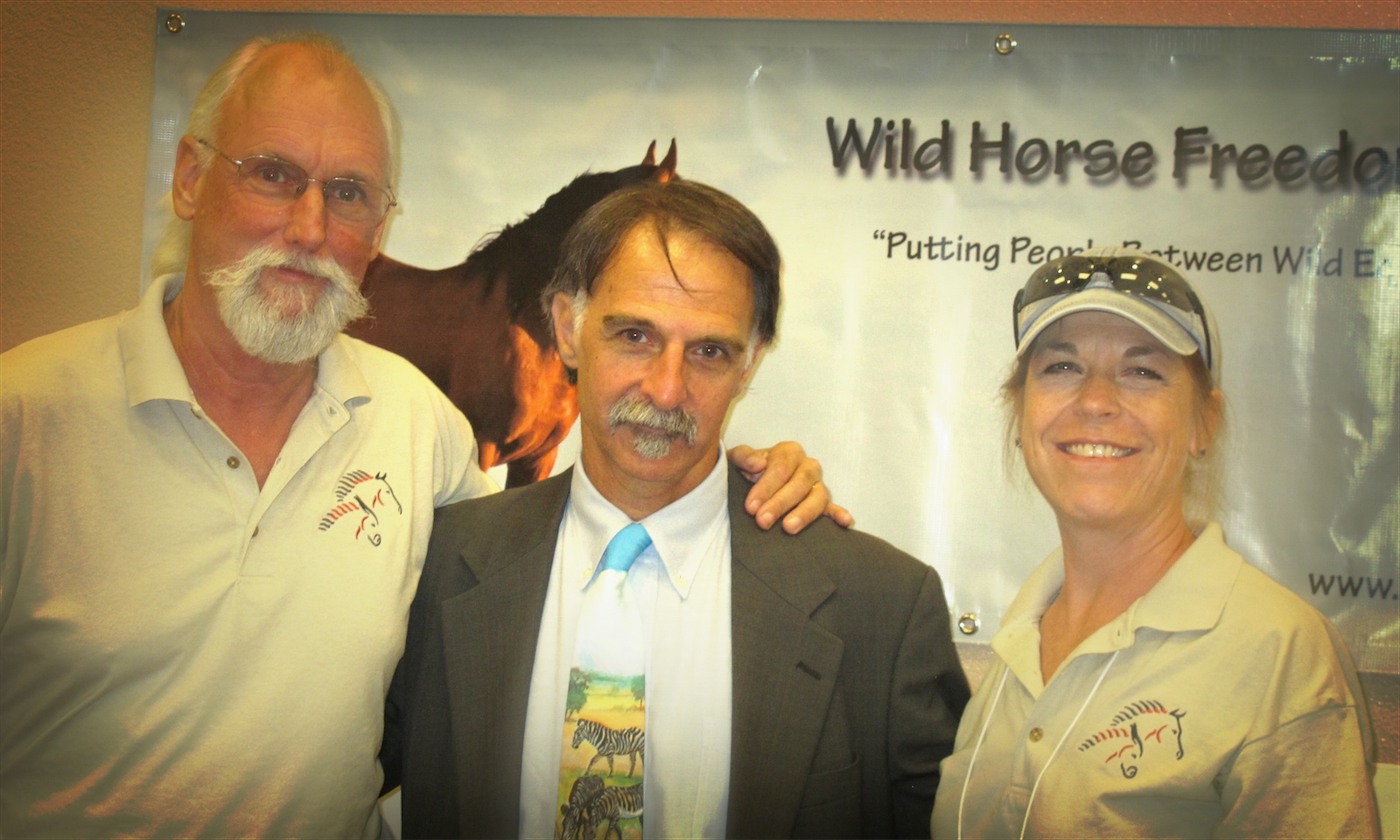
Author/Compiler of White Paper, Animal Law Attorney Bruce Wagman with R.T. and Terry Fitch
This prologue has been a long time coming, and it is with a sense of overdue acknowledgment that we address you today. In essence, we have silently closed the chapter on Wild Horse Freedom Federation, stepping back from our decades-long endeavor to challenge the BLM’s relentless efforts to erase our native equids from the public lands that inherently belong to them. This journey has been marked by profound challenges and introspection.
My wife, Terry, and I delved into our retirement savings on multiple occasions to engage the expertise of the world’s foremost animal law attorneys, all in pursuit of our mission. However, over the span of a few years, we came to a stark realization: our strategy of pursuing the BLM and the Department of Interior across the western United States with Temporary Restraining Orders (TROs) was neither effective nor a prudent use of resources. It became, what I would metaphorically refer to as, a three-pronged pitchfork approach.
- We would allocate our funds, sourced from hardworking US taxpayers, to initiate legal action against the BLM or DoI.
- Paradoxically, as taxpayers, we were unwittingly funding the very BLM roundups we sought to challenge.
- Consequently, the BLM would then tap into more of our taxpayer dollars to engage legal representation in defense against our efforts, effectively pitting us against our own resources.
This circular pattern was relentlessly recursive and persists to this day. Eventually, we acknowledged the myopia of our approach and shifted our focus to a new battlefront: preventing captured horses from being transported across the Mexican border for slaughter. Notably, we achieved some traction in Texas by confronting veterinarians who were negligently endorsing health certificates for horse transport. However, our momentum was derailed by the Open Border policy of the current Administration, as the human migration across the southern border took precedence and shifted the news narrative.
Coupled with the profound health challenges faced by several members of our board, we collectively chose to gracefully disengage from the tumultuous arena. Personally, I embarked on a quest for an alternative path to safeguard wild horses. As an advocate for wild equids and a seasoned combatant against the system, a struggle etched deeply in my memory, I threw my support behind the Wild Horse Fire Brigade.
In forthcoming communications, I shall detail the particulars of our chosen trajectory. Meanwhile, I stand resolutely aligned with Bill Simpson, whose perspective is encapsulated in the forthcoming article, below. He astutely emphasizes the incontrovertible truth that, “If you always do what you always did, you will always get what you always got!” This declaration encapsulates the essence of our imperative for innovation, for daring to transcend the conventional.
The moment has arrived to break free from the confines of the established paradigms, to forge a new course, and to champion the cause of the horses and burros.” ~ R.T.
~~~~~~~~~~~~~~~~~~~~~~~~~~~~~~~~~~~~~~~~~~~~~~~~~~~~~~~~~~~~~~~
Wild advocates continue to file lawsuits to halt wild horse roundups, but most of these efforts end in failure. It appears that they haven’t gained much knowledge over the past 30 years.

photo by Terry Fitch
The recent news cycle is filled with stories about deadly wild horse roundups in Nevada that have resulted in the deaths of at least 31 protected wild horses.
The U.S. Bureau of Land Management (BLM), as mandated by federal law, is responsible for managing wild horses in a way that maintains an ecologically balanced landscape and preserves their genetic diversity.
However, the news cycle for July-August 2023 is also dominated by reports of lawsuits from wild horse advocacy groups attempting to stop these roundups. These groups claim that the BLM is mishandling American wild horses.
Organizations advocating for wild horses, such as Wild Horse Education, have repeatedly filed lawsuits over the decades, including one aimed at halting the ongoing deadly BLM roundup of wild horses in Nevada.
According to an August 9th article by Scott Sonner at the Associated Press, U.S. District Judge Larry Hicks ruled against Wild Horse Education’s request for an emergency order to stop the Nevada roundups. The group argued that the roundups are inhumane and illegal. The judge decided to allow the roundup to continue despite the deaths of 31 federally protected wild horses in the days prior.
But why?
Firstly:
Judges are not saints; they are merely humans and are, to some extent, susceptible to political and economic influences, as well as potential biases. This is precisely why extensive debates about Supreme Court appointments occur in Congress. The idea behind a large panel of judges is to mitigate potential bias. However, when a single judge makes a ruling, there is no consensus among legal experts.
Secondly, and more importantly:
Powerful, economically supported lobbies oppose non-commercial herbivores (wild horses) when they stand between economic development and profitability.
Nevada hosts a range of strategically and commercially valuable mineral deposits, which are currently in high demand. Lithium is one such mineral. Alongside the billions of dollars in mineral wealth, livestock grazing also presents multimillion-dollar economic opportunities. In comparison to this level of wealth, the preservation of native wild horses holds less weight than the individuals at trillion-dollar corporate conglomerates who yield significant political influence.
Regrettably for the wild horses, many leaders of wild horse advocacy organizations lack a comprehensive understanding of how our government and economic forces function.
An unemotional, clear understanding is crucial to propose effective solutions for wild horses that could prevent these extensive deadly roundups, ultimately leading to the slaughter of numerous wild horses.
Competition among corporations for public land assets and usage is at an all-time high and continuously increasing. Consequently, maintaining wild horses in such landscapes will become even more challenging over time.
“Many wild horse advocacy groups need to recognize that their repeated legal actions stem from reliance on an outdated, unscientific statute—the 1972 Free-Roaming, and Wild Horse Burro Act. This law compels the BLM and the Forest Service to manage horses where they were found in 1972, often in direct conflict with cattle, sheep, and oil & gas interests. What’s required isn’t litigation but new authority for these agencies to manage these horses in locations where they can contribute to the environment and minimize conflicts with other users,” stated wildlife advocate and litigator Michael R. Harris, who serves as the Legal Advisor to Wild Horse Fire Brigade.
The promotion of the notion that sterilizing wild horses is a solution displays astounding ignorance and defies simple logic.
A sterilized wild horse demands just as much forage and water as a genetically intact wild horse. Consequently, sterilizing wild horses, disguised as ‘Fertility Control,’ constitutes a false solution that costs taxpayers millions annually. Worse yet, since sterilized horses still compete with livestock for forage and water, they will eventually be rounded up to facilitate more livestock grazing and create space for large-scale mining, oil, and gas extraction operations.
During the December 2022 MUSTANG SUMMIT in Sacramento, California, the founder and executive director of Wild Horse Fire Brigade, William E. Simpson II, delivered a presentation to the largest audience at the EQUUS Film & Arts Festival. He discussed the challenges faced by wild horses and the threats to their survival. The presentation can be viewed for free on YouTube via this link: https://www.youtube.com/watch?v=s3pCv0VgMOI
Is there hope? The short answer is yes.
Empirical evidence over the past 30 years demonstrates that the strategies employed by prominent wild horse advocacy groups have repeatedly failed.
The only accurate measure available to wild horse advocates is how wild horses are presently treated and the speed at which they are disappearing from the American landscape.
Many advocates fail to comprehend that persisting in a losing battle doesn’t advance the cause of wild horses.
Michelle Gough, treasurer and ethologist at Wild Horse Fire Brigade, offered this insight: “The BLM was established in 1946 through the merger of two agencies, the US Grazing Service and General Land Office. Both preceding agencies were responsible for grazing permits, with one also overseeing royalties from mineral extraction on those lands. The key takeaway here is that the BLM continues to issue grazing permits and engage in mineral and gas extraction because of powerful corporate interests. Visualize the BLM as a freight train propelled by major corporations. None of us can halt that freight train, and horses continue to perish while attempting to ‘stop that freight train.'”
Those genuinely invested in preserving American wild horses while there is still a reasonable number of genetically intact ones must disassociate from organizations that persist in failed approaches over the past three decades.
Individuals who genuinely seek the natural and humane conservation of wild horses in America need to begin by acknowledging that confining wild horses to conflict-ridden areas, whether sterilized or not, guarantees their extinction.
To genuinely rescue wild horses and enable their natural, sustainable conservation in a world dominated by greed and ego, they must be managed through a strategy that assigns them practical value beyond their aesthetic presence on the American landscape.
When wild horses are placed in naturally functioning, balanced ecosystems, they contribute to wildfire prevention, offering tangible value to taxpayers that extends beyond their value at slaughterhouses.
Each re-wilded wild horse released from a holding corral, or relocated from a conflict-ridden and roundup-prone area to an ecologically and economically appropriate wilderness, provides approximately $72,000 in value over its lifetime.
Wild Horse Fire Brigade is an all-volunteer 501(c)(3) nonprofit advocacy group that has developed and proven a nature-based solution for managing wild horses.
Wild Horse Fire Brigade also represents a proven, nature-based wild horse management plan that can enable wild horses to thrive in their natural habitat.
For more information, visit: http://www.WHFB.us
Categories: Horse News, Horse Slaughter, The Force of the Horse, Wild Burros, Wild Horses/Mustangs





 Straight from the Horse's Heart
Sorry to hear this, RT – but I do understand becoming discouraged.
LikeLike
My dream is of a place and time where humans, animals and all of creation will unite in spirit and consciousness as equals.
LikeLiked by 1 person
Have a good life.
LikeLiked by 1 person
Thank you for finally admitting that the current strategies used by wild horse advos are unsuccessful and useless. This admission should have come a long time ago. Most, if not all, of the advo organizations are woefully ignorant of effective organizing techniques and so keep on doing the same thing over and over. WHFB has at least come up with a specific plan. It is equally ineffective to keep emailing Congress, when they have shown they’re not interested in doing anything that has any teeth to it.
I’m not sure what we can do to create a forceful public outcry, which is our only way of acheiving success.
LikeLike
Thank you for this email. For some time now I have had some of the same thoughts that you outline below. Doing the same nonproductive thing time after time after has only resulted in spinning the wheel of “Maybe it will land on stopped roundups this time. When I began seeing that more Wildlife Biologist are saying that wild horses have become a Keystone Species in the areas they live in I wondered if this could be the thing that finally saves wild horses. They give back to the land in a number of ways. Cattle and sheep give back nothing. They only take from the land.
We need wild places. Wild places need Keystone Species. Our planet needs both.
LikeLiked by 1 person
RT, thank you … I support WHFB & WmSimpson’s vision… I don’t know if this is a solution on BLM’s radar…?
LikeLike
Mr. Simpson’s WHFB is one idea – a good one. But we still must have observers physically ONSITE at these roundups. And there are very few groups that are making that effort. WHE is one, Carol Walker with her photography & blog is another – I’m sure there are others that I’m unaware of. Yes, there are large organizations likely “in it for the money” but there are still many caring individuals & small organizations who are making the attempt to give the public – the ones whose Wild Horses & Burros these animals are – a way to view exactly what this government agency and its contractors are getting away with. If the light isnt shown on these actions – if no one KNOWS of these actions – there will be no reason for them to stop. Bringing this brutality to court – yeah – costs money but it also is a way to publicize it & bring it into the open.
LikeLike
I should have added to my comment – RT and Terry have done so much for so long to fight this fight, as have so many others. I never got physically involved – other than writing letters, emails, commenting & contacting politicians. That has been frustrating in itself – but for the people who were physically involved in this fight, actively rescuing & caring for these horses – it has got to be soul crushing to still be doing it after all these years and STILL its ongoing. I sure can understand why & how it gets to be just too much to take on anymore.
LikeLike