Posts Tagged ‘Equestrian’

2013 American Equine Summit: Ginger Kathrens

We will be featuring key presentations, everyday during this upcoming week.  The information contained within each is invaluable in fighting the horse-eaters and their propaganda.  Direct YouTube link for Ginger’s presentation is:  http://www.youtube.com/watch?v=4jYcGc71c5s

Related Articles

2013 American Equine Summit: Stephanie Graham

We will be featuring key presentations, everyday during this upcoming week.  The information contained within each is invaluable in fighting the horse-eaters and their propaganda.  Direct YouTube link for Stephanie’s presentation is: http://www.youtube.com/watch?v=A8qWmUQEGhQ

Three years running, Terry Fitch rides home with ribbons, this year she captured 11

Long time Wild Horse and Equine advocate Terry Fitch, co-founder of Wild Horse Freedom Federation,  has garnered 11 awards for her photographic artistry in the prestigious Equine Photographers Network‘s International 2013 Winter Photography Contest.

Ms. Fitch’s artistic subjects ranged from her own horses, Mongolian wild horses to the Royal Outer Mongolian Mounted Guard.  With an eye for the emotion evoked by an equine Fitch captured images that likewise capture not only the eye but the heart of the viewer.  Her winning photos are as follows:

The People’s Choice Amateur

“New Friends”

3rd Place Amateur Performance

“Changing of the Guard”

6th Place Amateur Performance

“Rough Day”

Honorable Mention Amateur Performance

“Heading Home”

4th Place Amateur Horse Human Bond

“Saddling up”

1st Place Amateur Head Study

“Lazy Day”

3rd Place Amateur Head Study

“Water Hound”

4th Place Amateur Head Study

“New Friends”

6th Place Amateur Extreme Action

“Mongolian Racers”

Honorable Mention Amateur Details

“Deep Thought”

2nd Place Amateur Wild Horses

“Mongolian Stallion”

Ms. Fitch would like to thank the Equine Photographers Network and all of the kind individuals that voted for and showed appreciation for her work.

Source: KOLOtv.com

“They will be in a good quality home to be 30 years old or more.”

wild+horseThe wild horses up on the Virginia Range are taking it easy this afternoon.

Just above DaMonte Ranch High School, wild horse advocates say their ranks are 30 horses lighter than a year ago.

“They run the risk of being hit by vehicles or picked up by the Department of Agriculture, either way they are gone,” says Shannon Windle, president of the Hidden Valley Wild Horse Protection Fund.

Horses may still continue to wander into neighborhoods.

The Department of Agriculture, if it sees a safety hazard, will pick them up.

But what happens next has wild horse advocates and the department elated.

“We end up contacting the organization we have the agreement letting them know we have horses. We will exchange horses for 100-dollars per horse with them. At that point they will contact whoever they are going to work with. Whether they work with cooperatives in this area– or out of this area as well–and place the horse at that time,” says Ed Foster with the Department of Agriculture.

Under the agreement, the horses will not be allowed to be set free on the range again, but wild horse advocates say they can offer another alternative.

“They will be in a good quality home to be 30 years old or more. They could be trained to be ridden that’s all the better. The young ones stand the best chance and we realize some of the older horses they may stay with us forever, and we are more than happy to take care of them and provide them with a quality of life that will ensure safety and health,” says Windle.

The contract, signed on March 12 will be renewed on a yearly basis, provided both parties want to continue with the agreement.

Click (HERE) to visit KOLO TV 8 and watch the video

Forward and Story by R.T. Fitch ~ Co-Founder/President of the Wild Horse Freedom Federation

“Feb 1st 2003 changed the lives of millions of people.  As a country and a human community we lost 7 brave souls over the skies of north Texas and Louisiana, that day.  The space shuttle Columbia came apart as she attempted to re-enter the atmosphere and the course of space flight was changed forever.  And likewise that day the experience was my very first glimpse into the soul of the horse.  Take it any way you want but I began to seek, explore and delve deeper into the equine/human relationship just 10 short years ago this very day.

The passing of the seven angels perhaps saved many future lives with the their sacrifice by highlighting safety as a major concern in future space flights, but their ultimate gift also opened up a few humble eyes to mysteries unknown, my own being one such pair.

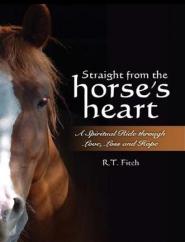
Below is the story and excerpt from our book, Straight from the Horses Heart: A Spiritual Ride through Love, Loss and Hope that was written in the cool, crisp dawn after the events of Saturday, February 1st, 2003.  It is the first equine insight I ever penned and because of that it will always be special.  We offer to you, today, in memory of those who lost their lives that day and to the memory of all those I have loved and lost since.

I mean it most sincerely when I say, ‘May the Force of the Horse® be with You!’” ~ R.T.

~~~~~~~~~~~~~~~~~~~~~~~~~~~~~~~~~~~~~~~~~~~~~~~~~~~~~~~~~~~~~~~~~~~~~~~~~~~

I Sit in Wonder

It started out as any other Saturday; up before the sun, make coffee, check email, say ‘hello’ to the dogs, greet the horses, and review the list of projects that needed to be accomplished before the sun set in the evening; however, this Saturday had a few dramatic twists.  I needed to be several places at one time during the same time frame, so there would have to be some fancy juggling.  The electricians were coming out to wire the new horse barn; at the same time, the farrier was arriving to trim the horses’ hooves; plus, we needed to pick up a load of hay prior to noon.  So, it was time to dance.

On the morning of Saturday, February 1st, 2003 all of Lafayette Parish, Louisiana was under a dense fog warning.  I stepped out of the house at sunrise, it was obvious that things might be moving a little slower until the fog lifted.

Ethan ~ by Terry FitchI was immediately greeted by the pair of happy-go-lucky German Shepherds who are always excited on Saturday morning as they get to go for a ride in the Big Red Truck to get hay.  Oh what fun!

As I gazed out into the pastures, I could not make out the four pampered ponies, as the fog was too thick.  I walked out through the back of the barn and no one was to be seen, so the odds were pretty good that they were in the back pasture munching down on their round bale.  I stepped out several yards, gave a call, and waited.  The mist swirled around me like foam in the surf as I listened intently for rumbling hooves, but the morning maintained its silence.

Unhurriedly, like dolphins slipping through the depths, the phantom shadows of the horses gradually began to materialize before me.  One at a time, in order, in line, they calmly walked up to me in formation for their rub on the withers, pat on the chest, and scratch on the belly; each taking their turn at receiving their morning hello, until all four circled me.  Together, we walked back to the barn.

At the barn I stopped and surveyed the new side gates that lay in place, waiting to be installed by the part-time ranch hand – me.  While Harley gently mouthed my cell phone in an effort to steal it from my belt, I began scratching down a list of hardware that I was going to need to accomplish the gate project.  I dropped my pen which meant Harley hit pay dirt as he quickly grabbed my cell phone and gracefully twirled it above my head by the antenna.  A big grin emerged on his face as this is his favorite game and he managed to accomplish the cunning feat without my interference – Harley one, Human zero.  I carefully retrieved my phone and bent down to pick my pen up when suddenly I heard a distant pop, bang or shot.  Immediately, I became alert to the fact that I was standing amidst a small herd of horses, in limited visibility, with “scary” noises occurring.

Quickly, I looked at the horses and then relaxed as they did not spook; they were not flustered or even nervous.  In fact, they were standing in an alert stance, heads held high and ears at full extension looking to the north/northwest, the opposite direction from whence the sound had come.  I wondered if it was a gun shot.  The thought slowly slipped away into ‘LaLa Land’ as I proceeded with my tabulations.  After all, who in their right mind would be hunting in the middle of a fog bank?

I remember concluding my list, walking back into the barn, and turning to gaze at our equine children – they were still there, standing in place.  In fact, they were in formation, one in front, three in back staring ever so intently to the northwest.  Their formation reminded me of a delta, a triangle pointing into the direction of their labored glare.  I was confused.  How could they be so interested in looking in the wrong direction; what were they hearing; what did they think they were seeing; and what was going through their minds as they appeared to be mesmerized and in a trance?

The sight of them there, standing in the mist looking off into nowhere, disturbed me to the point that I called to them.  No one budged.  I called again and the head of the Appaloosa slowly turned in my direction just enough so that one sad eye could look at me.  I motioned to him and he slowly turned around, walked to me with his head lowered and nuzzled my hand.  I scratched his forehead and noticed that his right eye had just formed a tear, one lone solitary tear.  I asked if he was sad; I asked if he wanted more food; I asked what the problem was and only heard a gentle sigh in response.  I dusted it off and went back to work.

At the time, I did not know that to the north of our quiet farm, a comet named Columbia was passing overhead, a bright meteor carrying the souls of seven courageous and generous human beings home.  I did not know.  I had no clue that seven souls of my species were headed across the bridge high over heads.  I did not know.

Four horses, however, stood gallantly at attention; four horses looked to the sky; and four horses felt something that I did not.

In reflection, I wonder if I did not miss something else that morning, something that my single-minded human brain did not hear, something special, something wondrous; yet, I was not listening.  I now sit in wonder and roll it over in my head time and time again, that gentle sigh, that horsy response, and the tear in that eye.  What did it say; what did it mean?

Did I really hear something in the gentle escape of air from those equine lips, a sound so profound that it did not compute at the time it happened?

Was that a gentle whisper, a thought, a suggestion?

Was my soul, and not my ears, hearing those quiet words?

Was the meaning really what I now believe it to be?

Was my heart touched by the souls of the four horses when I still failed to understand; yet, admittedly heard the whisper, the soft voice that spoke on another level. “We are so sorry; we are so very, very sorry.”

I sit in wonder.

space-shuttle-columbia-crew

by Kristyn Leon of Colorado’s Fox 21 News

“Horses are sensitive, majestic creatures, and seem to truly understand what the person truly needs.

“It’s ‘Feel Good Sunday’ and time to take a break from the bad news (not even going to there) that rains down upon our American equines.  Time to catch our breath, wipe our brow and embrace all those who diligently fight beside us to further the future welfare and safety of our horses, donkeys, burros and mules.  I had planned to write a wrap-up of the past week’s events but think, instead, that I will take a dose of our own medicine and call it a wrap.  Thanks to all of you for what you do to benefit our equines both domestic and wild…you are the voice of the voiceless and very precious, indeed!  Be safe!” ~ R.T.

~~~~~~~~~~~~~~~~~~~~~~~~~~~~~~~~~~~~~~~~~~~~~~~~~~~~~~~~~~~

COLORADO SPRINGS, COLO. — It’s more than just a horse ride for the community at the Colorado Springs Therapeutic Riding Center. The therapeutic riding center is about fostering relationships, boosting confidence, and creating life-long friendships for patients and their horses.

For one Colorado Springs family, the center has truly impacted and touched their lives. Their son, Michael, was diagnosed with autism at an early age. Michael’s dad, who served in the army was also deployed to Afghanistan, and this triggered a lot of anger for Michael. He wasn’t talking and needed an outlet to channel his emotions.

That’s when his mom, Karen Fetters, discovered the Colorado Springs Therapeutic Riding Center and what it offers to its patients. Michael began riding horses and working with therapists at the center to help him develop his cognitive and social skills. Everyday Michael was improving. He began to socialize with those around him, and through his friendship with his favorite horse, Michael changed for the better.

Deanna Shrewsbury, an equine assistance psychotherapist, pointed out the powerful human and horse interaction.

“When you’re in a relationship with a very large animal, it forces you to learn the importance of trust and how to problem solve verbally and creatively,” Shrewsbury said. ”Horses are sensitive, majestic creatures, and seem to truly understand what the person truly needs. They just want you to enjoy the moment with them.”

Michael’s family said horse therapy has helped them cope through difficult times in their lives, such as Michael’s autism and his father’s deployment overseas. Michael’s dad was also recently diagnosed with mutiple-schlorosis.

Ultimately, through the support system offered from the horses and equine staff at the Colorado Springs Therapeutic Riding Center, Michael has learned coping mechanisms, developed healthy relationships, and benefited from this life-changing experience.

Please, click (HERE) to visit Fox 21 and to Comment

By of the New York Times

“This is only a ticking time bomb…”
(Click Image to view Video)  The Devon Horse Show and Country Fair in Pennsylvania, one of the oldest and biggest in America, features hunting, jumping and other events.  Photo by Kristen Catalanotto

(Click Image to view Video) The Devon Horse Show and Country Fair in Pennsylvania, one of the oldest and biggest in America, features hunting, jumping and other events. Photo by Kristen Catalanotto

Early on the morning of May 26, Kristen Williams and her daughter, Katie, arrived at a barn on the grounds of the Devon Horse Show, where elite competitors in full dress have entertained spectators for the last century on Philadelphia’s Main Line.

Ms. Williams had paid thousands of dollars to lease a pony for Katie to ride in a hunter competition, a 12th birthday present. Soon after arriving, their trainer left to administer an injection to a nearby pony, Humble, that Katie’s friend, also celebrating her 12th birthday, was scheduled to ride shortly.

Moments later, with Ms. Williams and her daughter watching, Humble collapsed and died. The death of a supposedly fit pony about to carry a young rider over hurdles was worrisome by itself, but circumstances surrounding the death made it even more so.

In the three days before Humble died, he had been scheduled to receive 15 separate drug treatments, including anti-inflammatories, corticosteroids and muscle relaxants, according to his medication chart.

“The average horse that walks in my clinic here doesn’t get anything like that,” said Dr. Kent Allen, chairman of both the veterinary and the drugs and medications committees of the United States Equestrian Federation, the sport’s nonprofit governing body. “It gets a diagnosis and then gets a very specific, appropriate treatment.”

The horse-racing industry has openly debated the influence of drugs on the safety and integrity of the sport, and has taken significant steps this year to minimize it. But in the cloistered equestrian world, medicating horses has attracted much less public attention.

Since 2010, random drug tests at various equestrian events, including the Olympic trials, have uncovered dozens of violations for substances like cocaine, antipsychotics, tranquilizers and pain medication — even ginger placed in a horse’s anus to make its tail stick out.

While show-horse trainers have abused some of the same drugs that have caused problems in racing, the Equestrian Federation has lagged behind in regulating how they are administered. Now, the circumstances surrounding Humble’s death have become a rallying point for those who believe that the federation should more aggressively investigate drug use.

The federation says it responds promptly to drug concerns, citing its decision in February to ban a popular but potentially lethal drug that sedates horses, making them more manageable during competition. The group has also limited the use of anti-inflammatory drugs in competition. It randomly tests 10,000 to 12,000 horses annually. “We constantly look at issues in our sport and try to be proactive,” Dr. Allen said.

Still, a review by The New York Times of federation records, police reports and interviews with veterinarians and others in the sport shows that despite its best intentions, the federation is ill prepared to deal with episodes like Humble’s death.

At racetracks, only veterinarians are allowed to administer intravenous drugs, but on show grounds anyone can stick a needle into a horse before it performs. A year ago, the sport’s top veterinary group recommended that no horse receive drugs within 12 hours of competition. The Equestrian Federation has yet to adopt that rule. Humble was injected roughly two hours before competition, records show.

The federation also has no detailed protocol on how to respond when a horse dies on show grounds. In Humble’s case, there was no requirement that the vial and syringe be retained so its contents could be tested. And the federation relied on the mother of a competitor who saw Humble fall to collect evidence, hire a lawyer, and file a formal protest.

The federation, often referred to by the acronym USEF, convened a hearing panel, but it had no subpoena power and could not compel Humble’s trainer, Elizabeth Mandarino, to fully answer questions about the pony’s medical care, records show. The panel ultimately dismissed the protest, saying it did not have enough information to conclude whether Ms. Mandarino had violated federation rules.

Ms. Mandarino declined to be interviewed for this article, but her lawyer said in a statement that she had done nothing wrong, and that Humble had most likely died from an undiagnosed lung disease.

Federation officials point out that equestrian events run largely by volunteers cannot be compared to state-regulated horse racing, where access to the horses can be tightly controlled.

Even so, responding to questions from The Times, the federation’s chief executive, John Long, said in a statement, “It is clear that the Mandarino case has highlighted significant limitations in the USEF’s rules and procedures governing our investigative powers.”

The group, which oversees about 2,500 events each year, has assembled a task force to investigate safety issues stemming from Humble’s death, so that “the federation does not find its hands tied in the future when a matter of animal welfare like this presents itself,” Mr. Long said.

Much of the concern about drugs centers on hunter competitions, where young riders and future Olympians develop their skills.

“This is only a ticking time bomb,” said Julie Winkel, who runs a stable and has judged major shows nationally. “It’s not only the wrong thing to do for the horses, but I think it’s a very dangerous situation that we have created for the rider, handler, even grooms.”

Calming the Horses

More than blue ribbons and prestige are at stake in equestrian competitions. Horses that win big events increase in value, rising into the hundreds of thousands of dollars.

Hunters are judged subjectively, with an emphasis on well-mannered horses that jump safely and smoothly over fences. Temperamental horses with unnecessary movement or exuberance show poorly. Time is not an issue.

For these reasons, calming drugs and supplements are popular on the hunter circuit, even though drugs that influence a horse’s behavior are banned in competition.

Calming drugs allow horse owners to lease their animals to less skilled riders willing to pay thousands of dollars to compete. As one owner said, “It’s like putting training wheels on a horse.”

They also stunt the development of many young riders, according to George H. Morris, the show jumping chief of the United States Olympic team.

“There is more and more medication, more exhausted horses, and more incorrectly ridden horses,” Mr. Morris said at a federation forum last year.

Besides creating an uneven playing field, some calming drugs can endanger horse and rider, and be difficult to detect in post-competition testing.

A prime example: an injectable calming supplement called Carolina Gold. The federation first heard of it from competitors early in the summer of 2011, according to Dr. Stephen Schumacher, the federation’s chief veterinarian.

“The reason people were talking about it was because they were tired of getting beat by people using this substance,” he said. “We were also hearing reports of horses falling down.”

The federation learned that Carolina Gold had been used in horse racing, and that a veterinarian in South Carolina, Dr. Juan Gamboa, a rider and competitor himself, had been among those selling it. At the time the drug had not been banned in competition. Dr. Gamboa, who did not respond to requests for an interview, has served as a veterinary delegate for the Fédération Equestre Internationale, the sport’s international governing body.

To see how Carolina Gold affected horses, federation officials injected one with the substance. “The horse nearly collapsed,” Dr. Schumacher said. “It starts shaking and was really out of it.” The reaction was so worrisome that the attending veterinarian refused to test it on any more horses.

The federation now knew the drug was dangerous, but there was a problem: it was undetectable in horses.

Dr. Alex G. Emerson, a Kentucky veterinarian who blogs about horses, wrote this year that he had long worried about Carolina Gold’s “narcoleptic” effect. “How can half-asleep horses jumping three-foot wooden fences with a live human on their back be considered safe?” he wrote.

The federation eventually did develop a test for Carolina Gold and this year banned the sedative from competition. Within months, the drug had dropped in price to the point where “you couldn’t give that stuff away,” said the federation’s Dr. Allen.

Not everyone heeded the warning. The federation recently fined and suspended two trainers for using the active ingredient, a tranquilizer, in Carolina Gold and has other cases pending.

Another calming substance that worries the federation is injectable magnesium sulfate.

“It is readily available on the lay market,” said Dr. Midge Leitch, a veterinarian on two federation committees. “We’ve had a couple of quote-unquote suspicious deaths at performance horse competitions, which were probably related to inappropriate administration, either too fast or too much, which have an effect on heart rate and rhythm.”

The federation says it cannot yet test for abnormal magnesium levels, partly because magnesium, unlike Carolina Gold, occurs naturally in the body.

“It has a low margin of safety and can cause toxicity at doses that are not much higher than those used to produce a sedative effect,” said Dr. Rick Sams, who runs the drug testing lab for the Kentucky Horse Racing Commission.

The Equestrian Federation says magnesium in oral form does not affect performance. Yet marketers of oral supplements that include magnesium say otherwise. The makers of “Perfect Prep” products recommend using its “Extreme Formula” 90 minutes before a performance without fear that it will be “detectable as a foreign substance by the laboratory tests run by the governing bodies of high-level equine events.”

The company’s Web site included testimonials from trainers praising the formula’s calming action. “Nice horses become even nicer and even the tough ones melt,” one trainer says.

Heavy Medication

A week before Devon, Kristen Williams took Katie, her daughter, to a Florida show to try out Royal T, the pony she planned to ride at Devon. Katie’s friend Katie Ray had also traveled to Florida to try out her pony, Humble. Both ponies were owned and trained by Ms. Mandarino.

Afterward, Ms. Williams said she was surprised that Ms. Mandarino’s invoice listed $435 for unidentified “supplements.” Katie Ray’s mother, Carrie, had been billed $250 for unidentified supplements, records show.

At Devon, the following week, Ms. Williams came across the list of 15 scheduled drug administrations. All the drugs were legal. Saying she was shocked to see the horse so heavily medicated, Ms. Williams snapped a picture of the list with her cellphone. The following day, Humble collapsed and died after receiving another injection, this one not listed on the chart.

When told of the list of drugs, Dr. Rick Arthur, chief veterinarian for the California Horse Racing Board, said, “The treatment seems intensive even by racetrack standards, but I am unfamiliar with show-horse practices.”

Dr. Allen, who has extensive show-horse experience, said most veterinarians he knew could not imagine using all these drugs, “particularly large amounts of them in multiple combinations.”

The federation is realizing, he said, “that a very few trainers or owners are out there envisioning themselves as the veterinary managers of these horses, and they are giving a lot of medication with a small, very small, amount of knowledge, and to us that’s scary.”

Ms. Mandarino, who is not a veterinarian, told the police that she had given the pony the final injection. But according to a report filed by a federation steward, Carrie Ray, the mother of Humble’s rider, said Ms. Mandarino implicated a groom, saying he must have missed the vein and hit an artery. Ms. Mandarino has said the medicine was Legend, used to treat joint problems.

“Does it bother me that somebody injected a horse that close to competition? Yes, it does bother me,” said the federation’s Dr. Schumacher. “We’ve got to find a way to enforce whatever we want to put in place to curb that behavior.”

The burden for investigating Humble’s death fell largely to Ms. Williams, who described herself as a relatively inexperienced “pony mom.”

“What if Humble had made it to the ring and collapsed with Katie on his back?” Ms. Williams stated in her protest filing in June. “I am extremely concerned for the welfare of the animals and the innocent children that could potentially be victims.”

In his statement to The Times, Mr. Long of the federation emphasized that without subpoena power, its inquiries relied on members’ voluntary cooperation. He pointed out that Ms. Mandarino, through her lawyer, had refused to comply with requests for information and documentation of all substances given to Humble in the week before he died, and had even challenged the federation’s right to make the request.

Ms. Williams helped gather statements for the hearing from people who said they had seen Ms. Mandarino giving injections to horses.

In one statement, Dina Hanlon-Fritz said that her daughter, who worked for Ms. Mandarino for two months in early 2011, had seen the trainer “injecting the ponies twice a day every day so they would behave in the show ring.” According to the statement, Ms. Mandarino would yell at Ms. Hanlon-Fritz’s daughter because she “wasn’t able to get the blood off of the white ponies after so many injections.”

In another statement, Nancy Baroody said that while boarding her pony with Ms. Mandarino earlier this year, she saw her administer an injection just before the start of a 7 a.m. show. “I walked out of the tent area in disgust,” Ms. Baroody said.

And Wendy Brayman wrote that while she was with her daughter, who rode Humble in 2011, “just about everyone” associated with Ms. Mandarino was administering medicine. “I was often asked to get medicines from her drug chest,” including Carolina Gold and magnesium, Ms. Brayman said.

Ms. Mandarino did not attend the hearing, citing a death in the family. Instead, she produced statements attacking the motives of her critics and offering praise from clients, federation members and veterinarians.

Ms. Mandarino always provided “the utmost care in veterinary medicine” for her ponies, wrote Alexis G. Newman, a federation member. Ms. Mandarino also produced statements from suppliers saying they had not sold her Carolina Gold or other banned substances.

A post-mortem exam of Humble found an anti-inflammatory and a muscle relaxant, though not in excessive amounts, and no illegal drugs. In addition to emerging lung disease, the exam concluded that the pony could have died from “an overwhelming allergic response to medications or environmental triggers,” but said that was “speculative and impossible to confirm.”

In the end, the federation hearing panel dismissed Ms. Williams’s protest, saying it did not have enough evidence to decide if rules had been broken.

Ms. Mandarino filed an unsuccessful complaint against the federation’s general counsel with the Kentucky Bar Association and has filed a lawsuit accusing an online publication, Rate My Horse PRO, and various individuals of conspiring to harm her business. Rate My Horse PRO, which says it is an advocate for horses, has filed papers seeking to have that lawsuit dismissed.

A growing number of people in the horse world see another way of thinking about a horse’s behavior in the show ring. One approach that would reduce the incentive to medicate would be to change the judging criteria for hunters, said Ms. Winkel, the horse show judge and chairwoman of the officials committee for the United States Hunter Jumper Association.

This year, Ms. Winkel’s committee called for judges to stop rewarding horses for robotic conformity.

“People are realizing that it’s O.K. if horses are a little fresh and a little happy,” Ms. Winkel said, adding, “Why don’t we take a little more time and train these horses properly and educate their clients and give them better horsemen skills, other than to bring out a needle and a syringe every time we have a horse show.”

Joe Drape contributed reporting.

Click (HERE) to View the Times Video