

Report by Carol Walker, WHFF advisory board member, as posted on Wild Hoofbeats
“There was absolutely no mention of cattle or sheep on the range, who vastly outnumber wild horses”
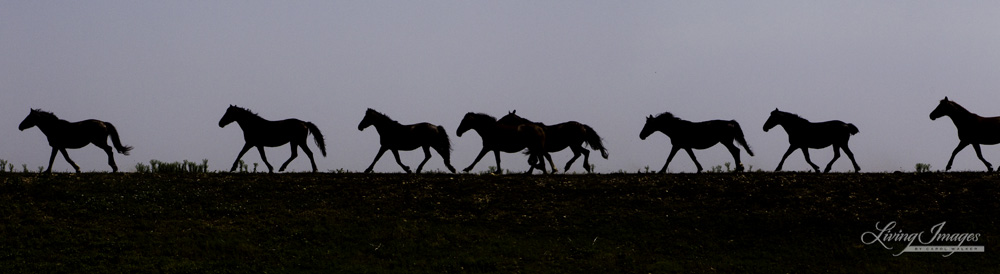
“Mares on the Ridge” by Carol Walker of Living Images
On Saturday morning, I drove to the Walmart in El Dorado, Kansas to go on the tour provided by the Bureau of Land Management of one of the largest Long Term Holding facilities for wild horses in the country. With 4400 wild horses on 3200 acres, Bob Buford’s Shadow 7 Ranch is known to the BLM as the “Teeterville Complex.” There were lakes and plentiful waterholes and very green grass, almost so green it hurts your eyes, completely unlike the arid, sparse range that these horses are used to.
Over 200 members of the public signed up for the tour, and there were more BLM staffers than I have ever seen in one place before, including from Washington D.C. Lily Thomas and Joan Guilfoyle, new Chief of the Wild Horse and Burro Division. Many of the people on the tour had never seen a wild horse, but there were also people wearing mustang club t-shirts.
While on one of the 5 huge air conditioned buses, we were given explanations about wild horses on the range and the need for holding facilities, and shown excerpts of the shiny new BLM Propaganda DVD “The Story of America’s Wild Horses and Burros.” We were also told that the main problem facing wild horses was overpopulation. There was absolutely no mention of cattle or sheep on the range, who vastly outnumber wild horses.
At least they did not include portions of Lili Thomas’ video where she claims that wild horses are far better off in long term holding than in the wild, and that the BLM is “removing them from stress” – in case you missed this gem, here it is: http://www.thehorse.com/Video.aspx?n=behind-blm-pasture-gates&vID=578
Some of the rhetoric made it seem as though the horses in this facility would never leave, no longer eligible for adoption, but live out their lives in idyllic splendor in the rich grass fields of Kansas. But I did ask and clarify that the 10 and older horses could be sold without limitation, and were at risk of ending up who knows where – at risk of being slaughtered. Paul McGuire from Oklahoma told me that only 1000-1500 horses were sold per year from long term holding, but when I had an opportunity to speak to Bob Buford myself, those figures seem low. He told me had had just sent 200 to a couple of different states, and this last year had sent 1700 to Hutchison Correctional Facility. He told me that the mortality rate is about 3 – 4% and the horses can live to 25 or even 30, which is a good 5-10 more years than in the wild.
35 million dollars from American taxpayers is spent every year keeping these wild horses in short term and long term holding facilities, instead of leaving them free on the range. Many more millions are spent each year rounding up and removing them from their homes.
With 5 buses, you can imagine that wild horses might not be easy to get close to, and you would be right. We started in the mare pastures, with horses being segregated by sex, as in all the holding facilities. At the first stop, as people piled off the buses cameras in hand, the horses ran, stopped, moved around, and got further and further away from all the hullabaloo. Some of my closer images were taken out of a tinted bus window.
We got off the buses two more times, and were treated to a large group of mares curious enough to run a big circle around the vehicles. Then we headed to a huge machine shed for lunch, mercifully not being treated to a long lecture by the BLM – they though better of it given the heat and so many people packed into the building.
After lunch we headed for the gelding pastures in another part of the ranch. The geldings seemed far more skittish than the mares, and every time we saw horses they ran. They also were in much smaller groups, and we saw two or three horses together as well.
Bob Buford attempted to get a group of geldings to come closer with the help of 4 wheelers, but the wild horses were smart enough to get away, and keep going.
During the tour, I was very aware of the absence of one of the most vital parts of wild horse society – family. It was odd seeing groups of mares all by themselves – they formed in large groups, very unlike the usual small families of 2 to 10, with the stallion, mares, youngsters and foals. It is a beautiful, sterile environment, and reminded me more watching of a group of ranch horses than wild horses.
The horses seemed to be in good condition, and many people asked me about their feet, which I was not able to get a good close look at, but zooming in on the photos showed wear and tear that looked like in the wild.
After this, the decision was made to head back to Walmart and our cars, including mine with my “Save America’s Wild Horses” magnets on the side – I received quite a few thumbs up on this. The BLM stayed to answer questions, and I was happy to get on the road heading toward home, and my three adopted mustangs.
Click (HERE) to visit Carol’s site and to view her outstanding photos
Related articles
- Americans Want Aid Sent to Pregnant Wild Horses and Babies – Not to Stampede Them (rtfitchauthor.com)
- Breaking News: Roundup of Wild Horses to Begin Despite Risks to Tiny Foals and Pregnant Mares (rtfitchauthor.com)
- Experts Urge BLM to Halt Massive Arizona Burro Roundup in High Desert Heat (rtfitchauthor.com)
- It’s Official: BLM’s Welfare Cattle Program Killing Western Public Lands, Wild Horses Not Guilty (rtfitchauthor.com)
- Wild Mares Giving Birth to Litters?(according to BLM population estimates, they do) (rtfitchauthor.com)
- Noted Wild Horse Photographer Exposes BLM Grazing Threat at Sand Wash Basin (rtfitchauthor.com)
- Government Transparency and Public Process on Wild Horses and Burros Jeopardized (rtfitchauthor.com)
- BLM Puts Public in Holding (rtfitchauthor.com)
- California BLM shows Transparency why not Nevada? (rtfitchauthor.com)
- Update: American Public Speaks Out on Lack of BLM Transparency (rtfitchauthor.com)
- Bumbled BLM Chopper Meeting Gets Bad Press and Crashes in Poll (rtfitchauthor.com)
Categories: Horse News, Wild Burros, Wild Horses/Mustangs





 Straight from the Horse's Heart
How are these horses managing on all that lush grass after growing up pretty much in desert?
It seems to me that at least some would have problems adjusting – I just remember how careful we used to have to be in the spring with any of thehorses that tended to be colicky at all.
I just think a drastic change in forage like that has got to bother some of them. And like you, wondered about their feet – how they could keep their feet worn down.
Sounds like they havent lost their suspicions about people…
LikeLike
Maggie, I was thinking the same thing when I read “lush grass”. Our oldest mustang doesn’t tolerate our pastures here in the south well at all, except in winter. He’s diagnosed as metabolic, which I hear so many mustangs removed from the range end up as, so we had to put in a track system and stock up on low sugar hay. I wonder how many of these mustangs have had issues with EMS, laminitis, and founder, just to name a few.
And why the heck would a prison system need 1700 mustangs??!!
LikeLike
Like Robin above, I quetion how a prison system would need and get 1700 mustangs. Are they a shipping location for mustangs to end up at the slaughering locations. I don’t trust the BLM any further than I could throw them. I know what I would like to see happen to the whole organization and they wouldn’t like it. They are a disgusting group of individuals.
LikeLike
Agree. Have always wondered how these prisons are holding so many of our horses. What’s really going on there? THey must have some backdoor operation going on. Some reporter needs to find out.
LikeLike
Less than 3/4 acre per horse whereas BLM states in their capture EAs that on some HMAs only one horse per thousand acres is all they can “manage”. This long term holding (Shadow 7 LLC) has made over 18 million dollars in the past 10 years and as my late father used to say, “what a racket”.
Thank you, Carol.
LikeLike
Thank you R.T. for attending this farce. Hopefully all 200 people on the bus tour could see through the charade. How surreal it must have been. Thank you for all you’re reporting
LikeLike
Hi Tina…it was not I who wrote this report but our good friend, Carol Walker. Please be sure to hit the link at the end of her article to view all of her great pictures.
LikeLike
With regard to that many horses going to the prison, I would wonder if there slaughter facilities at the prison or whether the prison was a holding site for kill buyers. I suppose it is possible that the prisons could be using the horses for therapy or activity for the prisoners, but I don’t know. I’d like to see an investigation of this.
All this skepticism and lack of trust of the BLM is a result of the BLM’s historic duplicity.
LikeLike
http://www.foiadvocates.com/
Ask the BLM nicely first – ask Sally Spencer.
If she refuses to give you info, first ask her WHY and then FOIA it.
This is not a global security issue here – this is public information that you and I have a right to know.
In addition, since this is data that is already in their databank there should be NO charge to you.
Ask that the info be transmitted to you electronically (i.e. emailed to you via excel spreadsheet).
Then if they refuse or hassle you announce it here so the public knows.
If you get the data then PLEASE share it with all of us.
Thanks and good luck.
LikeLike
I am so happy that someone like Carol reports these tours to those of us who cannot be there in person.
I am torn between being happy for these horses and sorry that they are not back in their old areas in family groups.
This facility is truly lush and they are healthy and happy even though not as free as in the wild.
The horses I feel so sorry for are the ones in the holding pens, just wastelands with hay and water, just standing around.
If they cannot be truly free, then this piece of land and others like it, is better than the pens by far.
LikeLike
They do not have their family units. How “happy” can they be without their family?
LikeLike
BLM doesn’t ship them to slaughter, technically.
There is a loophole called “sale authority” that allows bulk sales to dealers.
The dealers ship them.
Semantics game.
“Sale authority” needs to be repealed.
LikeLike
Yes you are correct – it is a slick and slimey process but the bottom line is the same – our mustangs are going to slaughter.
Now, if you and I were the BLM people that interviewed for these potential “large shipments” of sale authority horses and burros to private parties and we were the decision makers on this … would we not be smart enough to know where these wild ones were going? And would we not also do something to stop this or would we just sign the sale contract and then look the other way? If we did sign and “look away” would that not make you and me just as guilty as the buyers?
Funny that when I bought one sale authority horse I got the fifth degree including who the vet would be and how much water was available etc etc etc … and yet trailer loads are sold all the time and “everyone” knows that most all these Wild Horses and Burros will pass through a few layers of cover up owners and then “be gone”.
Even though this is common knowledge, after saying this “out loud” … I imagine I might “be gone”?
LikeLike
This is a 45 page document, including UDSA export charts.
Click to access Investigation-Gelding%20Exports_Final_VJP_11-13-2007.pdf
Investigative Report
Case Study
Suspected Illegal Exports of
Geldings by Non-Slaughter Shipment
From New Mexico to Mexico
By Valerie James-Patton
November 2007
Introduction
After several months of tracking the numbers of horses on the USDA Market News –
New Mexico Livestock Export to Mexico Reports, and comparing the numbers to the
USDA Texas Livestock Export to Mexico Reports, an unusually high number of geldings
being exported to Mexico from New Mexico under the non-slaughter status were noted.
Questions regarding these disproportionately high non-slaughter gelding exports are
compounded by the fact that no breeding females or breeding males are being exported from
New Mexico while the Non-Slaughter gelding exports continue to climb to record levels.
Page 1
Bureau of Land Management (BLM) Long Term Hold Facilities
As of Sept 9, 2007, BLM has contracted 10 long-term holding facilities in the United States, two
of which were recently added after July 2007. Six of the facilities are in Oklahoma, three in
Kansas, and one in South Dakota, with each facility being either a ‘mares only’ facility or a
‘geldings only’ facility.
Geldings Only
Six out of BLM’s ten long-term holding facilities are exclusively ‘gelding only’ facilities and
according to the September 9th, 2007 BLM Facility Inventory Chart, there are 11,756 geldings in
these long-term holding facilities. (Attached)
Whitehorse, South Dakota, the newest long term gelding facility, is starting out with 580
geldings and the Kansas, Tetervillw East gelding facility currently holds 2,083.
The other 4 gelding facilities are all located in Osage County, all of them holding over 2,000
geldings at each facility, with the current total for Oklahoma at 9,093 geldings. The facility in
Foraker, currently holds 2,495 geldings, and the Hulah facility holds 2,199 geldings.
The other two Oklahoma BLM long-term ‘gelding only’ facilities are contracted to John Hughes,
an Oklahoma cattle rancher, who keeps about 4,400 geldings between his two 2 ranches, both in
Osage County, one located in Bartlesville, and the other located in Catoosa.
BLM does not report the flow of horses that are sent to long-term facilities and there is virtually
no way to track this flow. In other words, they don’t show the flow of horses being sent to each
facility or of those deceased. One hundred horses could easily disappear and be replaced
within a week and the reports would not show these figures. BLM facility reports only provide
a “snapshot” of containment numbers, not the flow of horses moving in and out of the holding
facilities.
Additionally, all the paperwork for the Oklahoma and Kansas BLM long and short term
holding facilities, as well as the processing of all the adoption paperwork of wild horses for both
Oklahoma and Kansas, is handled by the BLMs Administrative Program Office in New Mexico.
(As shown on the BLM facility reports by state initials next to each facility – Attached)
Conclusion
Geldings shipped from New Mexico to Mexico are obviously not being exported for breeding
purposes. What other purposes could be served for exporting thousands of non-slaughter
geldings into Mexico if their final destination is not slaughter? There is little doubt that most, or
even all of these geldings are actually going over the border for slaughter as their final
destination due to the sheer numbers being exported.
LikeLike
This report was written in 2007???????????? Apparently noone ever read or looked at it or cared!
So this has been going on for (at least) 5 years – its a wonder there are any mustangs left.
Was Valerie James-Patton able to bring it to anyone’s attention?
This must be yet another of the BLM’s & other agencies little secrets, right?
Soylent Green is a definite possibility! (this says I’m old enough to remember that movie)Someone else mentioned this a while ago in the comments.
I’m still waiting to hear where the former horses at Palomino Valley disappeared to!! Havent read anything about that.
Hope the 2 people who got harassed at the Burro roundup are ok. BLM getting more out of hand all the time. But it also brings it out into the public eye.
LikeLike
Maggie, Cindy MacDonald wrote an excellent article. Here are just a few excerpts. You can go to her website and read the entire article:
http://americanherds.blogspot.com/2007/09/where-have-all-geldings-gone_06.html
Where Have All The Geldings Gone?
The geldings are the exclusive class of animal being shipped through this port under a “non-slaughter” listing, begging the questions-
-Why only geldings?
-Where are all the geldings coming from?
-What is Mexico doing with only geldings and no other class of horse?
They can’t possibly be for breeding purposes and once they cross the border, there is no legal limitations that prevent them being greeted by a slaughterhouse fate. Geldings are also worth more by “the pound”.
So what is going on?
Anyone remotely familiar with how BLM conducts wild horse removals knows that almost all wild stallions are gelded when they are removed from the range. Considering BLM has removed over 70,000 wild horses and burros between October, 2001 and March, 2007, logic would suggest the geldings being supplied to Mexico may be coming straight from our own wild American Herds.
LikeLike
Owain, There is no overpopulation prbloem the BLM keeps making their HMAs smaller by allowing more livestock and other uses of water like mining and fracking. Take 80 percent of the cattle off and make the welfare cattle ranchers (big corps that lease the grazing rights at a very low price) pay more per head for grazing the cattle on public lands BUT leave the horses alone!
LikeLike