

By JOE DRAPE of the New York Times
The meat of American racehorses may be too toxic to eat safely…

Eye to the Soul by Terry Fitch of Wild Horse Freedom Federation
PARIS — For decades, American horses, many of them retired or damaged racehorses, have been shipped to Canada and Mexico, where it is legal to slaughter horses, and then processed and sold for consumption in Europe and beyond.
Lately, however, European food safety officials have notified Mexican and Canadian slaughterhouses of a growing concern: The meat of American racehorses may be too toxic to eat safely because the horses have been injected repeatedly with drugs.
Despite the fact that racehorses make up only a fraction of the trade in horse meat, the European officials have indicated that they may nonetheless require lifetime medication records for slaughter-bound horses from Canada and Mexico, and perhaps require them to be held on feedlots or some other holding area for six months before they are slaughtered.
In October, Stephan Giguere, the general manager of a major slaughterhouse in Quebec, said he turned away truckloads of horses coming from the United States because his clients were worried about potential drug issues. Mr. Giguere said he told his buyers to stay away from horses coming from American racetracks.
“We don’t want them,” he said. “It’s too risky.”
The action is just the latest indication of the troubled state of American racing and its problems with the doping of horses. Some prominent trainers have been disciplined for using legal and illegal drugs, and horses loaded with painkillers have been breaking down in arresting numbers. Congress has called for reform, and state regulators have begun imposing stricter rules.
But for pure emotional effect, the alarm raised in the international horse-meat marketplace packs a distinctive punch.
Some 138,000 horses were sent to Canada or Mexico in 2010 alone to be turned into meat for Europe and other parts of the world, according to a Government Accountability Office report. Organizations concerned about the welfare of retired racehorses have estimated that anywhere from 10 to 15 percent of the population sent for slaughter may have performed on racetracks in the United States.
“Racehorses are walking pharmacies,” said Dr. Nicholas Dodman, a veterinarian on the faculty of Tufts University and a co-author of a 2010 article that sought to raise concerns about the health risks posed by American racehorses. He said it was reckless to want any of the drugs routinely administered to horses “in your food chain.”
Horses being shipped to Mexico and Canada are by law required to have been free of certain drugs for six months before being slaughtered, and those involved in their shipping must have affidavits proving that. But European Commission officials say the affidavits are easily falsified. As a result, American racehorses often show up in Canada within weeks — sometimes days — of their leaving the racetrack and their steady diets of drugs.
In October, the European Commission’s Directorate General for Health and Consumers found serious problems while auditing the operations of equine slaughter facilities in Mexico, where 80 percent of the horses arrive from the United States. The commission’s report said Mexican officials were not allowed to question the “authenticity or reliability of the sworn statements” about the ostensibly drug-free horses, and thus had no way of verifying whether the horses were tainted by drugs.
“The systems in place for identification, the food-chain information and in particular the affidavits concerning the nontreatment for six months with certain medical substances, both for the horses imported from the U.S. as well as for the Mexican horses, are insufficient to guarantee that standards equivalent to those provided for by E.U. legislation are applied,” the report said.
The authorities in the United States and Canada acknowledge that oversight of the slaughter business is lax. On July 9, the United States Food and Drug Administration sent a warning letter to an Ohio feedlot operator who sells horses for slaughter. The operator, Ronald Andio, was reprimanded for selling a drug-tainted thoroughbred horse to a Canadian slaughterhouse.
The Canadian Food Inspection Agency had tested the carcass of the horse the previous August and found the anti-inflammatory drug phenylbutazone in the muscle and kidney tissues. It also discovered clenbuterol, a widely abused medication for breathing problems that can build muscle by mimicking anabolic steroids.
Because horses are not a traditional food source in the United States, the Food and Drug Administration does not require human food safety information as it considers what drugs can be used legally on horses. Patricia El-Hinnawy, a spokeswoman for the agency, said agency-approved drugs intended for use in horses carried the warning “Do not use in horses intended for human consumption.”
She also said the case against Mr. Andio remained open.
“On the warning letter, the case remains open and no further information can be provided at this time,” Ms. El-Hinnawy said.
A New York Times examination of American horse racing showed an industry still mired in a culture of drugs and inadequate regulation and a fatal breakdown rate that remains far worse than in most of the world. The examination found that 24 horses died each week at America’s racetracks and that in one recent three-year period, more than 3,800 horses had positive drug tests, mostly for illegally high levels of prescription drugs.
Many American racetracks bar owners and trainers from running horses at their facilities if they are caught sending horses for slaughter, but the cases are difficult to prove. Last May, however, a Quebec slaughterhouse operated by Viande Richelieu returned the former racehorses Canuki and Cactus Cafe to Mark Wedig because antislaughter advocates and racing officials in Ohio and West Virginia were able to show that the horses had been given medications.
Horse meat remains a delicacy in Paris and in other countries for an older generation of Europeans. Henri-Previen Chaussier, a butcher who sells exclusively horse meat in the 13th Arrondissement of Paris, said demand from individual customers was still strong, but he had only one restaurant on his client list, the Taxi Jaune in the First Arrondissement.
“Excellent,” he said of the taste of his product.
Jerome Paviet, a horse-meat wholesaler, said about 30,000 tons of horse meat was consumed annually in France. He said most consumers are older than 45, because during and after World War II, doctors promoted horse meat as a healthy alternative to other meats that had become scarce. Still, Mr. Paviet has moved his business online because of the lack of outlets.
Mr. Paviet said that he started his Web site, www.ma-boucherie-chevaline.com, three months ago and that business had been steady. As a distributor, he said, he expects his meat to comply with the medication rules and be safe.
“We don’t really know if a horse has been treated,” he said. “We expect our Canadian slaughterhouse to be doing their job in controlling the quality on their end.”
Mr. Giguere, who runs the slaughterhouse in western Quebec, said that 200 to 450 horses a week were processed in his facility. He said that in addition to the Canadian authorities on site for testing, his company also performed random residue tests and occasionally spot-checked the drug use affidavits and other veterinary records of the horses it acquired.
He said he expected that more and stricter regulations would be handed down related to the handling of horses for consumption in theEuropean Union.
“It’s not a perfect system,” Mr. Giguere said. “But I’m confident our meat is safe because we work hard at keeping it so in a heavily regulated industry. Three years ago, there was nothing.”
Click (HERE) to visit the New York Times
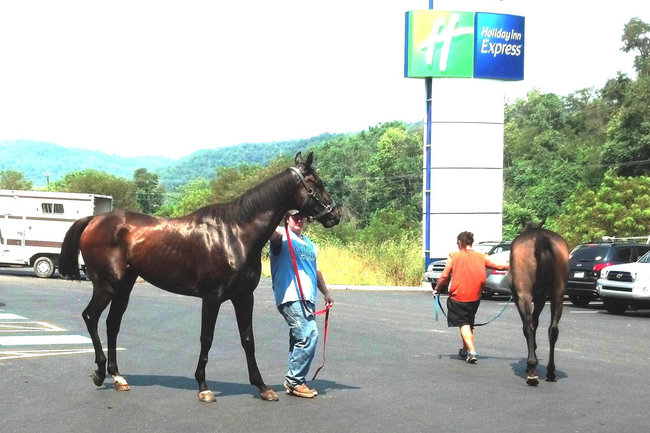
The racehorses Canuki, left, and Cactus Cafe were rejected for slaughter after tests showed they had been medicated. ~ photo by Michele Bollinger (Click Image to View Video)
Related Articles
- Trojan Horse Meat (slate.com)
- Status of US horse slaughter trade still uncertain (horsetalk.co.nz)
- County considering ban on slaughter of horses (heraldnet.com)
- Knowledge of horse-meat origins lacking – survey (horsetalk.co.nz)
- Ontario Race Horses Slaughtered for Meat (rtfitchauthor.com)
- Questions remains over short-lived slaughter halt (horsetalk.co.nz)
- Horse slaughter; is it on or off the table? (rtfitchauthor.com)
Categories: Horse News, Horse Slaughter






 Straight from the Horse's Heart
Too bad all of these horses are not rejected for slaughter!!
LikeLike
They all should be rejected for slaughter. They are all walking pharmacies. I don’t know anyone who owns a horse who has not dosed that horse at least once in its lifetime with Butte; and wormed that horse with a paste wormer. Matter of fact I just bought some today for my horses and it definitely says not to be used in animals slated for human consumption. Theses drugs that are so good for our horses are toxic for humans and they stay in the horses system throughout their lives. These are not farmed or ranched animals. They are athletes, companions and pets. They deserve a dignified end of life rather than the horror of the slaughter house. The Wild and Free Mustangs deserve to retain that status. They should be treated like a legacy rather than a commodity. “Oh what fools these mortals be.” William Shakespeare
LikeLike
They need to leave our horses alone, all horses are wormed, which is a posion.. so every horse has medication… there stupid or they just dont think and want money.. but it will kill the people eating the meat… We dont eat horse meat let them kill there own horses…. God help this country for killing the inoccent horses…..
LikeLike
“We don’t really know if a horse has been treated…”
Common sense tells me: chances are, the majority of all horses have been treated with one or more of the “Banned for human consumption” medications. I hope this kind of info is spread far and wide among the people and they will make the choice themselves to stay away from consuming this animal that is not raised for food.
Not giving up hope! TY
LikeLike
And the only reason those horses got rejected is because of the documentation history required by the racing authorities…not for food consumption, but for racing integrity.
The AVMA/AAEP KNOW the amount of banned substances prescribed and administered to the MAJORITY of US Equines and still support HCHS…AND THE SLAUGHTERHOUSES KNOW TOO!
Cretins!
LikeLike
Every horse owner I know has given their horses banned substances at some time or another. We all know it is not just the racers. TB’s make up a substantial portion of the slaughtered horses. You don’t have to actually make it to the track to be raised with the intent to race. How many horses wash out in training? Don’t think they get drugged too?
LikeLike