

Source: Lauren Donovan – Bismarck Tribune
“…the 2013 Legislature sanctions the preservation of the park horses as a historically important living treasure…”
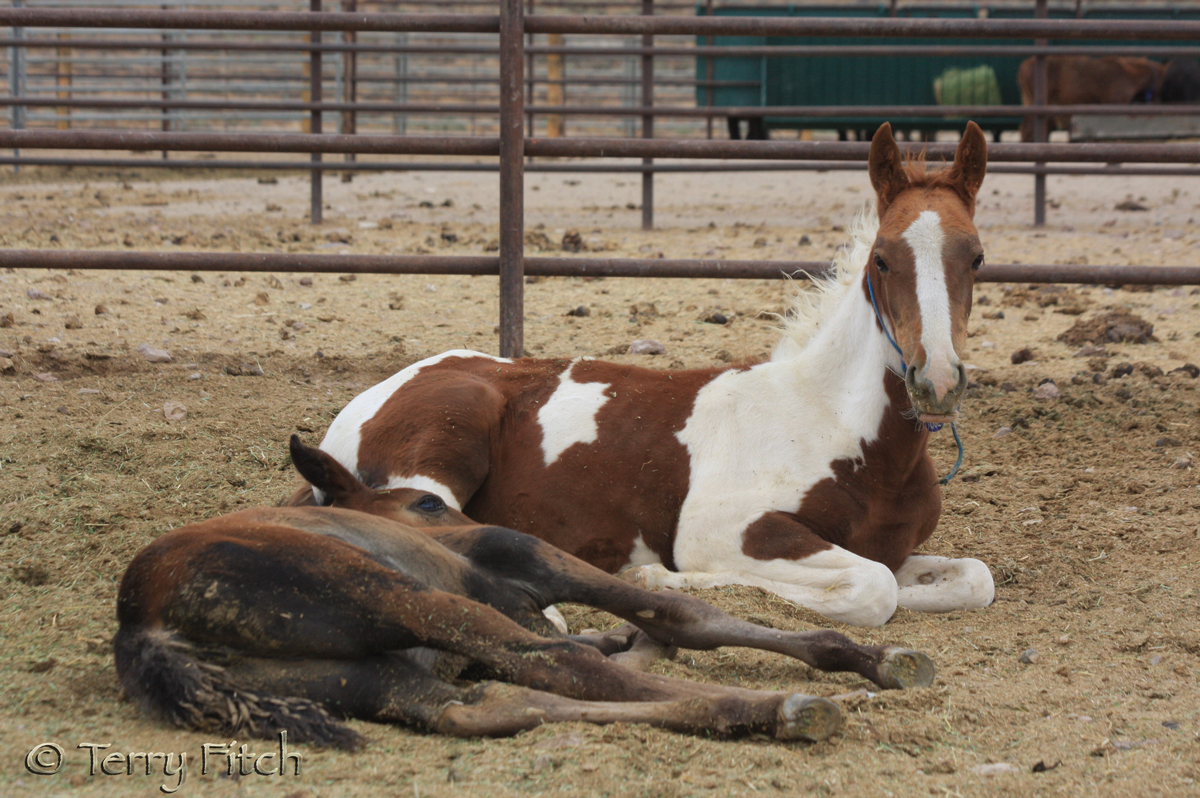
photo by Terry Fitch of Wild Horse Freedom Federation
A North Dakotan who has been working for years to preserve what he says is the original blood line of horses from Theodore Roosevelt National Park says the upcoming wild horse sale is a bad accident waiting to happen.
The park will cull 105 horses from its herd next week and sell them Sept. 28 at Wishek Livestock, the first time it’s held a wild horse sale outside of western North Dakota.
Frank Kuntz, of rural Linton, who formed the Nokota Horse Conservancy to save horse genetics he says date to Sitting Bull’s horses and early ranch stock from Roosevelt’s time in the Badlands, said the Wishek location is dangerous because its outdoor pens are constructed of steel girders and other sharp metal hardware.
“There’s not an alleyway or a pen where they can safely handle these horses,” Kuntz said. “It’s ridiculous to put them in a facility like that.”
Kuntz said he’s especially concerned because one of the park horses jumped the sales ring in Dickinson in 2009 and injured an elderly man in the audience. He said the park should use its own roundup facility, which is constructed with wood and tubular metal.
Park superintendent Valerie Naylor said the sale will continue as planned, though the park’s animal handling facilities near Fryburg could be considered in the future.
She said there is always risk when wild animals are taken out of the wild and handled during the roundups, which are held every several years to reduce the number of horses in the park.
There are some 200 horses in the park and the upcoming sale of roughly an equal ratio of foals and 1-, 2- and 3-year-old horses will reduce the overall number by half.
She said park staff and the livestock barn management are working together to ensure the animals are safe.
“They’re (Wishek Livestock) taking the horses’ safety very seriously and the whole community is taking this very seriously,” Naylor said.
She said ideally, the sale would be held closer to the park, but local livestock facilities weren’t interested, big enough, or available on the date.
The horses will be transported nearly 200 miles to Wishek and Naylor said problems in transport can occur no matter how far the distance.
“We’ll do our best, but there are no guarantees,” she said.
Kuntz has been advocating for the horses’ safety and bloodline preservation and sent letters to the Department of Interior.
He said a resolution passed by the 2013 Legislature sanctions the preservation of the park horses as a historically important living treasure.
Instead, he said the park continues to damage the historic nature of the herd and it no longer represents the old, Native American-infused bloodlines.
Sen. Robert Erberle, R-Lehr, who sponsored the resolution, said it’s wrong for the Interior Department to say the department doesn’t recognize the Nokota name because it’s a registered trademark of one interest group.
“The state of North Dakota is that special interest group,” Erberle said in a letter to the Interior Department. He said it wouldn’t be hard for the park to honor the state’s resolution by culling out horses that don’t have Nokota characteristics and reintroducing those traits if new sires or brood mares are added.
“Having a hodgepodge of sires such as Arabians, Clydesdales and others does nothing to enhance the horse herd in the park,” he said.
Kuntz said he’s been preserving the original bloodlines for decades by buying the most pure horses offered for sale. He said the Nokota conservancy has horses that could be used to restore original genetics in the park horse herd.
“We would be more than happy to do that,” he said.
Naylor said the park has never tried to reintroduce the old bloodline into the herd and has not introduced any new breeding stock for more than three decades.
“I think there would be very little chance that we would put unknown horses that he has bred, or that anyone has, into the park. These horses have been there for generations,” she said.
Related Articles
- Theodore Roosevelt National Park to round up, auction horses – Bismarck Tribune (donnellyunh.wordpress.com)
- Would BLM Sell Horses to Slaughter? (ppjg.me)
- Exclusive: Wild Horse and Wild Burro Good News and Bad News from Twin Peaks HMA (ppjg.me)
Categories: Horse News, Horse Slaughter, Wild Horses/Mustangs





 Straight from the Horse's Heart
Again people need to learn to leave them alone, and all would be as it should be, you would think you all would of learned this a long time ago ? To keep the herd pure you don’t bring in others to breed with, you don’t sell off the horses, how many acres of ground are these horse running on? Why would you take them some place else, 200 miles away to sell them, when it has been said it is not as safe? This is asking for problems, what are you all thinking? You are not using horse sense for these horses. If I were you I would do a lot more thinking then you are doing at this point. I am a horse owner for many a year.
LikeLike
Myself and many others believe that the wild horses should be left alone. It is not the Governments’ grand plan for these wild horses. Something needs to be done to change the Governments’ minds to leave the wild horses alone as nature intended them to be.
LikeLike
Oh the stubbornness and the official laize faire….
LikeLike
“He said the park should use its own roundup facility, which is constructed with wood and tubular metal.” Park superintendent Valerie Naylor said the sale will continue as planned, though the park’s animal handling facilities near Fryburg could be considered in the future.
Perhaps some cash warmed up somebody’s palm in order to have the auction at the commercial facility 200 miles away instead of at the safer and closer park facility? Just wondering.
“Managing for Extinction” – we who look, see it every day.
LikeLike
Nokota-Legend of the Badlands–yes grandmagregg”managing for extinction”-everyday
http://www.thejoyofhorses.com/oct06/nokota-01.html
LikeLike
Interesting article, Geri…thanks for sharing. (-:
LikeLike
Why do the people who have the say over these wildhorses care so little…I cannot believe all the injustices done to these icons of the west…this is a very shameful and a calculated removal… I sure hope they pay attention to these horses when they are transporting them 200 miles away…closer to the kill-buyers…??? I thought that the wildhorses in the US had protection against slaughter…just another extension of the slaughterpipeline…and young ones too…shameful…no better than the Bureau of Land Management (Bigoted Land-grubbing Maggots.
LikeLike
if a nation is judged by how it treats it’s animals, the united states of America had failed miserably!
LikeLike
You’re absolutely right, but the truth is, like on many issues that are facing out nation today, the majority of Americans DON’T approve of animal abuse or horse slaughter, because we are compassionate people, who respect life in all forms. We know where the blame lies and that’s what needs to be changed. We can only hope that with the truth and facts on our side, justice will prevail.
LikeLike
Shared with: WILD HORSE WARRIORS NOTE: More WILD HORSES IN PERIL from the National Parks wild horse extermination program… Lauren Donovan – Bismarck Tribune ~
“…the 2013 Legislature sanctions the preservation of the park horses as a historically important living treasure…” Yet 105 (mares with foals included) of these living legends (1/2 of the existing herd) descended from Sitting Bull’s horses in the Theodore Roosevelt Park area will be hauled 200 miles to a dangerous auction facility for auctioning off to the highest bidder (and we know kill buyers will be lurking). Please read, share and follow the links in the article to see how you can help and who to write to in the Dept of Interior…
LikeLike
http://bismarcktribune.com/news/state-and-regional/wild-horses-will-get-second-contraceptive-shot/article_46953184-1f15-11e3-bea7-001a4bcf887a.html
Wild horses will get second contraceptive shot
The last park wild horse sale in 2009 brought in nearly $18,000 for 78 horses. That far exceeded previous sales when horses sold for $25 to $100.
LikeLike
http://us1.campaign-archive2.com/?u=b16d80346618d3ce64e8e9877&id=fe2a5e67ec&e=ed857e93a6
Operation Badlands Moving Full Speed Ahead
A Report on our visit to this wondrous place
(photos by Ginger Kathrens and Lisa Friday)
On Thursday, September 5th, Lisa Friday and I flew to Billings MT, rented a car and drove for four hours to the Badlands of North Dakota and into Theodore Roosevelt National Park that evening. Herds of bison grazed, some with little orange calves born late in the season. Prairie Dogs barked and ducked into their holes and mule deer foraged near the road.
LikeLike