

Source: By Mara Gay / NEW YORK DAILY NEWS (Unedited)
“It’s the horses that don’t have jobs that we’re seeing shipped to slaughter.”
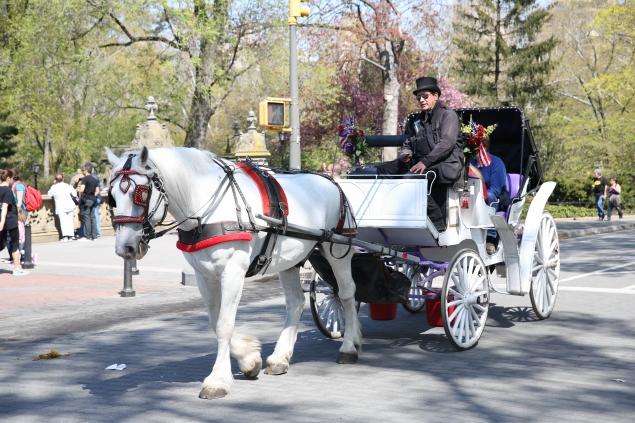
Horse-drawn carriages may be a thing of the past when the new mayor takes control.
After protests by animal rights activists, the days of carriage horse rides through Central Park appear to be numbered, but the push to “rescue” the horses could lead to their slaughter instead, experts say.
The top mayoral candidates, Democrat Bill de Blasio and Republican Joe Lhota, support a bill before the City Council to ban the horse-drawn rides, a move that would throw hundreds of drivers, and more than 200 horses, out of work.
Some experts, however, warn that retiring the horses would add to a “homeless horse” crisis in the U.S., which already sends 90,000 to 100,000 unwanted horses to slaughter in Canada and Mexico each year.
“We do not have enough rescue space in this country for the horses we have now,” Karen Waite, an equine extension specialist at Michigan State University, told the Daily News.
“To add another 200 to an already overburdened situation is not a good thing. It’s distressing, actually.”
Referring to the activists clamoring to end the carriage rides, Waite added, “Unless these individuals are planning to start a rescue organization for these horses, I think it’s a bit naive to say they will have a place to go.”
Christina Hansen, a carriage driver, agreed. “Horses that have jobs are the last horses that get neglected,” she said. “It’s the horses that don’t have jobs that we’re seeing shipped to slaughter.”
The economics of rescuing so many horses would be daunting.
It costs at least $200 a month to care for one retired horse, experts say, so the tab for sending 200 horses to live out their days in leafy luxury would start at $480,000 a year.
Based on the average age of the horses clip clopping through Central Park, and their life expectancy, the total cost could climb past $8 million over their lifetimes.
“We’ll raise whatever’s needed to take care of every single horse,” NYCLASS spokeswoman Allie Feldman said.
However, the group would not say how much it has raised so far, leaving even other animal rights organizations concerned.
“I hope they can raise that money. Maybe they have a good resource somewhere,” said Sandra DeFeo, a spokeswoman for the Humane Society of New York.
“Two hundred horses is a large number. … If we were them, we would have a plan. We would be able to tell you, ‘This is how much money we’re raising and this is what we’ll do with it.'”
The Coalition to Ban Horse Drawn Carriages, the other major organization against the carriage industry, hasn’t collected any money for rescues, according to its president, Elizabeth Forel.
“I’m not worried about these horses because over the years we have gotten so many requests from people, from good horse owners, to take them,” she said.
Feldman agreed, saying the Central Park horses have become “celebrities, in a way.”
“It’s very hard to find a home for a pit bull but when something like a golden retriever is up for adoption everybody grabs for it. Well, unfortunately, there are folks who don’t necessarily want to take any old horse but they do want to adopt a New York City carriage horse,” she said…(CONTINUED)
Click (HERE) to read the rest of the story and to comment at the NY Daily News
- NYC Horse-Carriage Rides Threatened By Mayoral Politics (huffingtonpost.com)
- Mayoral politics threaten NYC horse-carriage rides (miamiherald.com)
- Latest horse-drawn carriage accident reignites calls for a ban (pix11.com)
- Irish horse and carriage owners vow to fight Central Park horse’s ban (irishcentral.com)
- Michael Bloomberg Discusses the Many Ways to Use Animals (politicker.com)
Categories: Horse News, Horse Slaughter





 Straight from the Horse's Heart
This article is poop.
An equine’s life and death is the responsibility of the owner. What I gather is that all carriage horse owners are going to send their horses to slaughter? My guess is that if they send to slaughter after carriage business ends, they would or have sent to slaughter before this controversy.
And again, NOT everyone involved in animal, and specifically for equines are “animal rights” activists. Why can’t the idiot press get this correct? It feeds into the crazy killer agenda.
I’m not against carriage rides IN Central Park….I have a problem with the driving on the roads shared with autos and trucks. I also have a problem with poor ownership and care of the equines.
NY has a ton of rural real estate. Why can’t a tax be paid and collected to provide a retirement home for all NYC equines?….to include police equines.
This defies the common sense test.
LikeLike
Seems to me horses are workers either pulling carriages, doing trail rides, children’s pony’s. rodeo, doing lessons, racing, even tourism to observe them in the wild. Seems to me also that the owner of a horse is responsible for its well-being till its death. Those that earn a living from their horses must not only feed and house them but see to it that the horse gets to be in a pasture with others, is adequately cared for as it ages and properly disposed when it dies. All our healthy rescues work and help us support the ones that can’t. A tax or fee levied or paid by government or fine by poor caregivers would help support horses that fall through the cracks and wind up at rescues. A old horseman once told me “a running horse is a big responsibility”. That phrase should state owning a horse is a big responsibility. I once owned a boat and sold it. Five years later it was found on the rocks and I was notified by the Coast Guard that as an previous owner was responsible to have it removed. Sort of like cradle to grave. Maybe if a horse winds up at slaughter all the previous owners must anti up to provide for its care.
LikeLike
There is a big difference between planning for your horse’s retirement in the future and suddenly being forced to rehome him while at the same time losing your income. Blue Star Equiculture in Massachusetts is a retirement facility for these horses. They take in one or two at a time as they reach retirement age. Some are later adopted out to retire elsewhere, and most spend their golden years with other retired working horses. I don’t know how many horses they currently have, but I know for sure they couldn’t just take in 200 horses all at once.
The NYC carriage horses occupy some prime real estate and the developers want them out..there is a lot of money to be made developing the carriage horses’ land. Folllow the money…
LikeLike
Well, if you don’t the exact numbers of retirement or where every carriage horse goes after it’s “use/working” days, then you are not an expert or qualified to speak out against the end of carriage rides in NYC. I know the numbers going to slaughter……QUARTERLY!
Last I heard, Bloomberg GOT the stable land in NYC and the conditions of the equines stabled in NYC aren’t pretty because of land hogs. The advocates know well the “land hog” problem, especially wild equines.
As to jobs, there is NO job that qualifies as retainable or vital if it comes literally on the back of another living creature suffering.
And remember, I said I am NOT against carriages IN CP….they don’t belong on the roads with mixed vehicular traffic.
I don’t think I’ll change your mindset.
LikeLike
BTW Terri…isn’t the Army logo copyrighted?
Why do I ask? Because I AM Army too, but don’t use that for my sign in…supposedly not allowed. Just another technicality.
LikeLike
Unfortunately many owners dump their horses at auction once they become old and can’t perform up to par. These horses almost all go into the slaughter pipeline. That is why I do keep mine till death do us part. I have 2 very elderly horses at this time that cost a lot to keep up due to their health issues but they will stay with me till the end. The carriage horses will for the most part suffer the same fate so I think keeping them employed is much the lesser evil.
LikeLike
When I first learned about the NY carriage horse issue, I did some research. Unlike so many cities with carriages, Central Park is a big place. IMO, they could limit the rides to the park itself rather than the street. They could also build a covered stand at the edge of the park to keep the horses out of the weather and off the uneven pavement. Maybe even a turnout next to it, so the off-duty horses could get exercise and people could visit and photograph them. Just a suggestion for compromise.
LikeLike
Yes, limit them to the park itself. In my city, it’s horrifying to see them juxtaposed against the modern traffic, and callous drivers who get impatient and do u-turns in the middle of the street (and the noise, and the filthy exhaust). Keep them to areas without traffic if you must have them.
LikeLike
Ida, aren’t carriage horses more or less carbon neutral? Seems to me NY should be investing in more carriage businesses and weaning off automobiles, there could be some advantages being overlooked.
LikeLike
Not for the horses.
LikeLike
Horses live in makeshift stables where stairs are boarded over so they can climb to upper levels. The stalls are narrow so a horse can’t really turn around. These living conditions not only put horses at risk in case of fire, but they also have to fight their way through heavy traffic to Central Park where they work. Doubt very much that new stables will be built or any land for turnouts will ever be taken from Central Park — although it’s a nice idea.
LikeLike
Chris – who are you? Where do you get your info from? First off, the horses in NYC all live in buildings that were built as STABLES in the 1800’s. There are no “boarded stairs” – they are called “ramps”, which have a non-skid, rubber surface to keep horses and humans from slipping. The stalls are all (EVERY ONE) box stalls. They are bedded with either straw or sawdust, as is typical of any equine industry. Each stable (there are four) have automatic sprinkler systems, and are manned 24/7 by stable hands. The horses do not “fight” their way through traffic to the park – they simply go along WITH the traffic. As for being housed within the park itself – the Central Park Conservancy has long held its ground that they do not want the stables there (for whatever reason). Please research your facts before making such erroneous statements as you have here.
LikeLike
When was the last time you visited these stables? Never is my guess! I have seen horses in straight stalls that are 5 feet wide in other areas if that and these horses have stalls that are at least 12 feet by 12 feet and in some instance large. Get real.
LikeLike
Let’s remember what these horses were bred for “farming” NOT working in the busy streets of New York City!
LikeLike
Actually, Lisa, most of the breeds used in the carriage industry (not just NYC but everywhere) were, in fact, originally bred for city use (the Percheron is a good example of that). Again, please, do some research first.
LikeLike
The History of being within the cities is quite well written.
The Brooklyn Bridge for example, was built well before the advent of motor vehicles.
As was the city itself…
Please take the time to view this video:
“Remember who you are….. ”
LikeLike
I have to agree with the idea of compromise. I really like the idea of limiting them to Central Park. I really hate the idea of them in traffic, and then after a busy day at work warehoused in a building in the middle of a noisy city.
LikeLike
The accidents between carriages and autos that have photo documentation are undeniably horrific. How can any sane person can say this is acceptable? The stabling facilities are awful, too—cramped stalls, located in high rise buildings with steep concrete ramps for access.
LikeLike
“Photo documentation”? You mean the same handful of photos that are used over and over and over again?
Have you actually ever been in the stables? I have and they are nothing like you describe. The stables are clean, open, airy, and well-ventilated, stalls are well-bedded and big enough for the horses to turn around and lie down, the horses can all see each other, they have plenty of hay, custom mix grain, automatic waterers, sprinklers in case of, God forbid, a fire, misters and fans. Plus 24/7/365 stable hands and regular vet and farrier visits.
LikeLike
This is not a complex issue !!!!!! It is a beautiful thing to have Horses and carriages in the Park !!!! WOW !!!!! Like anything else these are beautiful animals that should be respected and taken extremely good care of while doing so !!!!!!!! They are living breathing beauties , Its a given to respected for who and what they are , its really a shame that people cannot appreciate what they have !!!! Why is it necessary to have to place Laws for this , it should be expected and given !!!!! Do we fricken have to Police them daily!!!!! Are people a bunch of spoiled babies who have no common regard for life !!!This pure common sense take care of them . The Horses need to have jobs as we do, they are not to be taken advantage of, for Petes Sake……. The nostalgia of yester year they bring to the Park is a wonderful thing !!!!! Respect it !!!!!!!
LikeLike
remember God made the horse
LikeLike
Very moving, Geri. It will be lost on the killers.
BTW…if one believes in a deity (and I do)…He/She also created Satan and Man.
LikeLike
There are, literally, tens of thousands of horses living in rescues right this minute, let alone the thousands of wild horses that have been rounded up by the BLM. Why on earth would you want to put more horses at risk?
The anti-horse crowd claims they have the resources and rescues ready to take these horses, yet they refuse to name them. Gee, I wonder why? And $200 per month? Dream on – these are draft horses, not ponies that can live on air.
And why would the city want to be seen as even a little bit anti-business? How does this make any sense in the current economic climate? Can the city afford to have this many additional people out of work?
Aside from all of that – 3 horses in 30 years have died as the result of accidents. THREE horses in THIRTY years. No other equine discipline can even come close to that safety record. None, zero, zilch.
LikeLike
I agree. I see no problem with rides in Central Park. Think of all the city kids who would never set eyes on one otherwise. Any animal having to share roads would need a heck of a lot of training and be worth its weight in gold. I do think they should enforce limits for when they can work. 100 degree heat index weather is absurd. But I can’t say its just a greedy human in this case because the human is driving the horse and suffering right along with it.
LikeLike
The ASPCA enforces the weather regulations – the NYC carriage horses don’t work when it is over 89 degrees.
LikeLike
I demand transparency Before they ban carriage horses. I want to know the exact amount of funding in house already, where the animals will go for purchase, adoption because I smell a rat. Organizations cannot close the carriage horses down with Horse Slaughter impeding progress to save animals from abuse and neglect. I want this organization to identify exactly the money they have raised, who would supposedly adopt the horses and when and how they will be prescreened an auction in this atmosphere with such large horses could be a catastrophe. And the owners have attachment to the animals and need a chance to decide how to keep and care for their wanted animals. I support caring and patient driverz who properly conduct themselves and the animals, however, this issue is way underscored by the lack of details on future care. This is not cleaning up New York or rescuing the injurex, ill or weak. This is about creating a case of publicity by closing down this businesz industry for a pat on the back. Punish or even educate abusers, that means training or rehabilitation for the offending abuser. These horses deserve protection and this woman cannot guaratee that protection. The current slaughter atmosphere is too complicated to track every carriage horse, so she needs to be pulled aside and given this is what happens when destroy a delicate balance and use her skills to help the horses instead of kill them!
LikeLike
Do you realize the proposed legislation would seize these privately-owned horses, forcing them to be turned over to sanctuaries where they could never be “worked” again — that includes ever being ridden or driven. Just wait until radical animal rights activists set their sights on your particular equine activity. If you have any questions about the conditions of NYC carriage horses, please visit Carriage Horse Facts on FB.
LikeLike
Originally I was uninformed… And there was plenty of opinions flying around… So I did what I believe in doing. I went personally and took in first hand the whole picture. Not just looking at photos, nor a quick trip. But many trips, many visits. And also touring the entire industry…
I now have a accumulation of over 500 some photos, and have written a numerous number of “Notes” to which my personal experiences have been.
And I continue to visit and have now personal friends and know many of the horses first hand.
Those who wish, may start with this Note of mine:
“NYC Carriage Horses” and some of the Real Truth one should understand …”
https://www.facebook.com/notes/alan-rochette/nyc-carriage-horses-and-some-of-the-real-truth-one-should-understand-/10151779181563151
LikeLike
Alan, would you be willing to post some of your information here for those of us not inclined to join Facebook? Thanks.
LikeLike
My Notes are interwoven with links and also photos.
And they are lengthy. It is time consuming to break them apart.
Not that I would not do that, but I don’t have the time at the moment.
A very good read would be here, which is on the web and not FaceBook:
http://www.equiculture.org/nyc-position-statement.aspx
…. and, when I can, I will try and place some of my own here, from my FaceBook notes.
LikeLike
Thank you for your “up-close-and-personal” account, Alan! Do you know what happens to horses who are no longer able to work? To me, those are the ones who people should help to find good retirement homes.
LikeLike
Truth is this.
The carriage horses are privately owned. The owners have an “option” to seek retirement with Blue Star Equiculture, or seek their help in rehoming or retirement through their services.
There is a very strong alliance between the Horse and Carriage Association of NYC and the Blue Star Equiculture – Draft Horse Rescue & Sanctuary.
Those two organization are solely independent of each other as entities. But are closely bonded by the working horse(s) which both are involved in.
Records, discretion, and privacy are upheld, for any dealings between both are a matter of private ownership of a horse entering into an agreement with Blue Star.
Some are made public, the stories if the previous owners allow that. But matters of discretion / privacy are always the previous owners privilege.
And many make use of that, for fear of retaliation from activists.
So, names of those horses even become changed.
And though, I am a volunteer to Blue Star Equiculture, please be aware I speak on my sole behalf here. If you have questions for Blue Star, please contact them directly. On FaceBook, or their website.
An example, is my Note of Moxie:
“I am now known as Moxie…”
By Alan Rochette · Monday, July 22, 2013
https://www.facebook.com/notes/alan-rochette/i-am-now-known-as-moxie/10151739942608151
LikeLike