

by Wayne Pacelle as published on Humane Nation
“As most of you are aware, our Wild Horse Freedom Federation‘s Director of Field Documentation, Carol Walker, has spent the last several weeks observing the destruction of Wyoming’s last wild horse herds at the hands of the BLM. None of it was, or is, pretty…’disgusting’ is perhaps a better word. Although no prominent HSUS observers were noted at the roundup the following article by Wayne Pacelle does have some very salient points and is well worth the read. We concur with the bulk of what is stated…the time for the brutality to stop has long past.” ~ R.T.
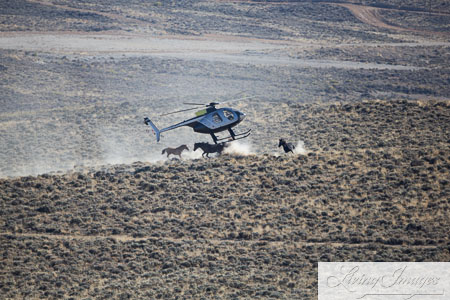
BLM terrorizing what’s left of Wyoming’s wild horses. ~ photo by Carol Walker of Wild Horse Freedom Federation
At least 10 animals, including four yearlings, are dead after a poorly conducted and strategically suspect government roundup of approximately 800 wild horses in Wyoming. This loss of life, and the stress and trauma for the survivors, could have been avoided had the Bureau of Land Management (BLM) put in place a more humane and economically viable management plan for wild horses throughout the West.
The current roundup is being conducted in the Great Divide Basin, Adobe Town and Salt Wells Herd Management Areas in Wyoming. The BLM’s records show that one yearling was found dead in a holding pen having suffered an acute neck injury, a three-and-a-half month old filly was found dead in a holding pen of unknown causes, and a six-month-old colt died in a horse trailer from pre-existing lung injuries that were exacerbated by the helicopter drive gather.
The HSUS has long argued that the BLM, which conducts these round-ups, should be working with the humane community to manage wild horses using fertility control methods. The broader implementation of this strategy would come with some costs, but those would be offset and then some by reducing the need for removals and the housing and feeding of tens of thousands of horses in short-term and long-term holding facilities. Implementing aggressive fertility programs is a solution supported by most stakeholders and the National Academy of Sciences. It would be much more humane for the horses if the government opted for this strategy.
It is a well-known fact that the BLM’s wild horse roundup program is a case study in mismanagement. There are now more than 40,000 free-roaming wild horses in the United States, most of them in Wyoming and Nevada, and the government has been rounding up and removing them, ostensibly to control these wild populations and minimize their ecological impact. Over the years, they have built up a captive horse population that now numbers in the tens of thousands, at short-term and long-term holding facilities. The cost of the roundups and housing and feeding the animals is now cannibalizing about two-thirds of the budget for the entire program…(CONTINUED)
Related articles


Categories: Horse Health, Horse News, Horse Slaughter, Wild Burros, Wild Horses/Mustangs





 Straight from the Horse's Heart
Why are they buying into the 40K on the range? Last year, at year’s end the reprts were 17,500, if that. The figure started moving around January to 20K, now its 40K.
LikeLike
Ran across this update http://www.sweetwaternow.com/wild-horses-arrive-holding-facility
LikeLike
http://www.westernwatersheds.org
LikeLike
geri . Dont you just love the Photo of the mess cattle grazing leaves???????
LikeLike
Yes and the fact it keeps going back and forth – back and forth
LikeLike
Some good news here regarding the pending lawsuit – seems a precedent is set here concerning the BLM ignoring NEPA requirements and not considering ending grazing as an alternative:
The U.S. District Court of Idaho ruled in favor of Western Watersheds Project in the second round of litigation of a case challenging 600 grazing permits across 25 million acres. This round focused on four allotments in the Burley Field Office of the Bureau of Land Management (BLM) of Idaho which are “test cases” for a broader set of grazing decisions that similarly overlooked providing meaningful protections for sage-grouse. (A summary of the round one win is here.)
Judge Winmill found that the BLM violated the National Environmental Policy Act (NEPA) by failing to properly disclose the cumulative impacts of its decisions and by failing to consider ending grazing on the allotments in any of the alternatives to proposed management.
Moreover, Judge Winmill ruled that the BLM must include mandatory terms and conditions to protect sage-grouse, including specific restrictions to address such things as stubble height, stream bank alteration, and utilization. Voluntary measures will not serve.
Additionally, the court issued an important ruling on the use of the congressional rider that allows the automatic renewals of grazing permits without environmental review. The ruling allows that the rider exempts permits from NEPA, but not the Federal Lands Policy and Management Act (FLPMA) and that the BLM is still obliged to consider ongoing environmental degradation and comply with the Fundamentals of Rangeland Health. This is an important precedent because the BLM has a bad habit of allowing harmful status quo grazing to continue while it defers NEPA analysis.
The Department of Interior should take heed of today’s win and realize that protecting and recovering sage-grouse on BLM lands is going to mean doing a lot more than status quo. It is going to require the immediate implementation of seasonal and utilization limits on livestock grazing, rapid improvements in its site-specific management, and a complete overhaul of its rubber stamp for permit renewals.
http://www.westernwatersheds.org/2014/09/om-293/
https://docs.google.com/file/d/0B1T2j7JW1SeoTGhfb0NTU0h1S2c/edit
LikeLike
This is great news! BLM reps just stated they were going to redo the RMP for zero wild horses. I hope this means back to the drawing board and put the horses back! And build fences so the horses don’t get onto the so-callled private land. And demand Omimex repair the damage done to the HMA land.
LikeLike
Please , Mr. Pacelle , tell us where you got that outrageous number of 40 thousand from . There are less than half of that left . And might your deceiving plea for birth control have to do with the fact that HSUS owns the monopoly on said fertility control ? You guys are in bed with the BLM and your statement here proves that . I am disgusted with your organization !
LikeLike
I have always wondered why and what the HSUS,has done or has not done, one would think that they would have some heavey Carte Blanche in Mustang matters///////????? Yet what remains to be seen, i think is their incolvement in saving the Mustangs has been far from Stellar, almost , minimal????????? WHATS UP HSUS???????? Am I the only one that feels this????????
LikeLike
This comment was posted on the Casper Star Tribune
http://trib.com/news/state-and-regional/blm-removes-wild-horses-from-checkerboard-lands-in-sw-wyoming/article_f2ee30a2-91d3-5997-a5b3-57aad81aa9b7.html
ButterCream
Has anyone read the U.S. Supreme Court decision made in 1976 titled Kleppe v. New Mexico? Google “Kleppe v. New Mexico (1976).” It took away a state’s right to manage federal wild horses and burros and affirmed the Wild Free-Roaming Horses and Burros Act (1971, as amended).
I have asked environmental attorneys to consider this important precedent case, as the State of Wyoming has been repeatedly in violation. The 2003 Wyoming/BLM Consent Decree was legally invalid, as are any other consent decrees where the state has involvement… and in this checkerboard gather case, the state/Governor Matt Mead was an intervenor. We need a test case on the interference of Wyoming in federal wild horse matters. This gather was absolutely illegal, in my view, and Wyoming is out of order. It’s not over yet, folks. The wild horses may have been rounded up, but the legal wheels are still turning. Stay tuned.
Patricia M. Fazio, Ph.D., Statewide Coordinator
Wyoming Wild Horse Coalition
Cody
LikeLike
I would have to wonder as well about HSUS?
I am tired of hearing inflated numbers in the wild at 40,000 my A##.
Thank you Jan for your updated numbers at 17,500 sound more like it.
LikeLike
I agree with Mr. Pacelle – up to a point. Past that point is the obvious line o’ crap about what exists on the range.
This year’s population is (yep; here’s that word again) ‘estimated’ at 49,209 animals – nearly as many as were ‘estimated’ in 1981 at 52,198, and exceeding every ‘estimate’ in the past decade.
I can’t understand it. More than 37,000 – nearly the equivalent of 2012’s entire population (estimated) have been taken off the range in just the past five years. It’s almost as if the principals of biology do not apply to wild horses and burros. All they seem to do is eat and drink too much (even when there’s nothing to eat or drink!), and babies fall out of them, fully formed and ready to make the next one.
They NEVER die from thirst, starvation, predation or old age. They aren’t subject to the same environmental detriments as other living things. They are iron-clad and immortal.
Yet…they seem perfectly capable of dying while in the custody of humans.
I can’t help it. I am not a True Believer. I need a picture or something. Until then, no birth control.
LikeLike
Well said, Lisa LeBlanc!
LikeLike
Some random thoughts on viewing the article listed below.
– The photographer was allowed much closer in than advocates were… and every photo presented is also for sale. Conflict of interest?
– Photos clearly show horses lathered up from running in the hot sun with denser hair coats on already, preparing for winter.
– What was the “extra” $111,538 change order for, dated yesterday? (posted in the comments by Louie C.). Something they forgot in the original bid?
Transaction # 9 (Delivery Order)
IDVPIID/PIID/MOD: INL10PC00593 / INL14PD00691 / 1
Recipient: CATTOOR LIVESTOCK ROUNDUP INC
475 S 200 W, NEPHI, Utah
Reason for Modification: CHANGE ORDER
Program Source: 14-1109
Department/Agency: Department of the Interior: Bureau of Land Management
Product/Service: F016: NATURAL RESOURCES/CONSERVATION- WILDHORSE/BURRO CONTROL
Description: CHECKERBOARD HORSE GATHER IGF::OT::IGF
Signed Date:
07-28-2014
Obligation Amount:
$111,538
– Are more cows and/or sheep going to be allowed into the “overgrazed” checkerboard now? The article says:
“With more than 900 horses being removed from the range, the BLM is changing its management practices in the area. BLM officials are beginning a new resource management planning process in 2015.
“The resource management plan process will make changes to allow for not having wild horses in the checkerboard,” D’Ewart said. “Sometimes it can benefit the ecosystem. If you take the horses off, there can be less competition for that resource.”
– Will taxpayers also benefit by having fewer wild horses to manage in the wild? When do we see a reduction in BLM program costs as the numbers of wild horses and burros “roaming where found” in 1971 are rapidly heading towards zero?
http://trib.com/news/state-and-regional/blm-removes-wild-horses-from-checkerboard-lands-in-sw-wyoming/article_f2ee30a2-91d3-5997-a5b3-57aad81aa9b7.html
LikeLike
Isn’t this interesting….
Can anyone find the link to this Legal Document?
It was available
NOW it is not
Google states that it cannot be provided because it violates their terms of service
https://docs.google.com/file/d/15XxDMsR1HKkjS_tWEb4QDIEKvMwrrSoiWlxlFWfbkLe8-boHU1lBYiuqd6pH/edit?pli=1
LEGAL RSGA EISENHOWER DECLARATION.pdf
DECLARATION OF LLOYD EISENHAUER
Katherine A. Meyer
Meyer Glitzenstein & Crystal
1601 Connecticut Ave., N.W.
Suite 700
Washington, D.C. 20009
(202) 588-5206
Timothy Kingston
408 West 23rd Street, Suite 1
Cheyenne, WY 82001-3519
(WY Bar No. 6-2720)
(307) 638-8885
Attorneys for Defendant-Intervenors
IN THE UNITED STATES DISTRICT COURT
FOR THE DISTRICT OF WYOMING
Rock Springs Grazing Association, Case No. 2:11-cv-00263-NDF
Plaintiff,
v.
Ken Salazar, et al.,
Defendants,
DECLARATION OF LLOYD EISENHAUER
I, Lloyd Eisenhauer, declare as follows:
1. I live in Cheyenne, Wyoming. I am a former Bureau of Land Management
(“BLM”) official with extensive experience in the Rawlins and Rock Springs Districts in Wyoming and intimate familiarity with the public lands under BLM management in those areas. I have reviewed the consent decree proposed by BLM and the Rock Springs Grazing Association (“RSGA”) in this case and provide this declaration based on my longstanding knowledge of, and management of, wild horses and livestock grazing in the Rock Springs and Rawlins Districts.
2. I grew up in Pine Bluffs, Wyoming with a livestock and farming background, served in the Marines for four years, and then owned a livestock business from 1952-1958. I enrolled in college in 1958, studying range management. From 1960-1961, BLM hired me to assist with collecting field data for vegetation assessments and carrying capacity surveys related to livestock and wild horses. These surveys were conducted in the Lander, Kemmerer, and Rawlins Districts. When I graduated in 1962, BLM hired me full-time to serve in the Rawlins District in Wyoming, where most of my work focused on grazing management involving sheep, cattle, and wild horses. From 1968-1972, I was Area Manager of the Baggs-Great Divide Resource Area in the Rawlins District. In 1971, the Wild Free-Roaming Horses and Burros Act was enacted, and in the spring of 1972, on behalf of BLM, I conducted the first aerial survey of wild horses in Wyoming, recording the number of horses and designating the Herd Management Areas (“HMAs”) for the Rawlins District. After a stint as an Area Manager with BLM’s Albuquerque, New Mexico office, in 1975 I took over as the Chief of Planning and Environmental Analysis in BLM’s Rock Springs District for three years. I was the lead on all planning and environmental assessments. During that time, I also served as the Acting Area Manager of the Salt Wells Resource Area, which is located in the Rock Springs District. In 1979, BLM transferred me to its Denver Service Center to serve as the Team Leader in creating the agency’s automated process for data collection. I received an excellence of service award from the Secretary of the Interior commending me for my work as a Team Leader. In 1982, I became the Head of Automation in BLM’s Cheyenne office, where I managed and implemented the data collection and processing of various systems related to BLM programs. I retired from BLM in 1986, and have stayed very involved in the issue of wild horse and livestock management on BLM lands in Wyoming, and have written articles about the issue in local and other newspaper outlets. I have won various journalistic awards, including a Presidential award, for my coverage of conservation districts in Wyoming. Along with a partner, I operated a tour business (called Backcountry Tours) for six years, taking various groups into wild places in Wyoming – without a doubt wild horses were the most popular thing to see on a tour, in large part due to their cultural and historical value. I also served six years on the governor’s non-point source water quality task force.
3. Based on my longstanding knowledge of wild horse and livestock management in the Rawlins and Rock Springs Districts, and in the Wyoming Checkerboard in particular, I am very concerned about BLM’s agreement with RSGA, embodied in the proposed Consent Decree they have filed in this case, under which BLM would remove all wild horses located on RSGA’s private lands on the Wyoming Checkerboard.
4. The Checkerboard is governed by an exchange of use agreement between the federal government and private parties such as RSGA. However, due to state laws, property lines, and intermingled lands, it is impossible to fence the lands of the Wyoming Checkerboard, which means that both the wild horses and the livestock that graze there roam freely between public and private lands on the Checkerboard without any physical barriers. For this reason, it is illogical for BLM to commit to removing wild horses that are on the “private” lands RSGA owns or leases because those same horses are likely to be on public BLM lands (for example, the Salt Wells, Adobe Town, Great Divide, and White Mountains HMAs) earlier in that same day or later that same evening. Essentially, in contrast to other areas of the country where wild horses still exist, on the Wyoming Checkerborad there is no way to distinguish between horses on “private” lands and those on public lands, and therefore it would be unprecedented, and indeed impossible for BLM to contend that it is removing all horses on RSGA’s “private” lands at any given time of the year, month, or day, considering that those horses would only be on the strictly “private” lands very temporarily and intermittently on any particular day .
5. Another major concern with BLM’s agreement to remove all horses from the private lands of the Wyoming Checkerboard is that BLM is undermining the laws that apply to the Checkerboard, and wild horse management in general, which I implemented during my time as a BLM official. Traditionally, BLM officials (myself included) have understood that, pursuant to the Wild Horse Act, wild horses have a right to use BLM lands, so long as their population numbers do not cause unacceptable damage to vegetation or other resources. In stark contrast, however, livestock (sheep and cattle) have no similar right to use BLM lands; rather, livestock owners may be granted the privilege of using BLM lands for livestock grazing pursuant to a grazing permit that is granted by BLM under the Taylor Grazing Act, but that privilege can be revoked, modified, or amended by BLM for various reasons, including for damage to vegetation or other resources caused by livestock, or due to sparse forage available to sustain livestock after wild horses are accounted for. BLM’s tentative agreement here does the opposite and instead prioritizes livestock over wild horses, by proposing to remove hundreds of wild horses from the Wyoming Checkerboard without reducing livestock numbers – which, in my view, is contrary to the laws governing BLM’s actions as those mandates were explained to me and administered during the decades that I was a BLM official.
6. While I do not agree with every management action taken by BLM over the years in the Rock Springs District, I can attest – based on my longstanding employment with BLM and my active monitoring of the agency’s activities during retirement – that BLM has generally proven capable of removing wild horses in the Rock Springs District, including by responding to emergency situations when needed and removing horses when necessary due to resource damage.
7. Considering that wild horses exhibit different foraging patterns and movement patterns than sheep and cattle, and also than big game such as antelope and elk, no sound biological basis exists for permanently removing wild horses from the Wyoming Checkerboard at this time. In particular, wild horses tend to hang out in the uplands at a greater distance from water sources until they come to briefly drink water every day or two, whereas livestock congregate near water sources and riparian habitat causing concentrated damage to vegetation and soil. For this reason, the impacts of wild horses are far less noticeable on the Checkerboard than impacts from livestock.
8. In addition, because livestock tend to eat somewhat different forage than wild horses (horses tend to eat coarser vegetation such as Canadian wild rye and other bunch grasses, whereas cattle and sheep mostly eat softer grasses), there is no justification to remove wild horses on the basis that insufficient forage exists to support the current population of wild horses. Also, because cattle and sheep have no front teeth on the front part of their upper jaws, they tend to pull and tear grasses or other forage out by the root causing some long-term damage to vegetation, whereas wild horses, which have front teeth on both their front upper and lower jaws, act more like a lawnmower and just clip the grass or forage (leaving the root uninjured), allowing the vegetation to quickly grow back. These differences are extremely significant because if there were a need to reduce the use of these BLM lands by animals to preserve these public lands, it might be cattle and sheep – not wild horses – that should be reduced to gain the most benefit for the lands, and which is why BLM, during my time as an agency official, focused on reducing livestock grazing.
9. BLM’s agreement with RSGA states that RSGA’s conservation plan limited livestock grazing, primarily by sheep, to the winter months to provide sufficient winter forage. This is a good example of “multiple use” management, since wild horses and sheep have very little competition for the forage they consume and the seasons during which they use parts of the Checkerboard. During winter, sheep use the high deserts and horses utilize the uplands and breaks (i.e., different locations) for forage and protection. During the summer, when sheep are not present, wild horses use various landscapes on the Checkerboard. This multiple use should continue for the benefit of the livestock, the wild horses, and the public and private lands involved.
10. I am also very concerned about BLM’s agreement with RSGA to permanently zero out the Salt Wells HMA and the Divide Basin HMA, leaving no wild horses in those areas that have long contained wild horses. I have been to fifteen of the sixteen HMAs in Wyoming, and to my knowledge none has ever been zeroed out by BLM. It is my view, based on everything I know about these areas and the way these public lands are used by wild horses and livestock, that BLM has no biological or ecological basis for zeroing out a herd of wild horses in an HMA that existed at the time the wild horse statute was passed in 1971, as is the case with both the Salt Wells and Divide Basin HMAs. And, again, because the wild horses have a statutory right to be there, whereas livestock only have a privilege that can be revoked at any time by BLM, there also is no authority or precedent, to my knowledge, for the agency to zero out these two longstanding wild horse herds simply to appease private livestock grazers.
11. The zeroing out of wild horses in the Salt Wells and Divide Basin HMAs is also concerning because it would mean that, in those two longstanding HMAs, there would no longer be the “multiple use” of these public lands as required by both the Wild Horse Act and the Federal Land Policy and Management Act. Currently, while there are other uses of this public land, such as by wildlife, hunters, and recreational users, the two primary uses in those HMAs are by wild horses and livestock. If BLM proceeds with its agreement with RSGA to zero out wild horses in those HMAs, the only major use remaining would be livestock use, meaning that there would be no multiple use of those BLM lands. Not only will that potentially undermine the laws that BLM officials must implement here, but it has practical adverse effects on the resources – multiple use is very beneficial for the environment, and particularly for sensitive vegetation, because different users (e.g., livestock, wild horses) use the lands and vegetation in different ways. When that is eliminated, the resources are subjected to an unnatural use of the lands which can cause severe long-term damage to the vegetation. As a result, zeroing out these herds would likely bedevastating for the vegetation in these two HMAs, because livestock would be by far the predominant use in this area.
12. Turning the White Mountain HMA into a non-reproducing herd, as the agreement between BLM and RSGA proposes to do, is also a farce, and violates the meaning of a wild and free-roaming animal. This is essentially a slow-motion zeroing out of this HMA, and is inconsistent with any wild horse management approach I am familiar with that BLM has implemented on public lands.
Pursuant to 28 U.S.C. § 1746, I declare under penalty of perjury that the foregoing is true and correct.
Lloyd Eisenhauer
LikeLike
I might; let me check, and I’ll get back to you.
p.s. I just love Lloyd Eisenhauer!
LikeLike
Dear Lisa. you are not alone , I love this Man also !!!!!!
LikeLike
Google Invests $168 Million In Ivanpah Solar Thermal Plant
Project already blading Mojave desert habitat
http://www.thewildlifenews.com/2011/04/12/google-invests-168-million-in-ivanpah-solar-thermal-plant/
Google announces its private investment in Brightsource Energy, the proponent of the controversial Ivanpah Solar Thermal Project:
This comes shortly after the Bureau of Land Management announced that the Ivanpah Solar Thermal Plant would likely displace as many as four times the number of Endangered Species Act protected Mojave Desert tortoise as previously estimated
LikeLike
The Irony Of Ivanpah
http://americanherds.blogspot.com/2010/02/irony-of-ivanpah.html
“The company in charge of this monstrocity, Bright Source, wants a total of 10,500 acres of public land and raised more than $160 million dollars from investors such as Google.org…”
The Clark Mountain Burros
The Clark Mountain burros were one of the oldest and most unique wild burro herds in America. Living in relative isolation for four centuries, their genetic tests revealed the herd had a “high proportion of rare variants” based on genetic tests performed by leading geneticts Dr. Gus Cothrane at the behest of the National Wild Horse & Burro Program on wild herds across the West.
In 2002, then BLM California State Director Mike Pool (now Deputy Director of the entire BLM) signed the Record of Decision for the Northern and Eastern Mojave Desert Management Plan (NEMO) that zeroed the Clark Mountain burros out.
During the planning process of NEMO, BLM presented five Alternative management options, four of which proposed to continue to manage the Clark Mountain burros. These Alternatives included such options as adjusting the AMLs upwards, supplying alternative water sources, modifying existing HMA boundaries to preserve and protect both wild burros and desert tortoise and initiating a five year carrying capacity range analysis.
Despite having many alternatives available to continue “managing” the burros, Director Pool signed off on the decision to zero them out. The only question that seems to remain is which heading BLM’s “Lost Land Explanation Team” now includes the Clark Mountain “unsuitable” Herd Area acreage under.
To illustrate this point, here is what is going to happen with just ONE solar plant out of hundreds currently being “fast tracked” by BLM in the former home of the Clark Mountain burros.
Basin and Range Watch (BRW) has provided extensive research and coverage of what the Ivanpah Solar Plant really means. Rather than work first to set up solar panels and plates on homes and business in already developed places like Las Vegas located just 35 miles away, this so called “green” technology will set up shop directly adjacent to the Ivanpah Desert Tortoise Critical Area of Environmental Concern (ACEC) that the Clark Mountain burros were supposedly zeroed out to protect.
LikeLike
We are hurtling without protective gear into this vortex of greed and gluttony. We will pay dearly. We always do.
God help us.
Sent via BlackBerry by AT&T
LikeLike
Thank you for reminding us what the real managers think about this situation.
And I’d like to also demand that Omimex, remediate the mess they have made of the grasslands on this checkerboard. They’ve killed everything in sight of the pipelines laid and left exposed tilled and churned topsoil to be picked up by the wind. They MUST be controlled.
LikeLike
Wondering today if they will quietly shoot those horses that escaped, since it seems there is not to be a single horse left in the checkerboard. Uglier and uglier.
LikeLike
As day 10 of the Wyoming roundup concluded yesterday, 349 wild horses have lost their freedom. There have been 6 deaths reported, 3 of which were under the age of 6 months old. Two of these babies crashed into the bars of the holding pens, broke their necks and died. A third colt collapsed on the trailer and died. A necropsy showed scarred lung tissue, indicative of past pneumonia, meaning that this poor baby was forced to run in terror for miles with compromised lungs before collapsing and dying. A stark example of the inhumanity of our government’s policy toward wild horses.
Photo of a mare protecting her foal who was too tired to continue running was taken during a roundup in the Blue Wing Mountain HMA in NV last summer.
LikeLike
Reblogged this on Wonder and Whimsy, Beauty and Soul and commented:
America’s Wild Horses are being exterminated. 😦
LikeLike
Thank you, Lloyd. We all see that extensive research and knowledgable don’t count. As a horse owner, I know that cattle and horses eat differently. But one cannot deny the knowledge that Mr. Eisenhauer has. I have been doing nothing but emails and callu g for the last 3 and a half he’s. I asked both of my senators to do a senatorial inquiry regarding the roundups. The law has not been followed for a very long time and it is of real concern. All our wildlife it seems has been up for grabs. The wild horses, burros, wolves and everything else some people want killed are on the chopping block. The Safe Act, I suspect is being held up and I wouldn’t doubt that it will comre up for a vote during this legislative session. As I have said before, loud and clear the only thing that these politicians understand are large protests in Washington, DC. and constant visits and calls to their offices.
LikeLike
I live in Australia and I find it absolutely disgusting what is happening to the chequerboard wild horses I can’t work out why they don’t use the fertility drug on them.
LikeLike
Vicki, our Wild Horses are not overpopulated, as the public and the media have been led to believe.
Here is an article and report that might help shed some light on it. There are many more.
A biologist’s response to the BLM’s wild horse “problem” (excerpt)
By Robert C. Bauer
http://www.habitatforhorses.org/a-biologists-response-to-the-blms-wild-horse-problem/
The rangelands, however, can easily sustain not only the wild horses and burros existing out there now, but also every one of those in holding facilities, which now number well over 40,000.
The truth is that every one of those wild horses and burros in holding facilities, if released back to the areas from which they were taken, along with those in the wild, would help bring the balance back to the rangelands, a balance that is so very vital!
REPRODUCTION, MORTALITY, AND OVERPOPULATION IN WILD EQUIDS by Robert C. Bauer, B.S. in Biology
https://docs.google.com/viewer?a=v&pid=sites&srcid=ZGVmYXVsdGRvbWFpbnxhbWVyaWNhbmhlcmRzNHxneDoxNDIxZTRlM2MzN2NmM2E4&pli=1
LikeLike
WASHINGTON, D.C., February 6, 2014 – Today, the House of Representatives approved H.R. 2954, The Public Access and Lands Improvement Act with a vote of 220-194.
http://naturalresources.house.gov/news/documentsingle.aspx?DocumentID=369164
This bipartisan package of bills would protect and promote access to lands; improve opportunities by removing red tape that stands in the way of responsible, local economic development and jobs; and encourage transparent, community-centered land management. Also, this legislation would advance important local projects that will create jobs and grow America’s economy.
“This small package of bills is reasonable, responsible, and reflects the will of local communities and their elected leaders. It will protect public access to public lands and implement common sense reforms to advance important local projects that will have a direct impact on jobs and economic growth in communities throughout the country,” said Natural Resources Committee Chairman Doc Hastings (WA-04).
Contact: Committee Press Office 202-226-9019
LikeLike
Where is the HSUS here?
If this doesn’t define inhumane nothing will. From the photos this horse was in good health and had healed from his older injury. Massive swelling probably is the result of this old horse running for his life for miles. Most likely he was a bachelor, too. This is institutionalized barbarity disguised as kindness.
From the AWHPC website (about the checkerboard roundup):
“An 18-year-old bay stud had a pre-existing injury. Its right front leg had broken and healed in a 45 degree rotation. There was massive swelling/fibrosis and the horse was walking on the inside of its right front hoof. Euthanized.” – Daily Removal Report for October 1 from the BLM WY Checkerboard Roundup.
This is the terrible reality, folks. Our government forced this mature stallion to run in terror for MILES in a helicopter stampede on a severely injured leg. He was then captured and “euthanized,” aka a bullet to the head. His life of freedom over. His final hours filled with trauma and pain. Thanks to Jennifer MaHarry Photography for these photos of the BLM Wyoming roundup, taken the week of September 15, 2014. This roundup is ongoing. It’s a reminder of what we are fighting so hard to change.
https://www.facebook.com/FreeWildHorses
LikeLike
Report Inhumane Treatment
If you observe or have factual information that a federally protected wild horse or wild burro has been treated inhumanely or sold to slaughter, please contact the BLM at wildhorse@blm.gov or at 866-4MUSTANGS (866-468-7826) with your name, contact information, and specific information about what you saw or know about. If possible, please include the freezemark. Federally protected horses and burros have a freezemark, which can be viewed here .
LikeLike