

by Ilie Mitaru as published in The Guardian
One man is on a mission to promote the grazing habits of wild herds as a way to stop extreme blazes from starting and spreading
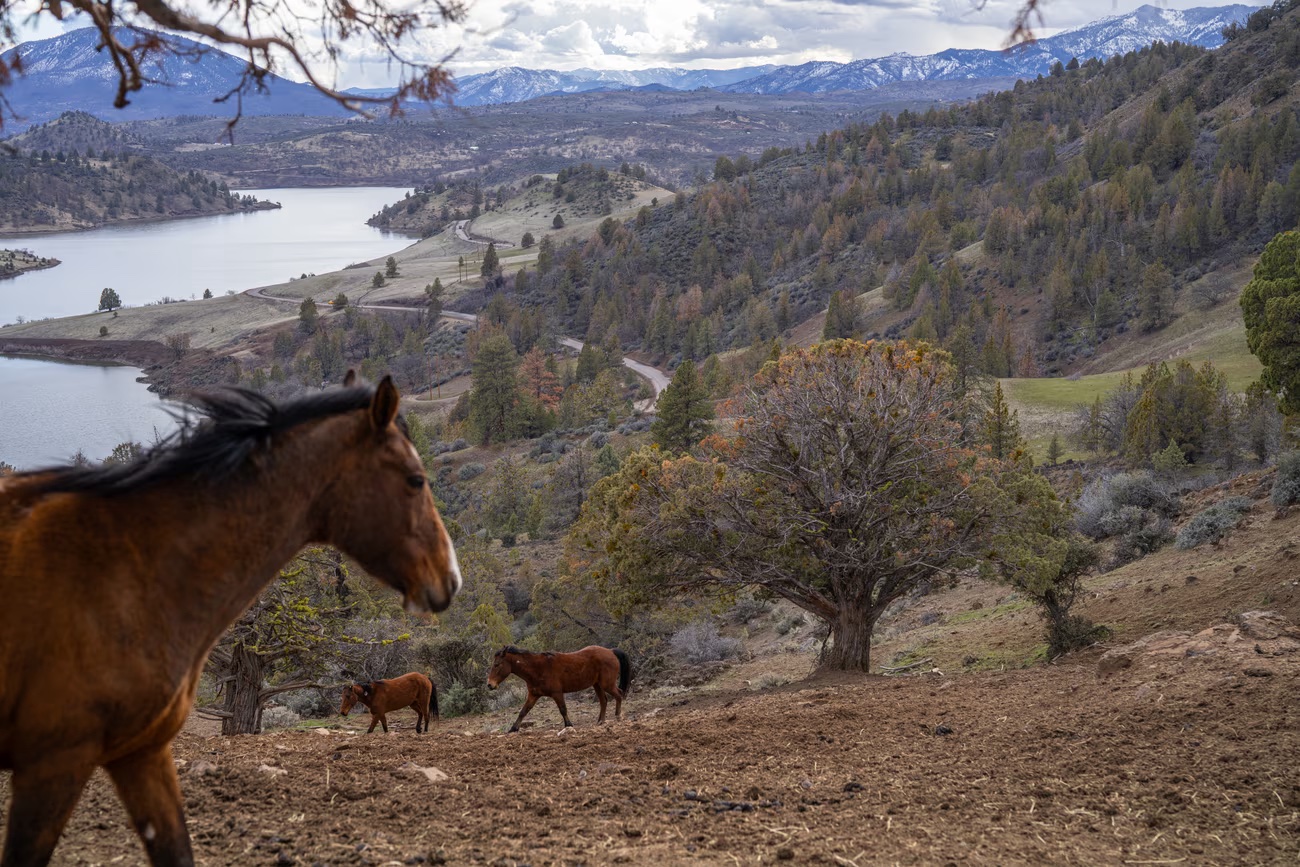
Wild horses roam Simpson’s land near the Oregon-California border
Since moving to a remote mountain region just south of Interstate 5 on the Oregon-California border in 2014, William Simpson, 70, has assumed responsibility for the care of 120 wild horses that roam his land. He has also adopted 60 more as part of an effort to study the effect that grazing has on managing grass, brush and other fuel for wildfires in the face of increasingly extreme blazes.
“I started watching the horses and seeing what they were doing,” says Simpson. “They were managing the fuel.”
He calls the project the Wild Horse Fire Brigade, and hopes the discoveries he makes from living among the animals will contribute to the debate around the role herbivores can play in wildfire mitigation.
Simpson argues that the steep decline of herbivores in the region – the deer population in California has shrunk to less than 500,000 from an estimated peak of about 2m in 1960 – is a factor in the state’s overgrown forests and grasslands, which in turn feeds increasingly extreme wildfires.
“We’ve lost our herbivory so now we have abundant, abnormally high levels of vegetative materials – that is what’s driving the fires,” says Simpson.
Federal protection was granted to wild horses and burros in 1971 in an effort to stop their decline. This quickly led to a population surge and a few years later the Bureau of Land Management (BLM), which has jurisdiction over most wild horse lands, was tasked with mitigating the rapid growth. The agency began removing wild horses from public lands in annual round-ups. Last year, 20,000 horses were removed from public lands. Nearly 8,000 of those were adopted or sold, and 1,622 were given fertility treatment.
The agency spent more than $84m (£65m) on the long- and short-term care of the wild horses in 2022. Simpson believes that money doesn’t need to be spent. He is on a mission to prove these large herbivores should instead be strategically located in critical wilderness areas to manage wildfires. “That’s a win-win for everybody,” he says.
Simpson describes his method as “Goodallian”, after the famed primatologist Jane Goodall. He spends every day among the animals, knows them by name and temperament, and is able to record novel behaviour within the species. He shares his findings with an array of niche industry publications and on his website, where he has published more than 150 articles in the past nine years.
“What I’ve been able to do is get so close to the horses I can smell them, I can touch them, I can look at their parasites, I can pull ticks off them,” he says. “There’s so much that’s unknown about wild horses and how they live.”
In 2018, a fire tore through Siskiyou county, where Simpson’s land is located. The Klamathon fire scorched 38,000 acres before it was contained. Simpson’s home and immediate surroundings remained largely undamaged. Simpson says that is down to the horses.
As the frequency and intensity of wildfires have increased, Simpson says he is increasingly receiving inquiries – from fire departments, ranchers and insurance representatives – all curious to learn more about the role wild horses may play in reducing the risk of wildfire.
“People are finally starting to listen,” he says.
View the photos at: https://www.theguardian.com/environment/2023/jul/27/are-americas-wild-horses-the-answer-to-wildfires-a-photo-essay-aoe
Categories: Equine Rescue, Horse News, Horse Slaughter, Wild Horses/Mustangs







 Straight from the Horse's Heart
Well finding a “job” for wild horses is good. But there needs to be much more attention paid to the current roundups and the mortality rate of OUR wild horses! WHE is going back to court to try & get some change actually put in place. Come on, RT where is the coverage of the roundups? You used to keep us up to date. Reading about Mr. Simpson’s efforts is fine – hes even getting publicity about them – BUT the roundups keep on going – horses are being killed – I think the number was 21 from Antelope.
Have all the people who used to comment & push for change quit? No posts whatsoever?
LikeLiked by 1 person
I tried to post the following comment to WHE and whatever other entity was referenced and I was not allowed to do so, without joining the organization, etc. Here is what I tired to post. I think it should get posted somewhere: Really want to stop the roundups? Make Congress STOP FUNDING the BLM and FS programs/policies that pay for them, Now is a good time to contact Senators and congresspersons and request them to strongly oppose funding for these activities–It’s Appropriations Legislation season again and if you want to make a change for the next fiscal year (begins on October 1, 2023), now is the time. So, (get off your donkeys and) log on to their websites and send them email. And, then follow up with a short phone call to ask if they have received your email yet, and tell them what it’s about if they don’t ask! I also email/call all the members on the Appropriations Subcommittee handling BLM/FS. It can’t hurt. It’s not as hard to do as you might think. So, don’t be scared. They can’t come over the phone line and choke you and you always get a staff person. The boss never answers the phone or takes calls either. As long as they have money to waste on roundups and storage, they’ll continue to do so. Make them spend their appropriations (our tax dollars) on moving the WHs they already have stockpiled to wilderness area lands. It is a win-win for all involved. Maybe you can post it.Best,Judith
LikeLike