

By Shao Wei ( chinadaily.com.cn)
While U.S. Mismanages Wild Horses & Burros other Countries Protect and Preserve Their Treasures
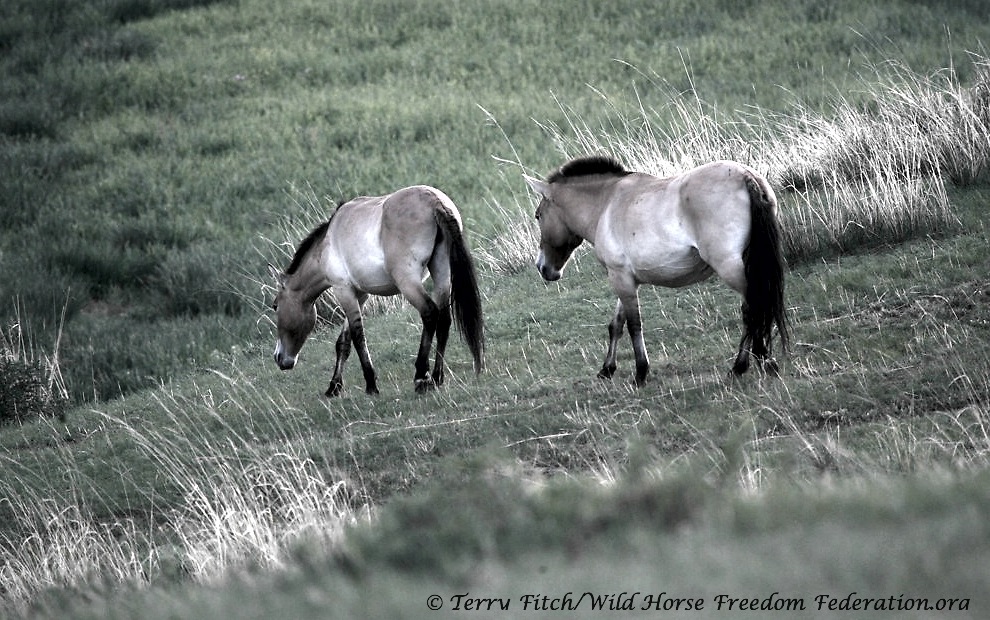
Wild Outer Mongolian Takhi – photo by Terry Fitch of Wild Horse Freedom Federation
As the cold front pounds Northwest China’s Xinjiang Uygur autonomous region, 700 tons of forage have been sent to the Kala Maili Natural Reserve, home to the rare and endangered Przewalski’s horses.
“The horses have difficulties foraging with the thick snow on the grass. We’ve prepared more than 600 tons of forage, and nearly 700 tons of corn, barley and carrots for the wild horses here,” Zhang Yanbao, a specialist at the Xinjiang Wild Horse Breeding and Research Center of the natural reserve, told Xinhua News Agency.
Przewalski’s horse is a rare and endangered wild horse named after a Russian colonel who believed he had discovered this breed of wild horse in 1878. Its population is even slightly smaller than that of giant pandas.
At present, there are 954 Przewalski’s horses living in the wild at the natural reserve.
Raw Video Report by R.T. Fitch of Przewalski’s (Takhi) wild horses in Outer Mongolia
Click (HERE) to visit China Daily and to Comment
Related Articles
- Winnipeg zoo welcomes two Przewalski’s horses (horsetalk.co.nz)
- CNN: American Wild Horses & Burros at Risk (rtfitchauthor.com)
- BLM Still Investigating Colorado Wild Horse Deaths (rtfitchauthor.com)
- My Turn: Is BLM mismanaging wild horses? (rtfitchauthor.com)
- Feds target 600 mustangs for removal from burnt range (horsetalk.co.nz)
- Native Wild Horses & Burros Misclassified to Push for Massive Removals (rtfitchauthor.com)
Categories: Horse News, Wild Horses/Mustangs





 Straight from the Horse's Heart
How about that? Some different than how we treat our wild horses. On the other hand, China waited almost too late for this. Hope the US doesnt.
LikeLike
Too true and I pray we don’t.
LikeLike
it’s so heartwarming to know that at least some human beings “get it” and treat the wild equines with care, compassion, and love. perhaps they can be an example for us and maybe one day we’ll figure it out before it’s too late! we need some of these preserves, to ensure their safety and it can be economically feasible too and not a drain. i pray this comes to pass!
LikeLike
They mourn everything. Send money for everything but can’t even appreciate their own wildlife..Damn it America!!!
LikeLike
Gee, after watching the video, I now know where Dr. Sheldon Cooper get’s his throat singing! LOL!
Although I agree with providing forage for the wild horses during droughts like the one we’re experiencing now the feeding of wild animals does present some issues. Living in Florida we deal with the loss of a pet or two a month (not to mention the occasional child) to alligators that people have fed. I wouldn’t want to be the fella to have to go hang red bloody meat in the same spot everyday for the tigers. Eventually they associate food and humans and like a stray cat you feed once they will keep coming back.
Why? Because it’s easy pickens. Animals that have to endure extreme climates build up fat as an energy source for when times are tough. Searching for food requires energy and animals will avoid expending their energy supply as much as they can. Human supplied forage offers the animal the opportunity to graze with little exertion. It’s their dream come true.
This feeding practice is the very issue we have to overcome in the Virginia Range. The loving and caring folks see hungry horses and offer them food. They think it’s the right thing to do, or it’s cute, or it’s noble but in fact they are killing them with their kindness. We’re hoping to create diversionary feeding way out of town and far from roadways and the State Agriculture Department’s traps.
Wild horses, being a much more intelligent animal than an alligator, could be cared for as long as experts are consulted, i.e. the successful Chinese, although I doubt they are dealing so much with major metropolitan areas or busy highways, or other animal behaviorists and the rules for feeding are planned and the plan followed.
Once you’ve begun feeding program it’s hard to stop. It doesn’t take long for them to become dependent. I particularly disagree with the Chinese’s adding carrots to the mix. SUGAR! One of the most addictive ‘drugs’ we know. My horses love peppermints and they love carrots and I’m sure more than a few of you offer apples to your horses (my horses just never liked them). I offer my golden’s Pupperoni’s or carrots…which do you think they like best? (Good thing cause carrots are cheaper…lol).
In the remote HMA’s much of this should not be an issue. I believe as long as we offer only basic forage, nothing fancy, and on a sporadic schedule, at different locations so they still have to hunt for their dinner the horses will probably be fine.
I would suggest helicopter drops as it wouldn’t create a mental track the horses could follow like that of a truck bearing food. This could lead them to danger i.e. off the HMA where they loose their protections or nearer to roadways and other man made dangers.
Yes it’s easy to say we need to be supplementing. We don’t want them to starve (although pictures and video suggest they are doing quite nicely on their own). We don’t want them to suffer. But we have to step back and look at the overall picture. What we do could be very good or it could be very bad.
My biggest concern in many of our HMA’s is water. Are the springs being trampled down or are they drying up because mining operations are siphoning off the water table? Is the water table drying up because millions of cows have trampled the ground to the consistency of concrete so rain runs off rather than soaks in? Are the watering holes being fenced so horses have no access by ranchers who hold the water rights?
A horse will eat most anything that grows…green grass, dried grass, leaves, tree bark, even palm frawns. It’s the water that’s a problem. I believe this has to be priority number one.
LikeLike
Again, Man has altered Mother Nature that almost always leads to ecological imbalance.
The equines that are wild don’t need to be removed.
That they are being removed is more a function of Man’s arrogance about and hubris against Mother Nature….and money.
The 1971 ACT was about protecting 70k plus wild equines and those lands….that is gone.
I don’t trust the Chinese any more than I can throw one of them across a line in the sand.
But any port in a storm….I guess.
LikeLike
Denise you bring up an interesting point. Because of the wording of the WFRHBA the BLM is not allowed to ‘move’ horses so they ‘remove’ them. What if the Act were amended to allow for the moving of horses to areas more lush with forage and better water sources? Moving beats removing…don’t you think?
LikeLike
Steve..you are one sharp human.
Many long and die hard wild equine advocates have always said the 1971 Act is so much poop
The citizens and Wild Horse Annie believed, naively that the Act was what it was intended to be.
I understand now why most humans despise lawyers and appointed/elected officials.
LikeLike
Regarding this story, Steve’s remarks were the same thoughts that came to my mind, also. Hay drops from the air, disbursed widely, would be the long range most humane way of augmenting their forage. The grain, carrots, and other goodies are not part of the natural forage. These types of non-roughage based foods could be very disruptive to the gut microbiology and even make them sick. I have read that stockyard cattle suffer intestinal and liver/kidney disease from the unsuitable corn diet they are fed and if not dispatched by slaughter, would die at a young age from the diet induced gut sicknesses we force on them.
LikeLike
BLM seems to agree with you, Steve! They are just about to wrap up the removal of most of Owyhee’s herd because they claim there is a water problem. It saddens me no end that BLM got away with this ruse a second time and the advocates are not looking at the HMA for evidence that there is enough water. This removal is based on a lie and even the few advocates who have been out there have nothing to say about the range conditions because none of them are qualified to do an assessment. We have untrained people out there unable to describe what they do see in a decent report. All we get are hysterics and fear and no facts to counter what BLM is doing. These horses did not have to be removed! BLM wanted to remove them. There was no emergency this time as the only emergency in 2010 was created when horses were kept behind closed gates when they normally move to spring meadows.
My biggest concern is BLM continuing to create shallow and unprovable reasons for removing our wild horses and burros and we never have enough field data to present to them or in a court room to show BLM works with bogus information most of the time and to counter their decisions with real facts.
The advocacy has failed to find or train qualified field techs to assess and collect data. We have one group that states they do this and I know for a fact they are not trained to do this and have not got the skills or experience to do this and have never released a report that has enough data on it to show any provable conditions at the time. This is fraudulent and misleading information and is the cause for others to not pursue this work properly because someone claims’ to be doing it already when they have never done it at all. Not Ever! This needs to be seen for what it is; a lie to get funds from advocates for inadequate or never performed field data collection!!!!
No one is collecting field data except Craig Downer and a few other professionals who are on private reserves. No one!!!! Please do not support people who claim to be doing this and are not!
If we want to make change then we have to change also. We have to find and train people who will do real data collection that can stand up in court and in reports to the public.
LikeLike
Without independent study all the ideas we have in the world are not worthy of our wild ones! With out developing field studies and having real data collection over years we have nothing to offer but opinions with no base in reality. We already have that with BLM!
LikeLike
We are responsible for finding the information from research that will create policy based on science. The 71 Act says this. Why dance around this fact? Why act like it is someone els’s responsibility when it is our own?
LikeLike
I think the original Baskir Curly came fron near here also in Mongolia. I know my Baskir, Stormy, looks a lt like these horses in conformation. She also has a very similar face.
LikeLike
Glad that China is trying to save their rare horses, other wise they don’t care much about their other wildlife, i.e. tigers, dolphins turtles to name three. Are we sending our hay to China along with our dairy cows causing a shortage in the U.S.? I believe so. In addition, stupid, horrid State of Michigan will start hunting wolves as soon as Gov. Snyder signs the bill into law. What is this guy good for?
LikeLike
Just trying to pass along a little good that is going on in this world…….
LikeLike
And doing a damn fine job R.T.!
LikeLike
RT…some good and said so.
Thank you for the story.
LikeLike
If horses were part of the hunting industry, plenty of food would be made available. Elk hunting is a good example of how the elk are fed in order to assure all the money that can be made from elk hunters keeps flowing. Horses on the other hand are dispensable as they aren’t money makers. It all boils down to that and special interest groups who benefit.
LikeLike
I agree with Steve’s thoughts – just felt it was kind of good to hear people(anywhere) actually trying to help the horses – wintertime there has to be tough.
The thing is – there must have been financial arrangements made to do this. So no matter anyone’s feelings about the chinese – at least there is awareness of their wild horses. Even their government!
Not like here.
LikeLike
Keep in mind that China breeds horses for slaughter. They also breed thousands of mink and fox and many other animals for the fur industry including dogs and and cats and skins them alive. No matter what China does about helping to keep this horse from extinction as it has done for the Panda it commits to many animal cruelties for my taste, I have no use for China.
LikeLike
I am replying FROM China, actually headed back and sitting in the Beijing airport. I think when I get back I will clear the air on the tolerance of cruelty, here.
But, we as Americans need to be very careful on how we brand and stereotype an entire nation by the cruelty of a few. I have worked in South America, Africa, Europe and beyond but have found that my past two years of being in China and face to face with the people has been one of the biggest and most pleasant eye-openers of my life.
And for the record, the Chinese eat all sorts of things and critters that we Westerners would never eat and to date, I have never found anyone who eats horse.
Mongolia is different, they eat horse and drink fermented mare’s milk (I know, as I drank a large quantity, by mistake, because our guide said it was a magic drink with 7% alcohol…it was Terry who said, “do you know what that was that you drank?”…I got food poisoning from it and being out on horse back, in Mongolia, with no toilets is pretty ugly when you are that sick. It was not a pretty picture.)
LikeLike
Brave or foolish, RT, you had an authentic experience which I think gave you deeper insight into a horse culture and way of life dependent upon the horses.. Many of us have dreamt of doing what you and Terry did. Sorry you got sick, but you are initiated!!
LikeLike
I can’t wait to read your report. China has always been so mysterious. People do as they are taught and believe what they are taught to believe. We don’t eat certain animals…they do. That doesn’t make them bad people. I recall the lyrics to a song from Rogers & Hammerstein’s “South Pacific”
You’ve got to be taught
To hate and fear,
You’ve got to be taught
From year to year,
It’s got to be drummed
In your dear little ear
You’ve got to be carefully taught.
You’ve got to be taught to be afraid
Of people whose eyes are oddly made,
And people whose skin is a diff’rent shade,
You’ve got to be carefully taught.
You’ve got to be taught before it’s too late,
Before you are six or seven or eight,
To hate all the people your relatives hate,
You’ve got to be carefully taught!
LikeLike