

by Kevin Woster as published on Keloland Television
“Western South Dakota makes its living with tourism and livestock, and you’re going to have neither here if that aquifer is polluted…”
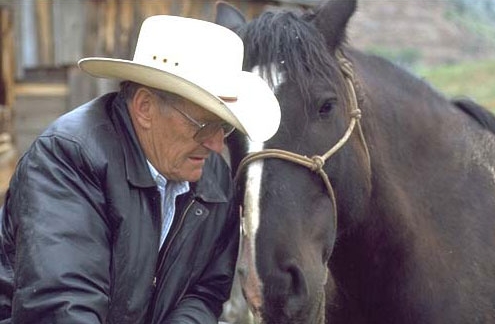 From a jagged cliff above the Cheyenne River, wild horse rancher Dayton Hyde celebrates the past and worries about the future.
“You find dinosaur bones and all sorts of things on this place, it should be protected.” Horse rancher Dayton Hyde said.
As founder and operator of the Black Hills Wild Horse Sanctuary, Hyde lives to protect hundreds of horses on his 13,000-acre ranch southwest of Hot Springs. But he frets more these days about the land and water.
He is part of a coalition fighting a proposed uranium mine by a Canada-based company, Powertech Uranium, northwest of Edgemont. The location is more than 20 miles away, but it’s near the Cheyenne River, which snakes through Hyde’s property and sits on top an aquifer he fears will be in jeopardy if the mining operation is approved.
“Western South Dakota makes its living with tourism and livestock, and you’re going to have neither here if that aquifer is polluted,” Hyde said.
Edgemont rancher and engineer Mark Hollenbeck says polluting the river or the aquifer is the last thing he wants to do. Standing near un-reclaimed uranium pits not far from the proposed mine site about 15 miles northwest of Edgemont, he pledges a different environmental future if this mine is permitted.
“This is what the technology used a half a century ago was. It was open-pit mining with no reclamation standards. And this is not how we are going to be doing our project.” Powertech Manger Mark Hollenbeck said.
The proposed mine would involve a system of wells that inject an oxygenated solution into seams of uranium 300 to 800 feet underground. That solution would then be extracted, along with uranium particles it carries.
Hollenbeck says uranium doesn’t travel far without oxygen. And without the oxygen-rich fluids pumped into the seams under pressure and extracted in a way that pulls the solution toward recovery wells, uranium particles barely move at all. So Hyde and his water supply are safe from damage by the project.
“There’s no way possible that we can affect Mr. Hyde’s or anybody else’s wells that are in another part of the Black Hills, or anywhere else,” Hollenbeck said.
Others aren’t so sure. One of them is Rapid City Mayor Sam Kooiker, who has joined members of the Rapid City Council in expressing concern to state and federal environmental officials about the project’s potential impact on the city’s water supply.
Kooiker isn’t comforted by the 85-mile buffer between Rapid City and Edgemont, or by Hollenbeck’s assurances.
“We have people that are knowledgeable that are concerned about the impact of this on the city’s water supply and indeed on the city’s water supply for the entire central and southern Black Hills.” Rapid City Mayor Sam Kooiker said.
Kooiker says his worries are shared by the city engineering staff and by people throughout the community.
“I would say that this ranks as one of the top several issues of, maybe the top five issues, of my time in city government, in terms of the level of engagement in the community,” Kooiker said.
The engagement is different in Edgemont, where Mayor Carl Shaw worries about a stagnant economy and a lack of jobs for the town and its 770 residents.
“It would help the community, possibly draw more people into town, help our tax base of our school district. I think the majority of the people are in favor of it.” Edgemont Mayor Carl Shaw said.
Shaw said his own support for the project is based in science.
“I’ve read the reports that the state has put out. And I trust the state people,” Shaw said.
The staff of the state Department of Environment and Natural Resources recommended approval of state permits for the operation. But after initial public hearings, two state boards with the authority to reject or grant water and mining permits are waiting for the federal officials to act. That could still be months away.
After almost seven years of work on the permits, Hollenbeck is hoping to get them all approved by next year. Opponents will do their best to fight that.
Click (HERE) to visit KeloLand.com
Related Articles
- State board postpones uranium hearings (rapidcityjournal.com)
- Another delayed hearing about Rapid City uranium mining plan (nuclear-news.net)
Categories: Horse News, Wild Horses/Mustangs







 Straight from the Horse's Heart
They kn that it’s going to pollute the water in any and all parts that are affected. Water is fluid, it travels. The aquafer supplies water to many parts of the area. Once again, this is a foreign country and they don’t care about the damage they cause because they can ignore the fines and walk away from it all ..just like the horse slaughter plants. How do you clean up polluted water? How many lives will be affected, both animal and human? All for the almighty dollar bill that they so covet and worship..
LikeLike
The scary part is that if folks are wrong about the mechanism of contamination, the water supply would already be tainted. Hoping South Dakotans keep asking the tough questions to protect their natural resources and their heritage.
LikeLike
You are going to want to see this one. All of these lands with unclaimed mines are polluted with Uranium, Mercury and Arsenic. When the drought was in play, the only place wildlife could find water, including our horses and burros, were in the abandoned mines. And we are allowing horses to go to slaughter filled with these chemicals? How unconscionable.
LikeLike
I have been Shouting from the Rooftopsfor the past year about the mercury, arsenic, and uranium poisioning in the Navajo horses. I also believe Ben Shelly and Zah know this real probability and pushed them to slaughter to avoid breeding them and to avoid an EPA issue with having to find disposal let alone treatment of the animals affected. It also explains the lack of explanation the their SUDDEN push to slaughter right after the government replaced several.hundred wells this summer. I am sorry but the man above should not have to worry, Our Government should just say there are strictly controlled areas you can be getting uranium, and close to aquifer is OffLimits Period, but we have Met Our Government This Year and we are Still wsiting for it to work for us.
LikeLike
Unfortunately, our federal government’s scientific programs are contaminated with political agents that have scientific credentials. Apparently, you can be considered an expert w/o any evidence that you are more scientifically literate than a fifth grader. The Harvard IUCNer that came up with the alien, invasive species theory about our native wild Horse’s was trying to get the horses removed before people discovered our federal government (you know the people so worried about climate change & sustainability) was poisoning the land & water.All these schemes to get people and livestock off the land has nothing to do w/ wildlife & nature.
LikeLike
Thank you for providing the infomation, along with the facts on the serious issues from the unclaimed mines. The health of the people and wildlife are jeopardized, which should be reason enough to put an end to this horrfic practice!
LikeLike
Mr. Hollenbeck may be an engineer but I can assure you radioactivity does travel downstream in water for I worked in the industry years ago. Radon occurs naturally in the formations containing Uranium as well. From personal experience I can relate that the water coming into our mine was more radioactive than when it left since we had what were at that time state of the art controls and cleaners in place. Nevertheless, miles downstream was a city reservoir, and from that reservoir many subdivisions received their tap water. When folks began monitoring it they effectively shut down the mine… though the work there had actually made the water less radioactive.
Point being, radioactive particles and gases do travel naturally despite Mr. Hollenbeck’s claims, and may well have been running down that river in trace amounts all these years already.
LikeLike
POWERTECH URANIUM
http://www.powertechexposed.com/
Powertech sells 60% of Centennial project to Hong Kong investment firm; inexperienced Chinese company becomes largest Powertech shareholder
Powertech agrees to sell controlling interest in dormant Colorado uranium project to recently-formed Azarga Resources; 38-year-old Australian CEO Alex Molyneux makes deal to buy out Toronto hedge fund’s shares, and is likely to propose new mining and processing methods for project
Posted October 13, 2013
POWERTECH QUITS LEGAL FIGHT AGAINST COLORADO MINING REGULATIONS
Canadian firm loses litigation after failure to appeal dismissal order
Posted January 1, 2013
Attorneys for Powertech Uranium Corp. will not be filing an appeal of a judicial order dismissing the company’s lawsuit against the State of Colorado, according to someone with knowledge of the matter. This marks the end of an over two-year legal effort by the Canadian start-up company to overturn strict new regulations governing in-situ leach uranium mining.
An attorney from Powertech’s Denver law firm, Fognani & Faught, PLLC, recently told a representative of the Colorado Attorney General’s office that an appeal was not forthcoming, according to the source. All deadlines for filing a notice of appeal have passed.
The deadlines were apparently extended after attorneys from Fognani & Faught missed the original deadlines and later filed a motion alleging the July 13, 2012 order dismissing the case was never properly signed by former Denver District Court Judge Christina Habas. Judge Habas retired from the bench on the same day the order was issued.
Judge Habas dismissed the case because “Powertech has failed to meet its burden in establishing the allegations contained in its Complaint”, according to the July 13 order.
Powertech’s attorneys made several legal arguments against the 2010 rules promulgated by the Colorado Mined Land Reclamation Board, none of which were ultimately successful.
In April 2011, Powertech CEO Dick Clement revealed that the decision had been made to put the Centennial project on hold and to focus on the proposed Dewey-Burdock project in South Dakota. It remains to be seen if the cash-strapped Canadian company can obtain the myriad permits needed for Dewey-Burdock, and whether returning to Colorado and the Centennial project is a viable option.
Company observers will be awaiting Powertech’s year-end audited financial statements to see if the company discloses the terminated litigation, and whether an impairment loss is taken on the project.
LikeLike
And its legal for these uranium mining companies to just leave these pits open? Over 3000 of them in the 4 states. How is this ok? I just watched the movie Thunderheart again(!) it was made many years ago & the main issue was Uranium mining! And once again – it was the Indian reservation near there that bore the brunt of the contamination. It was supposedly a true story. So nothing has been done since then to clean these areas up? And they want to do MORE??? Talk about a lack of common sense!
LikeLike
This is from 2004,
BLM MANAGER FOR ANACONDA MINE FILES WHISTLEBLOWER CHARGE
Abrupt Termination Due to Raising Pollution and Safety Problems
http://www.peer.org/news/news-releases/2004/11/11/blm-manager-for-anaconda-mine-files-whistleblower-charge/
Click to access dixonDOLcomplaint.pdf
Hope this will help Mr. Hyde.
LikeLike
Read most of the above link regarding PM Dixon complaint! Certainly gives you a more complete picture of Mr. Abbey. Not that I ever thought of him as an upright citizen anyway – but reading the details of what went on regarding the mine cleanup is scary – especially when you consider how many of those mines are “out there”.
No regard for the workers whatsoever. Not just Abbey but pretty much everyone that had the power to fix this.
LikeLike