

Story by as published in ‘Russia Beyond the Headlines‘
There are only about 2,000 Przewalski horses left in the world, but in October six endangered members of this species arrived in Russia. Scientists hope to restore them in the wild, and they are also betting that the horses will contribute to the restoration of the steppe ecosystem.
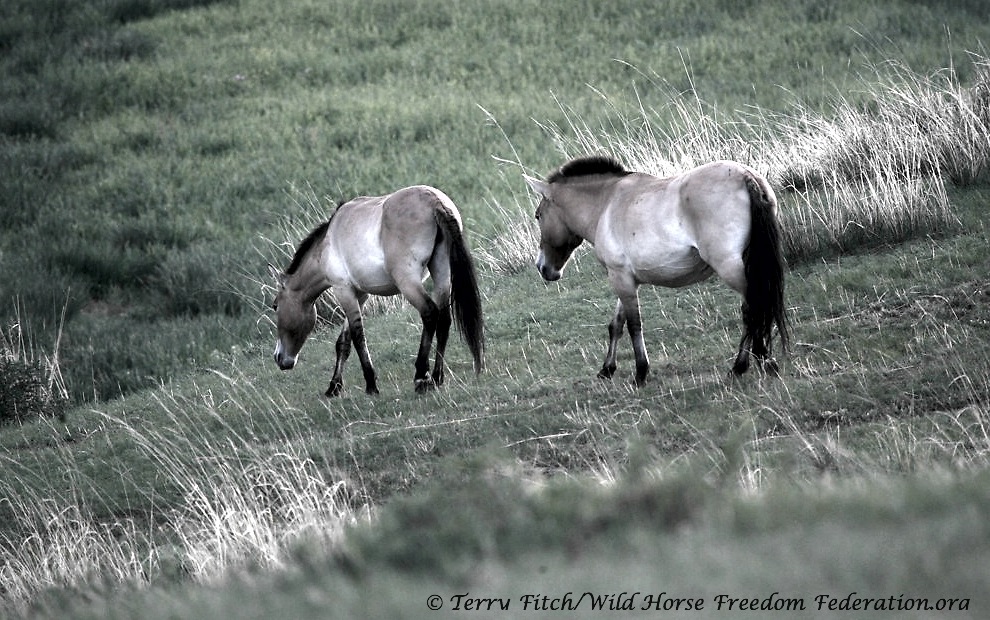
Wild Outer Mongolian Takhi – photo by Terry Fitch of Wild Horse Freedom Federation
Zoologists say very few wild horses remain on earth, with the Przewalski horse counting among them. Of the less than 2,000 Przewalski horses left, 300 live in the wild and about 1,500 are in captive breeding programs and zoos. Le Villaret in France is one of the largest natural reserves for these horses.
Recently, six Przewalski horses were brought by plane from France to the Russian city of Orenburg as part of a new program to return them to their original habitat.
China and Mongolia launched their own reintroduction programs in the early 1990s. Also, a few horses were released, as an experiment, into the exclusion zone near the Chernobyl nuclear power plant in Ukraine. There, they began to actively proliferate despite the radiation. Now, according to scientists, the Przewalski horse population in the Chernobyl zone amounts to about 100.
Why they left the steppe
Today, this steppe beauty can be seen only in zoos. Captivity, however, effects these horses adversely because in the wild they were in constant motion, covering many kilometers each day.
As in the case of European bison, when the number of horses in captivity reached a critical mass the question arose of returning the species to the wild. The horses were presented to Orenburg by the French Association for the Przewalski Horse (Association pour le cheval de Przewalski, or TAKH). At the Tour du Valat Biological Station, several generations of horses are kept in a fenced-off area, similar to their natural environment.
The steppe needs the horse

Prehistoric Takhi reintroduced into Outer Mongolia ~ photo by Terry Fitch of Wild Horse Freedom Federation
The reintroduction program was the brainchild of the Severtsov Institute of Ecology and Evolution at the Russian Academy of Sciences, and the Orenburg Reserve. Its steppe territory is the historic home of the Przewalski horse, and the steppe needs this horse to survive, literally.
“In steppe ecosystems these animals contribute to their recovery,” said Olga Pereladova, the head of the World Wildlife Fund’s Central Asian program. “If horses are not grazing in the steppe it deteriorates because vegetation is not trampled; overabundance of grass can cause fires.”
According to scientists, it is important not only that the horses have adapted to the new conditions of the Ural steppes, but also that they did not mix with farm-raised horses when stallions expelled competitors from the group.
In this case, the unique gene pool would be lost. That is why the animals were initially placed in the fenced-off reserve, allowing for enough time until a stable population capable of existing under natural selection could be formed. For this, it is necessary to have 1,000 horses, with half being of reproductive age.
Categories: Horse News, Wild Horses/Mustangs





 Straight from the Horse's Heart
This will be the future of our wild horses and burros after they are wiped off U.S..soil.
LikeLike
Thank you, France and Russia.
LikeLike
Two videos of Chernobyl ‘ s wild horse—-
LikeLike
LikeLike
Why can’t our government get it? All these other countries have opened theit eyes to the truth!
This doesn’t pertain yo this but I didn’t know the BLM could sell Public Land, can they?
http://www.ask.com/web?q=BLM+Land+for+Sale&qsrc=466&o=24628&l=dir&qo=relatedSearchNarrow
LikeLike
From the Ian Somerhalder Foundation
Horses: Majestic Animals Helping Our Environment
http://www.isfoundation.com/news/youth/horses-majestic-animals-helping-our-environment
“Roaming Horse and Burro Act of 1971 “that wild free-roaming horses and burros are living symbols of the historic and pioneer spirit of the West; that they contribute to the diversity of life forms within the Nation and enrich the lives of the American people.” Wild horses, wherever they roam, are nature’s healers. They are vital to the environment. If they were to no longer roam free, conservation efforts would be seriously impacted with the possible loss of threatened animals and plants”.
How many people know that horses running free in our world help the environment they live in? Probably not many. Most people probably see these beautiful creatures as companions, workers or athletes, but not as important guardians of our planet. The majority of the UK’s wild horses are semi-feral, which means they have owners but roam free as if they were wild.
When horses graze for food they don’t just eat everything in their path, they pick and choose. Also, different breeds have different eating habits. The uneven eating habits of the horses mean that vegetation of different heights is created. Wild horses are continually on the move, stepping on unwanted growths of vegetation that would otherwise overtake other plants so they can’t thrive. Horses aren’t fond of eating flowers either, giving rare wild flowers a chance flourish. As a result, the wild horses keep the land from unwanted overgrowth and provide ideal habitats for birds and other small animals to live. Loch of Strathbeg, a nature reserve in Scotland, has recently released a herd of konik horses onto its wetland
In Italy, the Foce Isonzo Natural Reserve has used French Camargue horses since 1991 to keep the park’s environmental balance. Since the horses arrived the variety and health of the reserve’s plants and animals, in particular its birds, has flourished.
In North America, wild horses help the environment too. When a horse eats, it does not breakdown any seeds that enter its system, so when it comes back out again the seeds germinate. Because wild horses roam over quite large areas, seeds get spread over a greater distance, keeping the plants thriving, which helps ensure that the other animals sharing the habitat have enough to eat. If animals that eat plants are plentiful, then animals that eat meat will also have enough to eat. The wild horses also play a very important role in the winter when water sources freeze. Horses have strong hooves that can break through ice to make the water available. Animals that can’t break the ice can then drink. Without the horses to help them they would not survive. Horses provide one of the most valuable contributions to the biodiversity and health of the land where they live. They have an interconnection with man that goes back thousands of years. Congress states in the Wild Free
Roaming Horse and Burro Act of 1971 “that wild free-roaming horses and burros are living symbols of the historic and pioneer spirit of the West; that they contribute to the diversity of life forms within the Nation and enrich the lives of the American people.” Wild horses, wherever they roam, are nature’s healers. They are vital to the environment. If they were to no longer roam free, conservation efforts would be seriously impacted with the possible loss of threatened animals and plants.
LikeLiked by 1 person
Bering Strait land bridge helped ice age horses survive for millennia
http://horsetalk.co.nz/2015/11/10/bering-strait-land-bridge-ice-age-horses-survive-millennia/#axzz3r9DTJNtU
LikeLike
Interesting that it requires 1,000 horses in the Mongolian Steppe to ensure a viable herd, but in our Sagebrush Steppe fewer than 50 is often considered too many. What makes sound science true in one place but not in another?
LikeLiked by 1 person
Another nice article:
http://www.bbc.com/earth/story/20151111-the-worlds-last-truly-wild-horse-is-making-a-comeback
LikeLike
Western Icons—-management raises concerns:
http://m.bendsource.com/bend/western-icons/Content?oid=2564346#CommentsMobile
LikeLike