

Report Issued by Animal’s Angels
AA Needs Help Identifying Horse
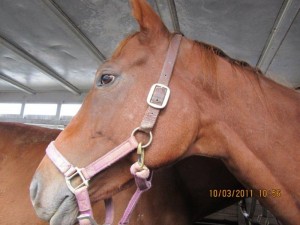 New Holland, PA – Investigators arrived at the weekly auction at 4:00am. Trucks were arriving to unload animals and most of the pens in the sheep & goat barn as well as the pig barn were already occupied. No dying or injured animals were found. However, investigators saw several dead pigs in the pen area. Many of the pens still have no access to water for the animals.
When the horse auction started it was noted that kill buyers Bruce Rotz & Brian Moore were present as well as horse trader Frank Carper. When investigators looked at Bruce Rotz’s trailer they saw that three Thoroughbreds were inside the trailer. One of them was very thin. They were able to identify two of them by their lip tattoos as former race horses named Hawser and Bobcat Bandit. Bobcat Bandit had last raced at Laurel Park on October 29, 2010. Hawser had last raced at Gulfstream Park on February 12, 2011.
When the owners were contacted that same day, very little, plausible explanation was offered as to why their horses were on a kill buyer’s trailer. However, miraculously, Hawser and Bobcat Bandit both returned to their owners a few days later. When questioned, the owner of bobcat bandit provided the statement that her mare “apparently” had “just got a ride about an hour north and was dropped off at a small farm to be used as a tease/broodmare”.
Hawser’s owner ensured Animals’ Angels that the thin gelding would receive very good care and that they were currently trying to “get some weight back on him”.
 Animals’ Angels has no knowledge in regards to what happened to the third horse they unfortunately were not able to identify. (If you recognize the horse in the picture, please email information to info@animalsangels.org. Likely it ended up at the same destination kill buyer Bruce Rotz delivers thousands of horses to every year, the Richelieu Meats slaughter plant in Quebec.
The Director of Racing for Laurel Park stated that the track would no longer take any horses in its entries from the owner of Bobcat Bandit.
Related articles
- Horse Slaughter: What YOU can do NOW to Stop it’s Return (rtfitch.wordpress.com)
- EWA Takes Horse Slaughter Issue to Law Makers (rtfitch.wordpress.com)
- For Horse Lovers Everywhere: The Truth About Horse Slaughter (rtfitch.wordpress.com)
- Animal’s Angels Investigate Known Texas Horse Slaughter Buyer (rtfitch.wordpress.com)
- Video: Confessions of a Horse Slaughter Kill Buyer (rtfitch.wordpress.com)
- New Mexico Feedlot Sends Hundreds of Horses across Boarder to Slaughter (rtfitch.wordpress.com)
- Alleged Horse Trainer BBQs Horses for Clients (rtfitch.wordpress.com)
- New USDA Transportation Regulations for Slaughter-Bound Horses Applauded (rtfitch.wordpress.com)
Categories: Horse News, Horse Slaughter






 Straight from the Horse's Heart
It would be very difficult to figure out who he is with that picture. I am shocked that he wasn’t pulled and saved and then later on figure out who he is. It seems that would have been the best thing to do than to worry about it now.
LikeLike
Animals Angels does not rescue, they are strictly investigative. Through outside sources the contacts where notified and they were more than willing to take their horses. As for the additional horse, since there were no legitmate rescues there was not much that could be done to aid it. Due to the sheer numbers of horses sold through New Holland, it is impossible to get even a very few. Hope this helps your understanding of the work done by Animals Angels.
LikeLike
And how stupid to let these horses return to the owners.. this is NOT doing them any favors… my guess is that they are now dead or will be sent back to slaughter eventually 😦
LikeLike
I agree, I could not believe that I read that these horses were returned to their owners.
LikeLike
Oh Lord…the ugly just never stops…does it?
LikeLike
No It just keeps getting uglier, but its now getting exposed !!!!! Just asking why wasnt the horse in question taken from there in lieu of finding the owner ,he also is very thin?????????? i find that there are some very sick people amongst us ,the more I see of these people the sicker they become…………………. They just throw them away like yesterdays newspaper when they dont make the cash that they are so greedy for……………
LikeLike
Home
News
Racing
Breeding/Sire Lists
Auctions
Videos
Community/Blogs
Photos
Handicapping
Health
International
Regional
SPECIAL EVENTS
Breeders’ Cup
Australian Racing
Triple Crown Mania
Eclipse Awards
FEATURES
Stallion Register Online
Industry Library
FREE Reports
Trade Zone
Talkin’ Horses
TOOLS
Calendars
Classifieds
SERVICES
New Products & Services
Advertise
Subscribe
Photo Store
Race-Day Medication Pros and Cons Debated
By Tom LaMarra
Updated: Monday, November 14, 2011 10:05 PM
Posted: Monday, November 14, 2011 10:05 PM
Email
Print
Race-Day Medication Pros and Cons Debated
Photo: Anne M. Eberhardt
The pros and cons of race-day medication in racehorses were debated Nov. 14 during a lengthy meeting of the Kentucky Horse Racing Commission Race Day Medication Committee at the state Capitol.
The committee was formed earlier this year after calls for a ban on race-day anti-bleeding drugs and an international medication summit held in New York in June. The KHRC has taken no position on race-day use of furosemide and adjunct bleeder medications.
“It’s a very divisive issue,” said KHRC vice chairman Tracy Farmer, who chairs the committee. “This is an informational session. No decisions will be made today.”
Farmer said about 30 organizations and individuals were asked to comment on the race-day drug issue. About 15 signed up to attend and testify.
“Several invitees said their groups haven’t formed a consensus on the issue, so they declined to speak,” Farmer said.
The meeting began with several presentations on furosemide, called Salix or Lasix, and exercise-induced pulmonary hemorrhaging, the condition for which it is used to treat.
Dr. Alice Stack of Michigan State University said EIPH is common in horses around the world, and that furosemide reduces blood pressure and bleeding but doesn’t cure EIPH.
Stack cited research that shows EIPH increases with age and exercise. Because racing accounts for only 2% of horses’ high-pressure exercise, Stack said it’s feasible to believe a race-day ban on furosemide would have limited impact on the progression of EIPH—but she also said elimination of the drug would likely result in more severe bleeding episodes in racehorses.
There was some discussion early in the meeting about whether furosemide has a positive effect on performance during races and therefore is used for that purpose. Clearly there is disagreement.
KHRC member Ned Bonnie cited “incidental” information that trainers use furosemide to enhance performance because its affects the larynx and thus can aid breathing. Stack said it is feasible furosemide can increase airflow, but no studies have been done linking furosemide, EIPH, and performance.
Dr. Foster Northrop, a member of the KHRC and the committee, took issue with claims individuals use furosemide to enhance performance. Northrop, a racetrack veterinarian, said he never has used furosemide to improve throat function, and to his knowledge there is no legal medication that can be used for that purpose.
According to information presented at the meeting, most foreign racing jurisdictions that ban use of furosemide in racing consider a horse a bleeder if blood trickles from its nostrils after a race. That led to a suggestion that perhaps foreign countries don’t have a handle on EIPH since bleeding in the lungs is the best gauge of the condition.
The meeting, which included 5 1/2 hours of testimony, broke no new ground on research or opinion. If anything, it drove home the split between supporters of continued use of Salix and those who oppose it.
Matt Iuliano, executive director of The Jockey Club, said the organization is against the use of race-day medication. He also cited results of a survey conducted by McKinsey & Company that indicated racing fans oppose use of performance-enhancing drugs.
Iuliano said Salix improves performance; others that offered testimony disagreed, saying it merely combats EIPH. In response to questioning from racing commissions, Iuliano said there is no other known drug that combats EIPH, but he also said The Jockey Club is against race-day medication of any kind.
Dr. David Richardson, representing the Thoroughbred Owners and Breeders Association and its American Graded Stakes Committee, said an AGSC pilot program to ban use of Salix in graded stakes for 2-year-olds in 2012 is “designed to move the process beyond discussion and to get action on the issue.” Individual regulatory agencies in each state will have to adopt such a policy before it takes effect.
KHRC member John Ward Jr., a trainer and member of the committee, said if such a plan comes to fruition, he would like to see every 2-year-old that races without Salix in graded stakes be tested so substantive data can be collected. “Let’s get some science from it,” he said.
Some of the testimony dealt with the United States versus other countries that don’t permit race-day use of furosemide. Breeders’ Cup president Craig Fravel said the organization is “interested in a level playing field with respect to international competition.”
“It’s unquestionable that the American breeding industry has been denigrated in international eyes because we use race-day medication,” Fravel said.
No one from foreign jurisdictions spoke during the meeting.
Horsemen’s groups and the Jockeys’ Guild said they oppose a ban on Salix. David England, a Kentucky-based trainer, said horse racing has a marketing problem, not a drug problem.
“Many fans have never heard of (Salix), and it makes no difference to them either way,” England said. “It seems we’ve pretty much (eliminated race-day medication). It’s much more of a marketing problem.”
Email
Print
FREE! E-Newsletters from The Blood-Horse!…
Follow the top stories of major racing events, racing previews and results with FREE e-newsletters from bloodhorse.com. As news develops, we’ll deliver updates to your inbox. Follow important events moment by moment, step by step!
Click Here!
Most Popular Stories on BloodHorse.com
Race-Day Medication Pros and Cons Debated
Greely Dismissed from Golden Gate Fields
Unbridled’s Song’s Fee $85,000 at Taylor Made
Workforce Retired; Will Stand in Japan
Jockeys’ Guild Submits Petition to Churchill
Double-Digit Increases Continue at Keeneland
Seth Hancock to Receive Warner L. Jones Award
Haskin: A Day with Zenyatta and Rachel
New Hampshire Governor to Veto Slots Bills
Delay Requested in Filing Life At Ten Report
Click Here!
Don’t miss a minute! Get 8 FREE trial issues of The Blood-Horse! Click here to learn more.
Tags
race-day medication
salix
lasix
ned bonnie
dr. foster northrop
tracy farmer
dr. alice stack
bleeding
furosemide
eiph
kentucky
Related Stories
Race-Day Medication Pros and Cons Debated
Greely Dismissed from Golden Gate Fields
Unbridled’s Song’s Fee $85,000 at Taylor Made
Workforce Retired; Will Stand in Japan
Jockeys’ Guild Submits Petition to Churchill
Double-Digit Increases Continue at Keeneland
Seth Hancock to Receive Warner L. Jones Award
Haskin: A Day with Zenyatta and Rachel
New Hampshire Governor to Veto Slots Bills
Delay Requested in Filing Life At Ten Report
Click Here!
Read more: http://www.bloodhorse.com/horse-racing/articles/66189/race-day-medication-pros-and-cons-debated#ixzz1dnTK5XfZ
LikeLike